

A Deep, High-Angular Resolution 3D Dust Map of the Southern Galactic Plane
Authors
Catherine Zucker, Andrew K. Saydjari, Joshua S. Speagle, Edward F. Schlafly, Gregory M. Green, Robert Benjamin, Joshua Peek, Gordian Edenhofer, Alyssa Goodman, Michael A. Kuhn, Douglas P. Finkbeiner
Abstract
We present a deep, high-angular resolution 3D dust map of the southern Galactic plane over $239^\circ < \ell < 6^\circ$ and $|b| < 10^\circ$ built on photometry from the DECaPS2 survey, in combination with photometry from VVV, 2MASS, and unWISE and parallaxes from Gaia DR3 where available. To construct the map, we first infer the distance, extinction, and stellar types of over 700 million stars using the brutus stellar inference framework with a set of theoretical MIST stellar models. Our resultant 3D dust map has an angular resolution of $1'$, roughly an order of magnitude finer than existing 3D dust maps and comparable to the angular resolution of the Herschel 2D dust emission maps. We detect complexes at the range of distances associated with the Sagittarius-Carina and Scutum-Centaurus arms in the fourth quadrant, as well as more distant structures out to a maximum reliable distance of $d \approx$ 10 kpc from the Sun. The map is sensitive up to a maximum extinction of roughly $A_V \approx 12$ mag. We publicly release both the stellar catalog and the 3D dust map, the latter of which can easily be queried via the Python package dustmaps. When combined with the existing Bayestar19 3D dust map of the northern sky, the DECaPS 3D dust map fills in the missing piece of the Galactic plane, enabling extinction corrections over the entire disk $|b| < 10^\circ$. Our map serves as a pathfinder for the future of 3D dust mapping in the era of LSST and Roman, targeting regimes accessible with deep optical and near-infrared photometry but often inaccessible with Gaia.
Concepts
The Big Picture
Imagine trying to read a book through smoke. Now imagine the smoke is layered in wisps and clumps at different distances, some thick, some thin, shifting across three dimensions. That’s what astronomers face looking through the plane of our galaxy. Between us and distant stars lies an invisible obstacle course of interstellar dust, tiny particles of carbon and silicate that scatter and absorb light, rendering whole swaths of the Milky Way’s interior frustratingly opaque.
For decades, astronomers worked with two-dimensional dust maps: flat photographs of the smoke, with no depth information. If you want to understand a star cluster embedded in a dust cloud 4,000 light-years away, knowing there’s some dust between you and it isn’t enough. You need to know exactly where it sits along the line of sight.
A new paper by Catherine Zucker, Andrew Saydjari, Joshua Speagle, and collaborators delivers exactly that: the deepest, sharpest three-dimensional dust map of the southern Galactic plane ever constructed, assembled from light measurements of over 700 million individual stars.
Key Insight: By mapping how dust reddens the light of hundreds of millions of stars at known distances, this team has produced a 3D dust atlas of the southern Milky Way at 1 arcminute angular resolution, ten times finer than any previous 3D dust map, reaching structures as far as 10 kiloparsecs (about 32,000 light-years) from Earth.
How It Works
The core idea is simple: dust reddens starlight. Just as sunsets turn orange because blue light scatters away through the atmosphere, starlight passing through interstellar dust shifts toward longer wavelengths. Measure how much a star’s colors deviate from what they should be, and you can infer how much dust lies between you and that star. Do this for millions of stars at a range of distances, and you build a 3D dust density map by asking: at what distance does the reddening jump?
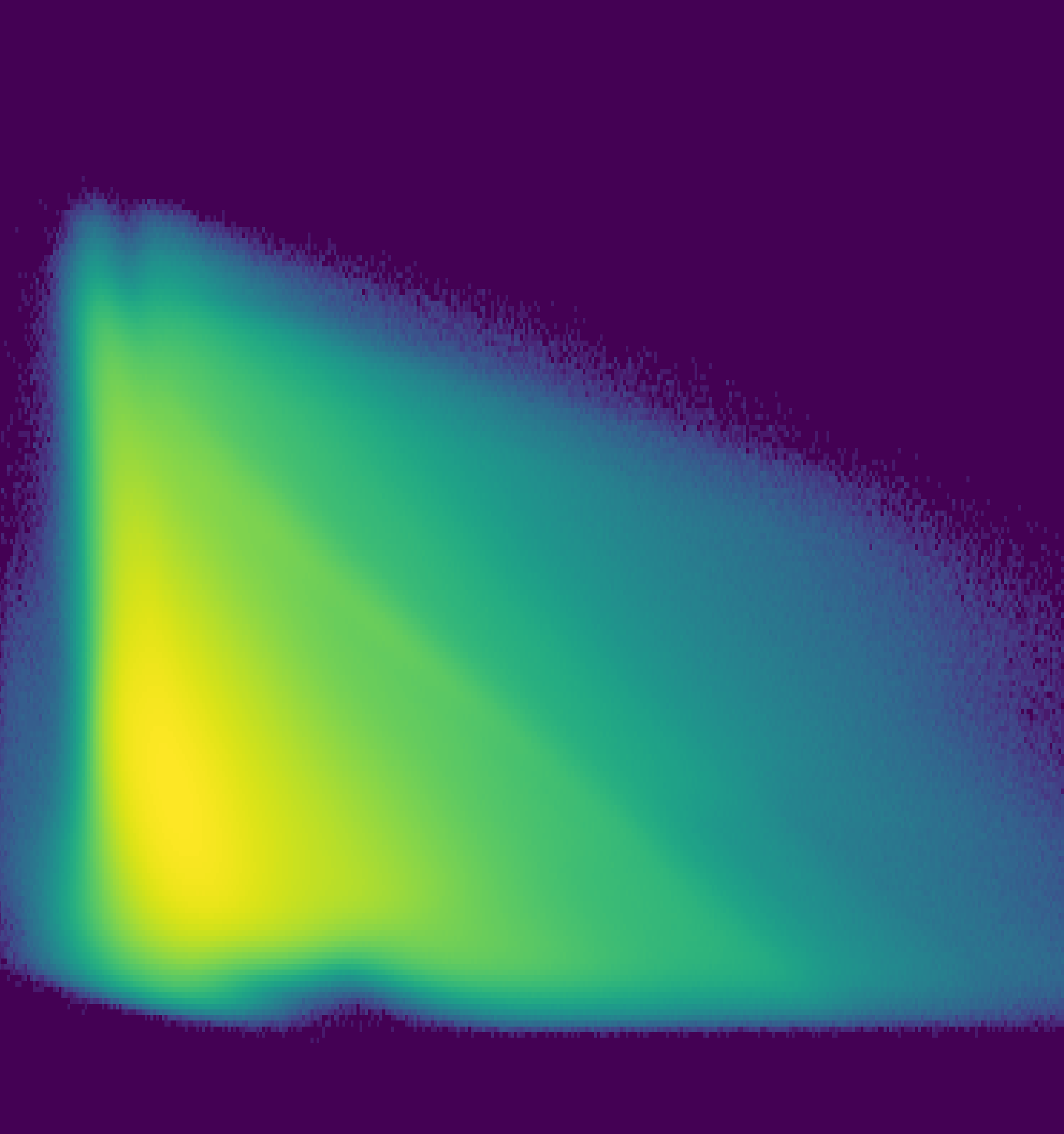
The team built their map on photometry (brightness measurements across multiple wavelengths) drawn from four major surveys:
- DECaPS2 (Dark Energy Camera Plane Survey, second data release): a deep optical survey of the southern Galactic plane reaching stars far too faint for earlier all-sky catalogs
- VVV (VISTA Variables in the Vía Láctea): a ground-based deep-infrared sky survey
- 2MASS (Two Micron All Sky Survey): a foundational full-sky infrared catalog
- unWISE: reprocessed data from NASA’s WISE space telescope
- Gaia DR3 distance measurements, where available, from the European Space Agency’s satellite that tracks tiny positional shifts as Earth orbits the Sun
Combining optical with infrared data matters here. Different wavelengths respond to dust differently, and using both lets the team pierce through heavier obscuration while constraining stellar types more precisely.
The inference pipeline uses brutus, a Bayesian statistical framework fed with MIST stellar models (MESA Isochrones and Stellar Tracks, a library of computer simulations showing how stars of different masses, ages, and compositions should appear across the electromagnetic spectrum). For each of the 700+ million stars, brutus simultaneously estimates three entangled quantities:
- Distance — how far is this star?
- Extinction (AV) — how much dust dimming has its light suffered?
- Stellar type — what kind of star is this intrinsically?
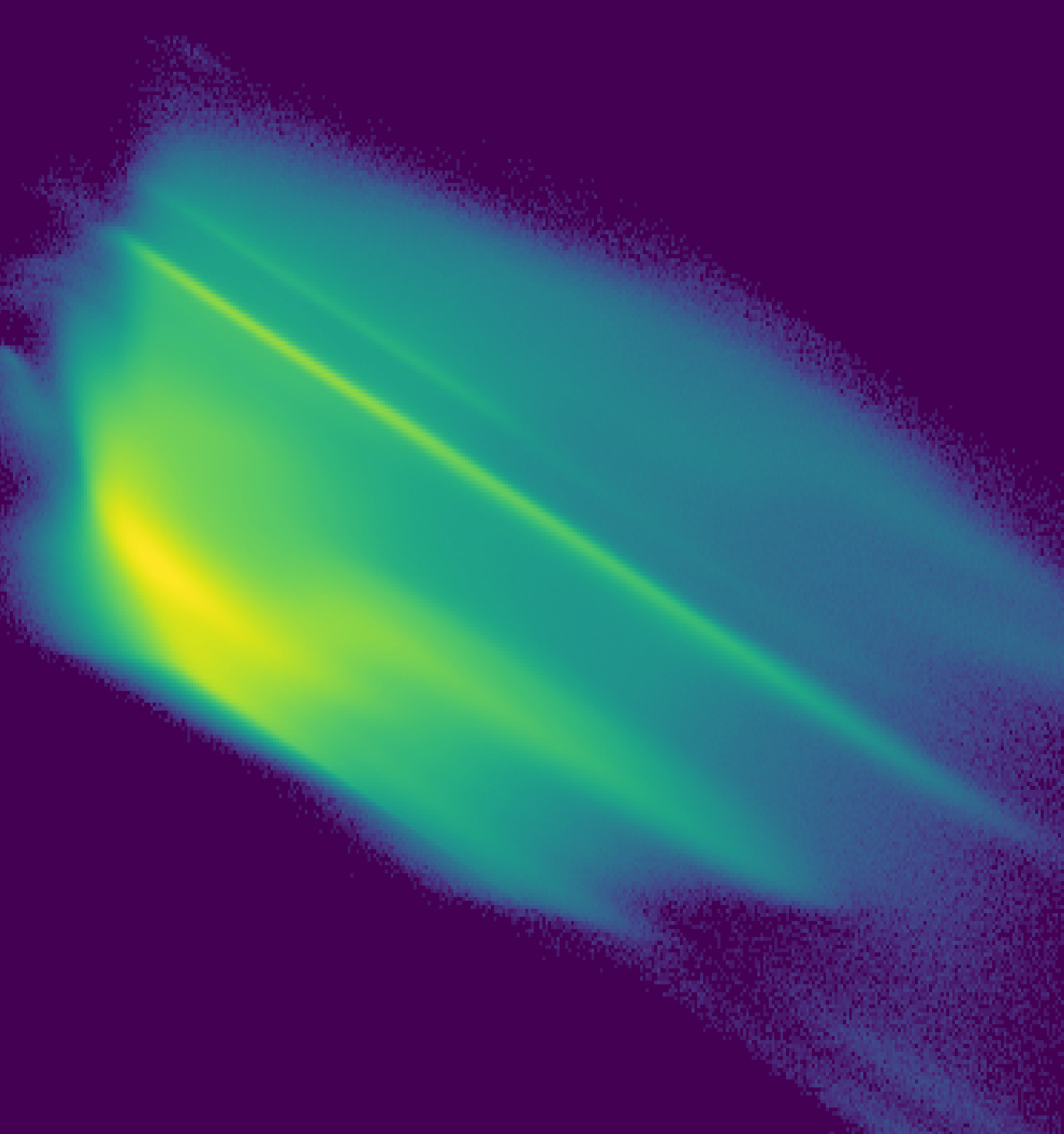
A star can look faint because it’s dim, far away, or heavily extincted. Brutus untangles these degeneracies by analyzing brightness across many wavelengths at once, finding the combination that best explains all the observations together.
With stellar distances and extinctions in hand, the team tallies dust encountered along each line of sight and reconstructs a three-dimensional density map. The result covers Galactic longitudes 239° to 6° (the entire southern Galactic plane) at 1 arcminute resolution. For comparison, the widely used Bayestar19 map of the northern sky achieves 7–14 arcminute resolution. This new map is roughly ten times sharper.
It reaches reliably to ~10 kiloparsecs from the Sun and detects extinction up to AV ≈ 12 magnitudes, tracing dust through some of the Galaxy’s most obscured regions. The team also identifies dust concentrations at distances consistent with two major spiral arms, the Sagittarius-Carina arm and the Scutum-Centaurus arm, visible as dense clumps in the 3D density field.
Why It Matters
The practical impact is immediate. Every astronomical observation through the Galactic plane must correct for dust extinction. Get it wrong and you distort distance estimates, luminosities, and color measurements. Surveys hunting for supernovae, variable stars, exoplanets, stellar clusters, and gravitational wave counterparts all depend on accurate extinction corrections.
Before this work, the southern Galactic plane was a blind spot. Bayestar19 covered the north, but the south lacked a comparable 3D resource. The team has released both the stellar catalog and the dust map through the Python dustmaps package, so anyone can now query extinction anywhere in the southern disk.
There’s a deeper payoff, too. Mapping dust in 3D is really mapping the Galaxy’s interstellar medium in 3D. The gas, the molecular clouds, the sites of ongoing star formation all trace the same density enhancements that accumulate dust. This map gives modelers of Galactic spiral structure and the molecular cloud lifecycle a new observational anchor.
It also sets up the next generation of wide-field surveys. The Vera Rubin Observatory (LSST) and Nancy Grace Roman Space Telescope will push even deeper, imaging billions of stars in regimes where Gaia’s parallaxes run out. The multi-band inference framework, spatial reconstruction pipeline, and public query tools developed here are ready-made infrastructure for those future maps.
Bottom Line: Zucker, Saydjari, Speagle, and collaborators have delivered the definitive 3D dust map of the southern Milky Way (700 million stars, 1 arcminute resolution, 10 kiloparsec depth), completing the full-sky 3D picture of Galactic dust and giving astronomers their first detailed look at the structure of the southern disk’s interstellar medium.
IAIFI Research Highlights

This work brings together large-scale machine learning inference and fundamental astrophysics, using a Bayesian stellar parameter framework to convert raw photometry from hundreds of millions of stars into a physically interpretable 3D map of the Milky Way's dust distribution.

The brutus pipeline demonstrates probabilistic inference at industrial scale, simultaneously fitting distance, extinction, and stellar type for 700+ million objects drawn from heterogeneous multi-wavelength datasets. It is one of the largest Bayesian inference runs applied to astronomical catalog science to date.

The resulting 3D dust map resolves spiral arm dust concentrations at 1 arcminute angular resolution, giving Galactic structure models, star formation studies, and interstellar medium research a new observational baseline. Combined with Bayestar19, it completes the full-sky extinction correction resource that astronomers have long needed.
Future surveys including LSST and Roman will extend this approach to billions of stars at greater depths; the methods and public data releases here provide direct infrastructure for the next generation of 3D Galactic cartography. The paper is available at [arXiv:2503.02657](https://arxiv.org/abs/2503.02657).