

A Stimulating Explanation of the Extragalactic Radio Background
Authors
Andrea Caputo, Hongwan Liu, Siddharth Mishra-Sharma, Maxim Pospelov, Joshua T. Ruderman
Abstract
Despite an intense theoretical and experimental effort over the past decade, observations of the extragalactic radio background at multiple frequencies below 10 GHz are not understood in terms of known radio sources, and may represent a sign of new physics. In this Letter we identify a new class of dark sector models with feebly interacting particles, where dark photons oscillate into ordinary photons that contribute to the radio background. Our scenario can explain both the magnitude and the spectral index of the radio background, while being consistent with other cosmological and astrophysical constraints. These models predict new relativistic degrees of freedom and spectral distortions of the cosmic microwave background, which could be detected in the next generation of experiments.
Concepts
The Big Picture
The universe is bathed in radio light no one can explain. Not Wi-Fi or cell signals, but a faint, diffuse hum of radio emission that fills the entire sky and refuses to fit any known astrophysical budget. For more than a decade, astronomers have pointed radio telescopes at the cosmos and found the same unsettling result: the radio background is simply too bright, by a factor of three to ten, compared to everything we know how to count.
Think of it like balancing a checkbook and finding far more money than your records explain. You could assume an accounting error. But what if every auditor confirms the same discrepancy?
That’s the situation with the extragalactic radio background (ERB), a uniform glow of radio emission arriving equally from all directions at frequencies below 10 GHz. No combination of galaxies, quasars, or cosmic ray electrons can account for it. The leading measurement from the ARCADE 2 collaboration found an excess amplitude of 24.1 Kelvin at 310 MHz, growing brighter at lower frequencies along a precise mathematical curve with a spectral slope of roughly −2.6. Every conventional explanation falls short.
Now, a team of theoretical physicists has proposed something new: the radio glow is the afterglow of dark matter, filtered through an invisible dark force field and converted into ordinary light. The mechanism even explains why the spectrum has exactly the slope it does.
Key Insight: Dark matter particles slowly decaying into hypothetical “dark photons,” whose decay is amplified by a thermal bath of those same dark photons, can naturally produce a radio background with precisely the observed amplitude and spectral shape, without violating any known constraints.
How It Works
The proposed scenario rests on three interlocking ingredients:
-
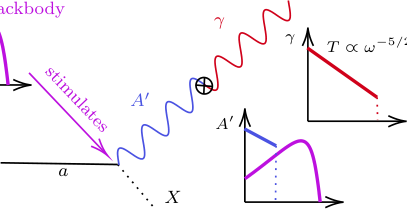
Dark matter decays slowly. The model posits a long-lived dark matter particle a, stable for billions of years but not forever. It undergoes a two-body decay, producing a dark photon A’, a hypothetical particle like a regular photon but charged under a hidden “dark” electromagnetic force rather than the ordinary one. These dark photons carry energy but are invisible to our detectors.
-
Stimulated emission amplifies the decay rate. Here’s where the physics gets elegant. A pre-existing thermal bath of dark photons, a background sea of A’ particles spread across all frequencies like the heat glow of a warm object, stimulates dark matter to decay faster. Just as photons in a laser trigger the emission of more photons from an excited medium, dark photons trigger more dark matter decay. The decay rate is enhanced by a Bose enhancement factor: the more dark photons already present at a given frequency, the more efficiently dark matter decays into that mode. Low-frequency modes are more densely populated in any thermal background, so the resulting dark photon spectrum is dramatically enhanced at low energies, scaling as ω^(−1/2) rather than a flat distribution.
-
Dark photons convert to radio photons. Dark photons and ordinary photons can mix through kinetic mixing, a subtle quantum effect allowing one particle type to spontaneously transform into the other, analogous to neutrino flavor oscillation. As dark photons propagate through the universe’s plasma, there are specific moments in cosmic history, when the plasma frequency matches the dark photon mass, where resonant oscillation efficiently converts dark photons into real radio photons. This conversion happens at relatively low redshifts, which matters for the signal’s spatial uniformity.
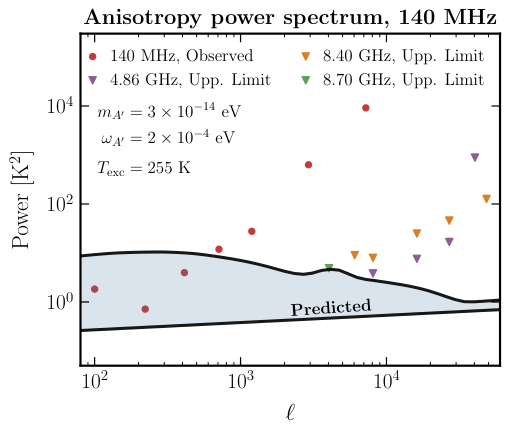
Put all three steps together and you get a radio excess scaling as T_exc ∝ ω^(−5/2). The ARCADE 2 spectral index of −2.6 sits close to the theoretical −2.5. The researchers fit a concrete example (dark matter of a specific mass range decaying into dark photons with a particular kinetic mixing parameter) and show it matches both the normalization and slope of the ARCADE 2 excess simultaneously. No previous proposal had managed that.
The mechanism also explains why the radio background is so spatially smooth. Because conversion happens in the diffuse intergalactic medium at moderate redshifts rather than in today’s lumpy dark matter halos, the emission spreads uniformly across the sky. Radio observations had found fluctuations at only the ~1% level, a puzzle for dark matter annihilation models. The stimulated dark photon scenario sidesteps this problem entirely.
Why It Matters
The extragalactic radio background is a genuine anomaly, one that has resisted conventional explanation long enough to warrant exotic physics. If this model is correct, it would be the first observational evidence for an entire dark sector: a population of feebly interacting particles with their own forces, their own thermal history, and their own dynamics playing out in intergalactic space.
The model makes concrete, testable predictions. The extra dark photons and dark sector particles contributing to early-universe energy density would increase the effective number of relativistic species, ΔN_eff, a quantity precisely measured by CMB experiments. The stimulated decay also deposits energy into the photon bath in a frequency-dependent way, producing spectral distortions in the CMB (tiny deviations from a perfect blackbody spectrum).
Neither signal has been detected yet, but both are targets for next-generation experiments like CMB-S4 and PIXIE. A future detection of radio excess correlating with small CMB spectral distortions would be a smoking gun.
There is also the 21-cm cosmology angle. Experiments like EDGES, LEDA, and LOFAR are probing the radio sky at exactly the frequencies where the ERB matters most. The stimulated dark photon model is consistent with their constraints because most conversion happens at lower redshifts, threading a needle that other models could not.
Bottom Line: A dark matter particle slowly decaying into a bath of dark photons, stimulated by that very bath and then resonantly converted to radio light, explains the mysterious excess radio brightness of the sky. It matches both amplitude and spectral slope while remaining consistent with all existing cosmological data. Next-generation CMB and 21-cm experiments will confirm or rule out this scenario definitively.
IAIFI Research Highlights
This work connects particle physics, cosmology, and astrophysics, using fundamental quantum field theory to resolve a decade-old puzzle in observational radio astronomy.

The systematic parameter fitting and constraint analysis in this study inform AI-driven inference frameworks being developed for cosmological survey data at IAIFI.

The paper introduces a new class of dark sector models where stimulated dark photon production and resonant conversion to ordinary photons explains both the magnitude and spectral index of the extragalactic radio background, the first proposal to do so without invoking implausibly large magnetic fields or exotic source populations.
Future experiments including next-generation CMB spectral distortion probes and 21-cm surveys will test the key predictions of this model; see [arXiv:2206.07713](https://arxiv.org/abs/2206.07713) for the full analysis and parameter constraints.