

A Wide Field Map of Ultra-Compact Dwarfs in the Coma Cluster
Authors
Richard T. Pomeroy, Juan P. Madrid, Conor R. O'Neill, Alexander T. Gagliano
Abstract
A dataset of 23,351 globular clusters (GCs) and ultra-compact dwarfs (UCDs) in the Coma cluster of galaxies was built using Hubble Space Telescope Advanced Camera for Surveys data. Based on the standard magnitude cut of $M_V \leq -11$, a total of 523 UCD candidates are found within this dataset of Compact Stellar Systems (CSS). From a color-magnitude diagram (CMD) analysis built using this catalog, we find a clear mass-magnitude relation extending marginally into the UCD parameter space. The luminosity function defined by this dataset, shows an excess of sources at bright magnitudes, suggesting a bimodal formation scenario for UCDs. We estimate the number of UCDs with a different origin than GC to be $N_{UCD} \geq 32 \pm 1$. We derive the total number of CSS within the core (1 Mpc) of Coma to be $N_{CSS} \approx 69,400 \pm 1400$. The radial distribution of UCDs in Coma shows that, like GCs, UCDs agglomerate around three giant ellipticals: NGC 4874, NGC 4889, and IC 4051. We find UCDs are more centrally concentrated around these three ellipticals than GCs. IC 4051 has a satellite population of UCDs similar to NGC 4874 and NGC 4889. We estimate only ~14% of UCDs, inhabit the intracluster space (ICUCD) between galaxies in the region, in comparison to ~24% for GCs (ICGC). We find red (metal-rich) UCDs are more likely located closer to a host galaxy, with blue (metal-poor) UCDs showing a greater dispersion and lower average density in the region.
Concepts
The Big Picture
Imagine trying to count every pebble, rock, and boulder scattered across a parking lot the size of a small country, from a hundred million light-years away. That is roughly what astronomers face when mapping the smallest, densest stellar objects in a galaxy cluster. The Coma cluster, one of the largest collections of galaxies held together by their mutual gravity anywhere near us, hosts thousands of galaxies and an enormous population of star systems so compact they defy easy categorization. Among these are ultra-compact dwarfs (UCDs), mysterious objects that blur the line between the biggest star clusters and the smallest galaxies.
UCDs occupy an awkward middle ground. They are too massive and large to be ordinary globular clusters, those dense, ancient balls of hundreds of thousands of stars that orbit most big galaxies. But they are also too small to qualify as true galaxies. They may be the stripped remnants of dwarf galaxies that strayed too close to massive neighbors. Or they may simply be the largest, most extreme examples of normal star cluster formation. No one had mapped UCDs across the full extent of a rich cluster at high resolution, so telling these scenarios apart has been an open problem for years.
A team led by Richard Pomeroy at the University of Texas Rio Grande Valley has now assembled the largest wide-field census of UCDs in the Coma cluster using archival Hubble Space Telescope data, and the picture turns out to be more complex than expected.
Key Insight: The spatial distribution and luminosity function of UCDs in the Coma cluster point strongly toward two distinct formation channels, with compact stellar systems huddling preferentially around a few dominant galaxies rather than roaming freely between them.
How It Works
The team built their catalog from 26 separate Hubble pointings using the Advanced Camera for Surveys (ACS), Hubble’s wide-field workhorse imager, covering Coma’s core out to about 1 megaparsec (roughly 3.26 million light-years). The raw dataset came from Madrid et al. (2018); Pomeroy and colleagues turned it into a systematic cluster-wide analysis.
Constructing the catalog required careful selection. For each candidate, the team applied the following criteria:
- Magnitude and color: Objects must fall within the expected range for compact stellar systems at Coma’s distance of 100 megaparsecs
- Size and morphology: Background galaxies with spiral arms or elongated shapes were removed
- Stellar contamination: Foreground stars were identified and excluded
The result: 23,351 compact stellar systems (CSS), a term covering every dense stellar object from small globular clusters to the largest UCDs, including 22,828 globular clusters and 523 UCD candidates.
UCD classification rests on a standard magnitude threshold: objects brighter than MV ≤ −11 (roughly ten million times the Sun’s luminosity) earn UCD status, placing them at the bright end of the globular cluster luminosity function. The team’s color-magnitude diagram (CMD), which plots brightness against color as a proxy for age and metal content, reveals a clear mass-magnitude relation extending into UCD territory. This is consistent with UCDs being genuine scaled-up globular clusters, at least in part.
The smoking gun for a second formation channel comes from the luminosity function, a count of how many objects exist at each brightness level. For ordinary globular clusters, this follows a well-characterized bell curve. The Coma CSS luminosity function shows a clear excess at bright magnitudes, a bump above what a simple extension of the GC population predicts. That excess points to UCDs formed through gravitational harassment: the slow dismemberment of smaller galaxies as repeated gravitational tugs from massive neighbors strip away their outer stars over billions of years, leaving only a dense, naked core behind.
The team estimates at least 32 ± 1 UCDs in Coma have this stripped-nucleus origin, a conservative lower bound given the overlap between the two populations.
Why It Matters
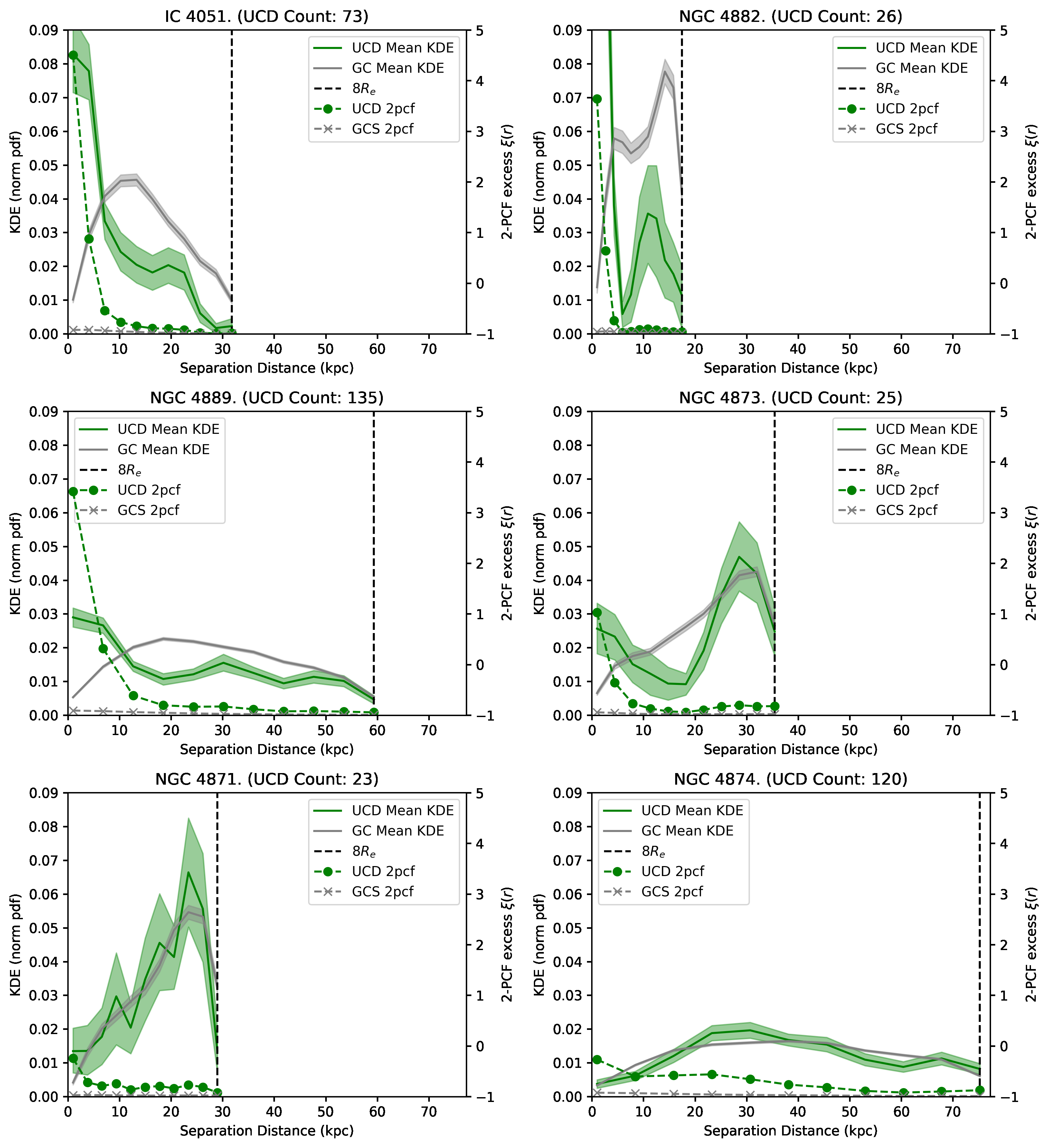
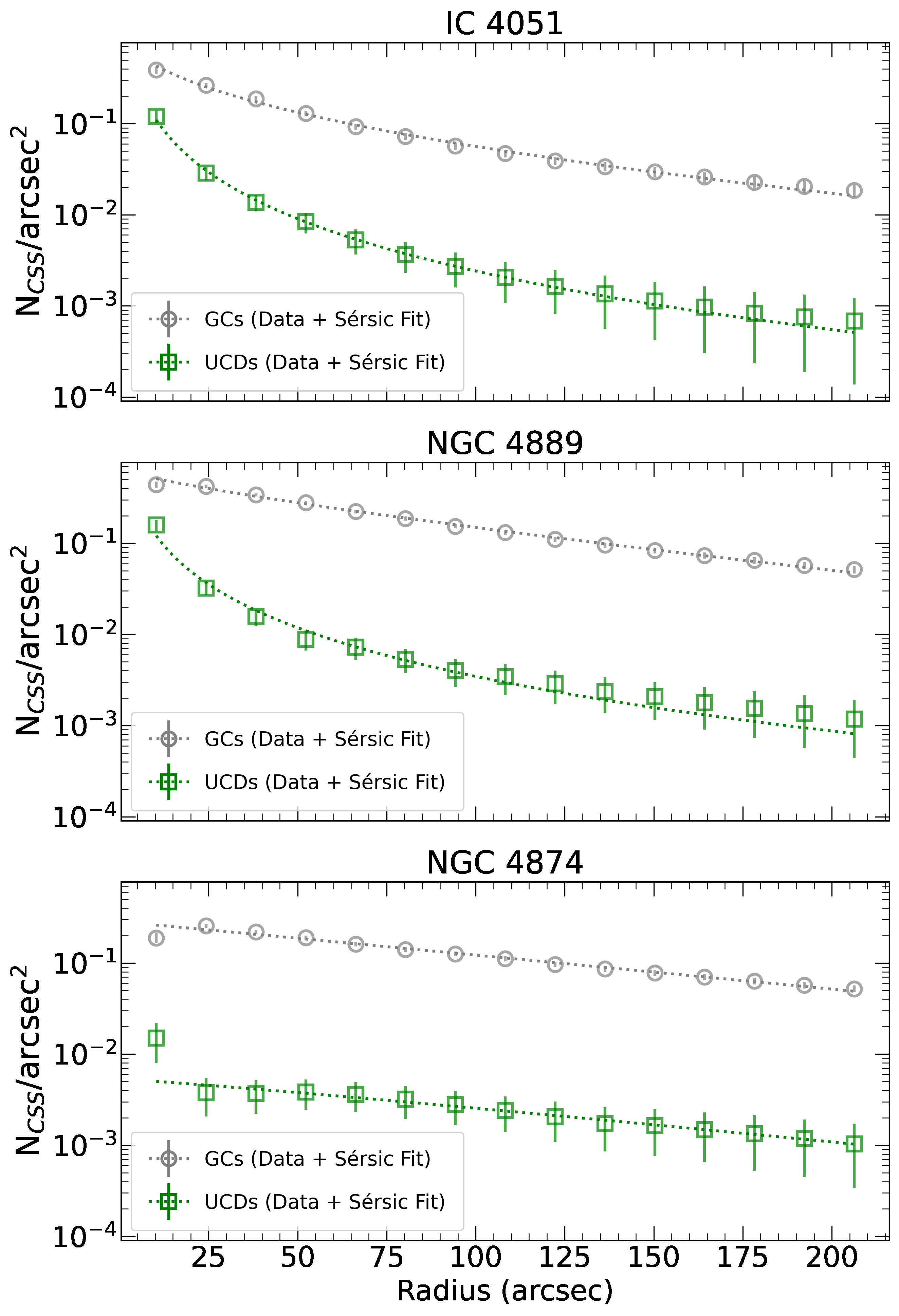
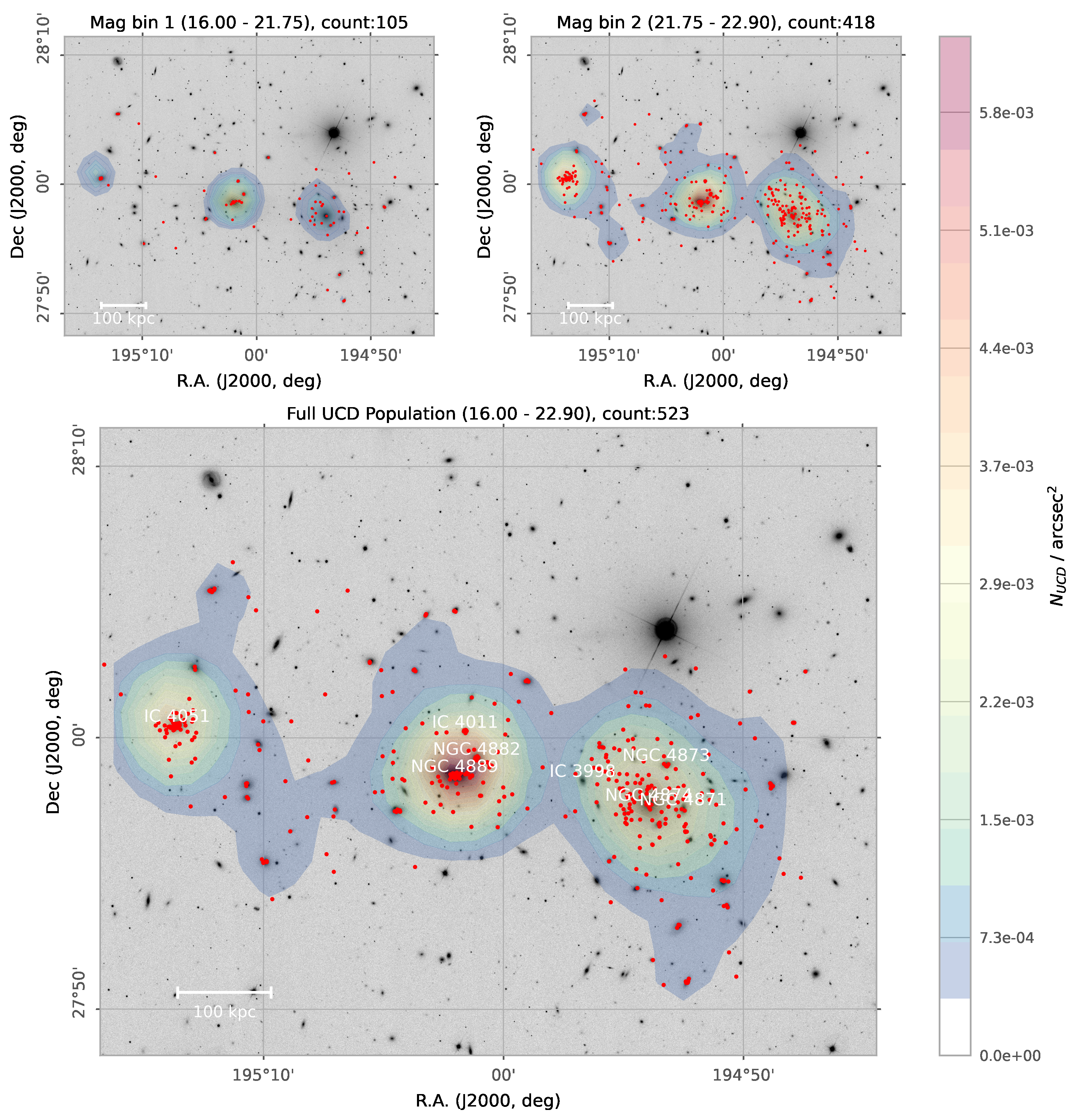
The spatial distribution backs up the two-channel picture. UCDs in Coma are not spread uniformly. They cluster tightly around three giant elliptical galaxies: NGC 4874, NGC 4889, and IC 4051. This mirrors the behavior of globular clusters, but UCDs are more centrally concentrated around these hosts than GCs are. About 86% of UCDs live within the gravitational sphere of influence of one of these three giants, compared to roughly 76% of GCs. Only about 14% of UCDs inhabit the intracluster space between galaxies, versus roughly 24% of GCs.
Color tells a similar story. Red (metal-rich) UCDs, enriched in heavier elements from forming in dense, chemically evolved environments, cluster tightly around host galaxies. Blue (metal-poor) UCDs show broader spatial dispersion, suggesting they either formed earlier in lower-metallicity environments or have drifted further from their birth sites over cosmic time. This color-position correlation is another sign of a composite population with distinct physical histories.
The total count of compact stellar systems within Coma’s core reaches approximately 69,400 ± 1,400, a number that illustrates just how rich this cluster is in dense stellar debris. Some UCDs may also harbor supermassive black holes inherited from their progenitor dwarf galaxies, objects that would otherwise go undetected in the crowded cluster environment. This systematic census lays the groundwork for targeted follow-up searches.
UCDs and GCs also trace the gravitational potential of their host clusters independently of ordinary luminous matter. That makes them useful probes of mass distribution across enormous structures, a key input for cosmological models of structure formation.
Bottom Line: The Coma cluster’s UCD population tells a two-chapter origin story: most UCDs are oversized globular clusters, but a significant minority are the ghost cores of devoured dwarf galaxies. Hubble’s wide-field view finally gives us the map to tell them apart.
IAIFI Research Highlights

This work combines large-scale HST observational surveys with statistical modeling to disentangle overlapping stellar populations, a clear example of the data-intensive, cross-disciplinary approaches at the heart of modern AI-physics research at IAIFI.

The catalog-building pipeline, combining morphological classification, color cuts, and luminosity function modeling across tens of thousands of objects, represents exactly the kind of large-dataset analysis that increasingly benefits from machine learning methods in astronomical surveys.

By mapping 523 UCD candidates across the Coma cluster and identifying at least 32 objects with stripped-nucleus origins, this study sharpens our picture of tidal stripping, galaxy evolution, and the distribution of compact stellar remnants in dense cluster environments.
Future spectroscopic follow-up of the brightest UCDs could confirm stripped-nucleus identifications and search for embedded supermassive black holes; the full study is available at [arXiv:2506.02296](https://arxiv.org/abs/2506.02296) (submitted to ApJ, accepted May 2025).
Original Paper Details
A Wide Field Map of Ultra-Compact Dwarfs in the Coma Cluster
2506.02296
["Richard T. Pomeroy", "Juan P. Madrid", "Conor R. O'Neill", "Alexander T. Gagliano"]
A dataset of 23,351 globular clusters (GCs) and ultra-compact dwarfs (UCDs) in the Coma cluster of galaxies was built using Hubble Space Telescope Advanced Camera for Surveys data. Based on the standard magnitude cut of $M_V \leq -11$, a total of 523 UCD candidates are found within this dataset of Compact Stellar Systems (CSS). From a color-magnitude diagram (CMD) analysis built using this catalog, we find a clear mass-magnitude relation extending marginally into the UCD parameter space. The luminosity function defined by this dataset, shows an excess of sources at bright magnitudes, suggesting a bimodal formation scenario for UCDs. We estimate the number of UCDs with a different origin than GC to be $N_{UCD} \geq 32 \pm 1$. We derive the total number of CSS within the core (1 Mpc) of Coma to be $N_{CSS} \approx 69,400 \pm 1400$. The radial distribution of UCDs in Coma shows that, like GCs, UCDs agglomerate around three giant ellipticals: NGC 4874, NGC 4889, and IC 4051. We find UCDs are more centrally concentrated around these three ellipticals than GCs. IC 4051 has a satellite population of UCDs similar to NGC 4874 and NGC 4889. We estimate only ~14% of UCDs, inhabit the intracluster space (ICUCD) between galaxies in the region, in comparison to ~24% for GCs (ICGC). We find red (metal-rich) UCDs are more likely located closer to a host galaxy, with blue (metal-poor) UCDs showing a greater dispersion and lower average density in the region.