

An Extensive $\textit{Hubble Space Telescope}$ Study of the Offset and Host Light Distributions of Type I Superluminous Supernovae
Authors
Brian Hsu, Peter K. Blanchard, Edo Berger, Sebastian Gomez
Abstract
We present an extensive $\textit{Hubble Space Telescope}$ ($\textit{HST}$) rest-frame ultraviolet (UV) imaging study of the locations of Type I superluminous supernovae (SLSNe) within their host galaxies. The sample includes 65 SLSNe with detected host galaxies in the redshift range $z\approx 0.05-2$. Using precise astrometric matching with SN images, we determine the distributions of physical and host-normalized offsets relative to the host centers, as well as the fractional flux distribution relative to the underlying UV light distribution. We find that the host-normalized offsets of SLSNe roughly track an exponential disk profile, but exhibit an overabundance of sources with large offsets of $1.5-4$ times their host half-light radius. The SLSNe normalized offsets are systematically larger than those of long gamma-ray bursts (LGRBs), and even Type Ib/c and II SNe. Furthermore, we find that about 40\% of all SLSNe occur in the dimmest regions of their host galaxies (fractional flux of 0), in stark contrast to LGRBs and Type Ib/c and II SNe. We do not detect any significant trends in the locations of SLSNe as a function of redshift, or as a function of explosion and magnetar engine parameters inferred from modeling of their optical lights curves. The significant difference in SLSN locations compared to LGRBs (and normal core-collapse SNe) suggests that at least some of their progenitors follow a different evolutionary path. We speculate that SLSNe arise from massive runaway stars from disrupted binary systems, with velocities of $\sim 10^2$ km s$^{-1}$.
Concepts
The Big Picture
Imagine the most powerful explosions in the universe, blasts so bright they outshine entire galaxies for weeks. Now imagine that roughly 40% of them detonate in the darkest, emptiest corners of their home galaxies, far from any obvious source of stars. That’s the puzzle at the heart of a new Hubble Space Telescope study of Type I superluminous supernovae (SLSNe), cosmic detonations that burn 10 to 100 times brighter than ordinary supernovae and linger for months.
Astronomers have long assumed that where a star explodes tells you something fundamental about where it lived. Massive stars that die young should blow up close to the star-forming nurseries where they were born. That logic works for most kinds of supernovae. SLSNe keep breaking the rule, and a new study by Brian Hsu, Peter Blanchard, Edo Berger, and Sebastian Gomez has assembled enough evidence to show just how strange these cosmic outliers really are.
Using archival Hubble images of 65 superluminous supernova host galaxies, from nearby to near the edge of the observable universe, the team has produced the largest and most statistically powerful census of where SLSNe happen within their home galaxies. The results demand a rethink of what kind of star could produce them.
Key Insight: About 40% of all superluminous supernovae explode in the dimmest, most star-poor regions of their home galaxies. This is a striking contrast to every other known type of massive-star death, and a clue that their parent stars may be runaways fleeing disrupted binary pairs at hundreds of kilometers per second.
How It Works
The analysis hinges on Hubble’s unmatched sharpness. Ground-based telescopes blur the fine structure of distant galaxies; Hubble resolves individual star-forming clumps even at cosmological distances. The team gathered images from Hubble’s Advanced Camera for Surveys (ACS) and Wide Field Camera 3 (WFC3), targeting the galaxy’s ultraviolet glow, the wavelength that most directly traces young, hot, massive stars still embedded in star-forming regions.
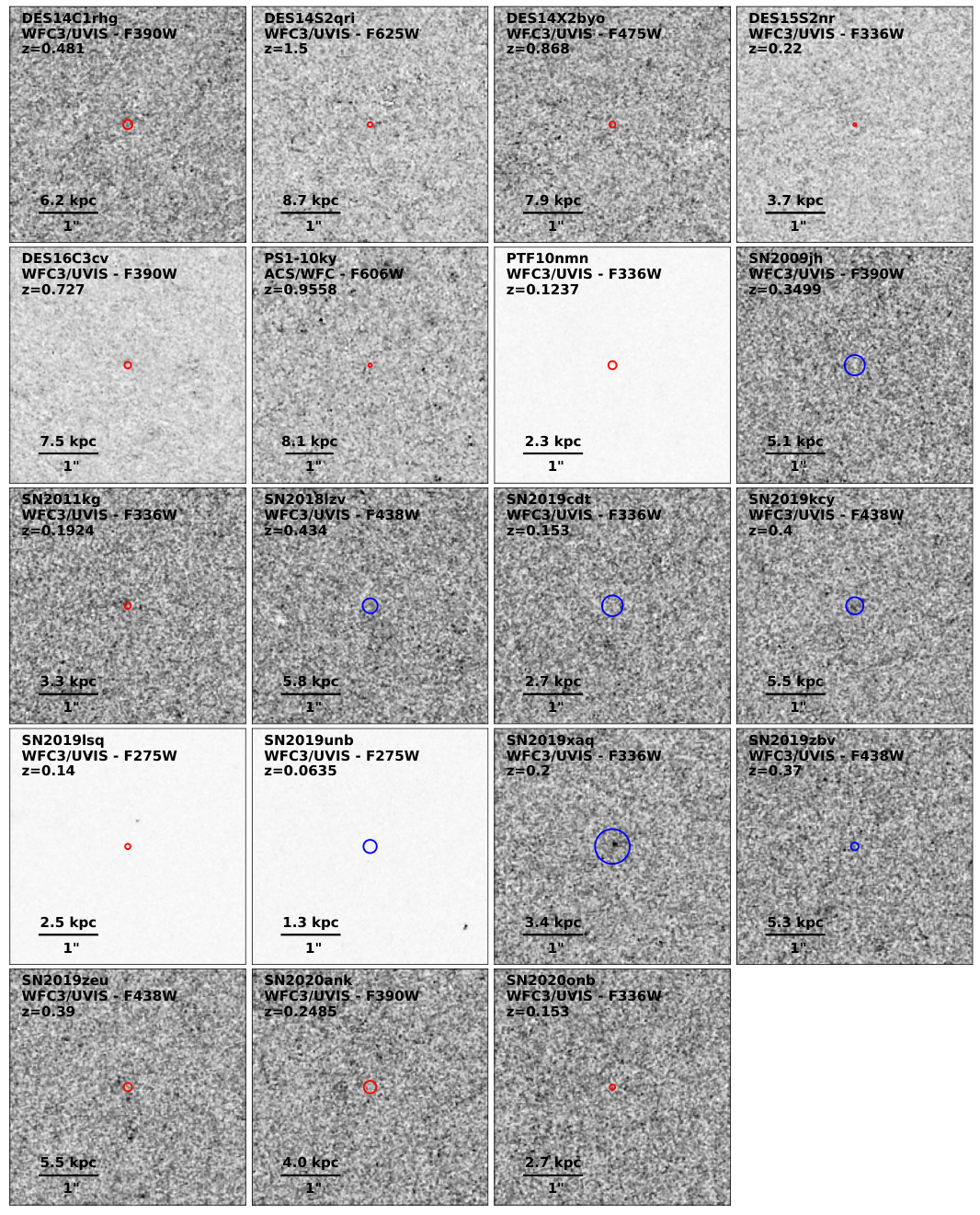
For each of the 65 SLSNe, the researchers performed careful astrometric matching, precisely aligning Hubble images of each host galaxy against earlier images that caught the supernova while it was still shining. This pinpointed each explosion to a specific pixel within the host galaxy image, often to within a fraction of an arcsecond (smaller than 1/3600 of a degree on the sky).
From those pinpointed positions, the team measured three things:
- Physical offset: the raw distance in kiloparsecs (thousands of light-years) between the supernova and its host galaxy’s center
- Host-normalized offset: that distance divided by the host galaxy’s half-light radius (the radius enclosing half the galaxy’s total brightness), enabling fair comparisons across galaxies of very different sizes
- Fractional flux: the fraction of the host galaxy’s UV light that comes from regions dimmer than the supernova’s location, a direct measure of how star-rich or star-poor that neighborhood is
The fractional flux statistic is the most telling. If a supernova lands in the brightest star-forming knot of its galaxy, the fractional flux approaches 1, meaning nearly all the galaxy’s light comes from regions fainter than that spot. If it detonates just beyond the galaxy’s visible edge, fractional flux is 0.
For comparison: long gamma-ray bursts (LGRBs), brief intense flashes also thought to come from dying massive stars, cluster in the brightest regions of their hosts, with fractional fluxes skewed strongly toward 1. SLSNe look nothing like that. Roughly 40% of the sample lands at fractional flux = 0, in regions so faint they register essentially no UV light at all.
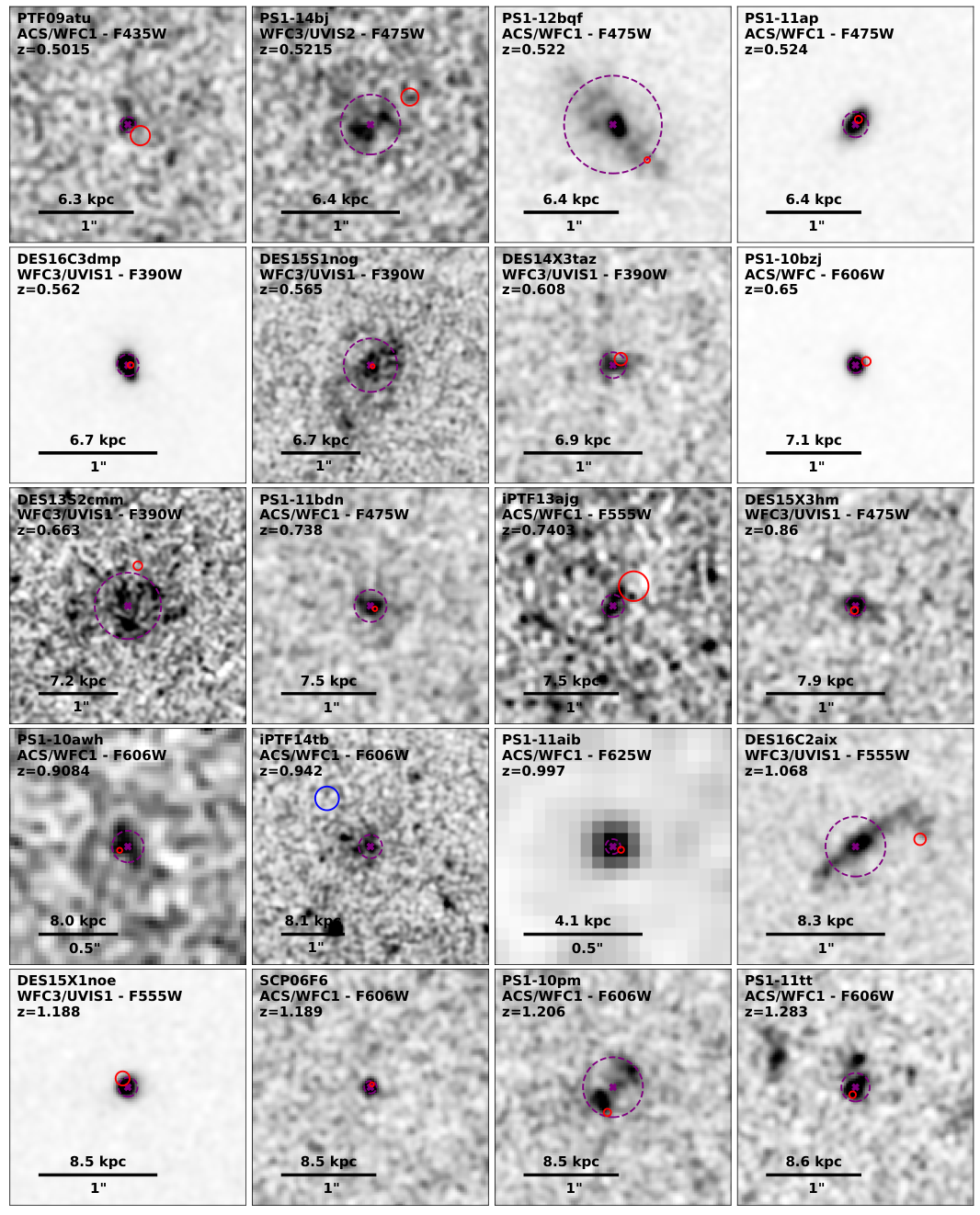
The normalized offset distribution tells the same story. SLSNe roughly follow an exponential disk profile, the gradual brightness falloff from galactic center to edge you’d expect if events traced the galaxy’s overall starlight. But there is a dramatic excess of events at large offsets: 1.5 to 4 times the host half-light radius. This excess is systematically larger than what’s seen for LGRBs, and larger still compared to ordinary Type Ib/c and Type II core-collapse supernovae.
Why It Matters
The contrast with LGRBs is the study’s sharpest result. Long gamma-ray bursts are also hydrogen-stripped (meaning the dying star shed its outer layers before exploding) and energetic. They famously prefer the brightest, most actively star-forming regions of their hosts. For decades, SLSNe were grouped alongside LGRBs as products of similar stellar evolution pathways: massive, fast-rotating, metal-poor stars that live fast and die spectacularly.
This study undermines that assumption. The SLSN offset and fractional flux distributions are statistically distinct from LGRBs, not just cosmetically different. Something is moving SLSN parent stars away from their birth sites before they explode.
The team’s favored explanation: runaway stars. In dense stellar environments, massive stars often form in binary pairs, two stars bound by gravity and orbiting each other. If one star explodes first, the blast can sever the gravitational bond and send the surviving companion careening through the galaxy at around 100 km/s.
Given typical SLSN parent-star lifetimes of tens of millions of years, a star traveling at 100 km/s could cover several kiloparsecs from its birth cluster before it too explodes. That naturally explains why so many SLSNe land far from star-forming regions, in the dim outskirts or beyond the visible edge of the galaxy.
The researchers also tested whether SLSN locations varied with redshift or with explosion parameters inferred from the magnetar model, a framework in which the blast is powered by the rapid spin-down of an ultramagnetic neutron star. Neither showed any significant correlation. If the runaway star scenario is correct, it would be a universal feature of SLSNe across cosmic time, not a property of any particular subpopulation.
If SLSNe are primarily the deaths of runaway stars from disrupted binaries, that constrains not just the parent-star mass and chemical composition, but the entire stellar evolutionary pathway: binary formation, first-star death, gravitational disruption, and then a long, lonely journey across the galaxy before the second star collapses.
The Vera C. Rubin Observatory’s Legacy Survey of Space and Time will discover thousands of SLSNe in the coming years. Those numbers should be enough to test the runaway hypothesis directly, searching for velocity signatures of runaway parent stars and mapping SLSN environments across a wider range of host galaxy types.
Bottom Line: The largest Hubble study of superluminous supernova locations finds that these extreme explosions are systematically offset from star-forming regions in ways no other massive-star death replicates, pointing toward massive runaway stars launched from disrupted binaries as the likely progenitors of the universe’s brightest supernovae.
IAIFI Research Highlights

This work combines precision astrometric techniques with statistical population analysis across 65 galaxies spanning nearly 12 billion years of cosmic time, an example of the data-intensive, multi-scale approach central to IAIFI's research.

The study uses automated astrometric matching pipelines and fractional flux analysis methods that can scale to the thousands of transients expected from next-generation surveys like Rubin/LSST, informing how AI-driven classification and host-association tools must handle spatially resolved galaxy environments.

By establishing that superluminous supernovae preferentially occur in star-poor regions inconsistent with standard massive-star evolution, this work places new constraints on the binary stellar evolution pathways and magnetar formation channels that govern the extreme physics of these cosmic engines.
The runaway binary hypothesis will be tested with Rubin Observatory's LSST and future space-based UV missions; the full dataset and analysis are available at [arXiv:2308.07271](https://arxiv.org/abs/2308.07271).
Original Paper Details
An Extensive $\textit{Hubble Space Telescope}$ Study of the Offset and Host Light Distributions of Type I Superluminous Supernovae
2308.07271
["Brian Hsu", "Peter K. Blanchard", "Edo Berger", "Sebastian Gomez"]
We present an extensive $\textit{Hubble Space Telescope}$ ($\textit{HST}$) rest-frame ultraviolet (UV) imaging study of the locations of Type I superluminous supernovae (SLSNe) within their host galaxies. The sample includes 65 SLSNe with detected host galaxies in the redshift range $z\approx 0.05-2$. Using precise astrometric matching with SN images, we determine the distributions of physical and host-normalized offsets relative to the host centers, as well as the fractional flux distribution relative to the underlying UV light distribution. We find that the host-normalized offsets of SLSNe roughly track an exponential disk profile, but exhibit an overabundance of sources with large offsets of $1.5-4$ times their host half-light radius. The SLSNe normalized offsets are systematically larger than those of long gamma-ray bursts (LGRBs), and even Type Ib/c and II SNe. Furthermore, we find that about 40\% of all SLSNe occur in the dimmest regions of their host galaxies (fractional flux of 0), in stark contrast to LGRBs and Type Ib/c and II SNe. We do not detect any significant trends in the locations of SLSNe as a function of redshift, or as a function of explosion and magnetar engine parameters inferred from modeling of their optical lights curves. The significant difference in SLSN locations compared to LGRBs (and normal core-collapse SNe) suggests that at least some of their progenitors follow a different evolutionary path. We speculate that SLSNe arise from massive runaway stars from disrupted binary systems, with velocities of $\sim 10^2$ km s$^{-1}$.