

Applications of flow models to the generation of correlated lattice QCD ensembles
Authors
Ryan Abbott, Aleksandar Botev, Denis Boyda, Daniel C. Hackett, Gurtej Kanwar, Sébastien Racanière, Danilo J. Rezende, Fernando Romero-López, Phiala E. Shanahan, Julian M. Urban
Abstract
Machine-learned normalizing flows can be used in the context of lattice quantum field theory to generate statistically correlated ensembles of lattice gauge fields at different action parameters. This work demonstrates how these correlations can be exploited for variance reduction in the computation of observables. Three different proof-of-concept applications are demonstrated using a novel residual flow architecture: continuum limits of gauge theories, the mass dependence of QCD observables, and hadronic matrix elements based on the Feynman-Hellmann approach. In all three cases, it is shown that statistical uncertainties are significantly reduced when machine-learned flows are incorporated as compared with the same calculations performed with uncorrelated ensembles or direct reweighting.
Concepts
The Big Picture
Imagine measuring how a rubber band stretches under different tensions. The smart approach isn’t to cut a hundred rubber bands; it’s to take the same rubber band and pull it to different lengths. Correlations between measurements on the same object let you subtract out noise that would otherwise swamp your signal. Physicists doing lattice QCD calculations face exactly this problem, just with quarks and gluons instead of rubber bands.
Lattice QCD is the gold-standard numerical tool for computing properties of protons, neutrons, and other particles governed by the strong nuclear force. It works by placing space-time on a grid and simulating how quarks and gluons interact at each point. Extracting physical results often requires comparing calculations at slightly different settings: different grid resolutions, quark masses, or interaction strengths. Those differences can be buried under statistical noise, and running fresh, independent simulations for every setting is brutally expensive.
A collaboration from MIT, Fermilab, Google DeepMind, and the University of Bern has now shown that machine-learned normalizing flows can solve this problem. These are AI models that learn to convert one set of simulations into another, manufacturing correlated ensembles where random fluctuations are shared rather than independent. When you compare the two ensembles, much of the noise cancels. The payoff: sharper estimates from the same computational budget.
Key Insight: Using AI to transform lattice configurations from one physical parameter setting to another creates statistically correlated ensembles. Shared fluctuations cancel when you take differences, yielding significantly more precise results without additional simulation cost.
How It Works
A normalizing flow is a learned mapping between two probability distributions. Think of it as a coordinate transformation: configurations sampled from one physical setup (say, a coarse lattice) get pushed through a neural network that reshapes them into configurations consistent with a different setup (a finer lattice). The transformation is invertible and tracks exactly how probabilities change, so the output faithfully represents the target distribution.
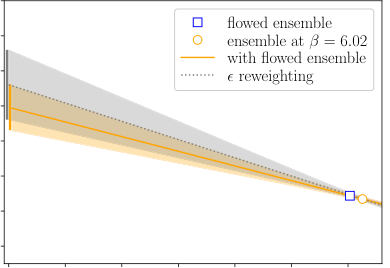
The team introduces a residual flow architecture, where each network layer adds a small, structured correction to a configuration rather than transforming it wholesale. When the two distributions are nearby in parameter space, those corrections are naturally small and easy to learn. A good match for the task.
The logic runs as follows:
- Generate a base ensemble at simulation setting α₀ using standard Monte Carlo methods.
- Train a flow to map those configurations to samples consistent with a nearby setting α₁.
- Apply the flow to produce a second ensemble that is statistically correlated with the first (the same underlying configurations, transformed).
- Compute observables at both settings. Shared fluctuations cancel when you take differences, cutting the variance.
The variance reduction follows the rubber band logic: noise affecting both ensembles drops out of the difference. The closer the two distributions, the stronger the correlation.
The researchers validate this across three applications. For continuum limits, extrapolating results to zero lattice spacing requires comparing calculations at multiple grid resolutions; flows between coarse and fine ensembles cut uncertainties in gradient flow scales. For mass dependence, the approach outperforms both independent ensembles and naive reweighting when tracing how QCD observables shift with quark mass. For hadronic matrix elements via Feynman-Hellmann, which computes quantities like the gluon momentum fraction of the pion by differentiating the action with respect to an external field, flows work well precisely because the technique requires comparing ensembles at slightly different coupling values.
In all three cases, flows beat simple reweighting (the naive alternative of rescaling the importance of existing configurations). The improvement is sharpest when parameter shifts are small enough that distributions overlap substantially but large enough that direct reweighting becomes inefficient.
Why It Matters
Much of the excitement around machine learning for lattice QCD has focused on replacing expensive Monte Carlo sampling entirely. That goal remains technically challenging at physically relevant scales. This work takes a different angle: augmenting existing calculations rather than replacing them. Flow models for variance reduction are easier to train than those needed for full configuration generation, because they only need to bridge nearby distributions rather than learn an entire complex probability landscape.
This opens a more near-term path to computational gains. Standard lattice QCD workflows routinely compare results across multiple lattice spacings, quark masses, and external field strengths. Anywhere such comparisons appear, correlated flows could reduce statistical uncertainties, potentially bringing calculations that currently demand enormous computer clusters within reach of more modest resources.
The Feynman-Hellmann application stands out. Many physically important quantities (nucleon sigma terms, isospin breaking corrections, derivatives with respect to the electromagnetic coupling) can be formulated as derivatives of the action with respect to some parameter. The correlated ensemble approach offers a unified strategy for all of them.
Bottom Line: Machine-learned flows act as statistical bridges between nearby lattice QCD ensembles, creating correlations that cancel noise and sharpen derivative-based observables. It’s a practical, near-term way to squeeze more physics out of expensive simulations.
IAIFI Research Highlights

This work brings modern deep generative modeling (normalizing flows, residual architectures) to one of the most computationally demanding fields in theoretical physics, producing concrete speedups in real QCD calculations.

The residual flow architecture and correlated-ensemble training strategy apply beyond QCD to any domain requiring variance reduction across related probability distributions.

By reducing the statistical cost of continuum extrapolations, quark mass dependencies, and Feynman-Hellmann matrix element calculations, this method accelerates precision QCD predictions relevant to particle and nuclear physics experiments.
Future work includes applying correlated flows to theories with a sign problem, such as finite-density QCD, where standard reweighting catastrophically fails; the full paper is available at [arXiv:2401.10874](https://arxiv.org/abs/2401.10874).