

ASURA-FDPS-ML: Star-by-star Galaxy Simulations Accelerated by Surrogate Modeling for Supernova Feedback
Authors
Keiya Hirashima, Kana Moriwaki, Michiko S. Fujii, Yutaka Hirai, Takayuki R. Saitoh, Junnichiro Makino, Ulrich P. Steinwandel, Shirley Ho
Abstract
We introduce new high-resolution galaxy simulations accelerated by a surrogate model that reduces the computation cost by approximately 75 percent. Massive stars with a Zero Age Main Sequence mass of more than about 10 $\mathrm{M_\odot}$ explode as core-collapse supernovae (CCSNe), which play a critical role in galaxy formation. The energy released by CCSNe is essential for regulating star formation and driving feedback processes in the interstellar medium (ISM). However, the short integration timesteps required for SNe feedback have presented significant bottlenecks in astrophysical simulations across various scales. Overcoming this challenge is crucial for enabling star-by-star galaxy simulations, which aim to capture the dynamics of individual stars and the inhomogeneous shell's expansion within the turbulent ISM. To address this, our new framework combines direct numerical simulations and surrogate modeling, including machine learning and Gibbs sampling. The star formation history and the time evolution of outflow rates in the galaxy match those obtained from resolved direct numerical simulations. Our new approach achieves high-resolution fidelity while reducing computational costs, effectively bridging the physical scale gap and enabling multi-scale simulations.
Concepts
The Big Picture
Imagine trying to simulate the entire history of a galaxy, billions of stars, vast clouds of gas, the explosive deaths of massive suns, but every time a star explodes, your computer grinds to a near-halt. That’s not a hypothetical problem. It’s the central challenge that has bottlenecked galaxy simulations for decades.
Supernovae, the catastrophic deaths of stars more than ten times the mass of our Sun, release about 10⁵¹ ergs of energy. That’s roughly what our Sun will emit over its entire ten-billion-year lifetime, compressed into seconds. To capture that explosion faithfully in a simulation, you have to shrink your computational time-step (the slice of simulated time the computer calculates in each cycle) down to mere hundreds of years. The rest of the galaxy ticks along on timescales millions of times longer. Reconciling those two clocks is brutally expensive.
The physics matters enormously. Supernovae don’t just make pretty light shows. They regulate whether gas clumps together to form new stars, drive powerful winds that blow material out of galaxies entirely, and seed the cosmos with the heavy elements that eventually make planets and people.
Get the supernova physics wrong, or skip it to save compute time, and your simulated galaxy drifts from reality in ways that compound over billions of years. The field has been stuck in a painful tradeoff: high-resolution fidelity or tractable computation, but rarely both.
A team from the University of Tokyo, the Flatiron Institute, Kobe University, and collaborating institutions has now broken that tradeoff. Their new framework, ASURA-FDPS-ML, pairs machine learning surrogate modeling with traditional direct simulations to cut computational costs by roughly 75%, without giving up the physical accuracy that makes high-resolution galaxy simulations worth running.
Key Insight: By training a neural network to predict supernova blast wave outcomes and replacing the most expensive direct simulation steps with those predictions, the team achieved star-by-star galaxy simulations that match full-resolution results at a fraction of the cost.
How It Works
The core bottleneck isn’t the explosion itself. It’s the Sedov-Taylor phase, the earliest stage of a supernova remnant’s expansion when the blast wave is still moving fast and hot. Capturing this phase correctly requires time-steps on the order of hundreds of years, three orders of magnitude shorter than the typical flow of gas in galaxy simulations. Even particles far from the explosion have to slow their clocks to keep pace. The result: thousands of tiny steps per supernova event, multiplied across thousands of stellar deaths in a single dwarf galaxy simulation.
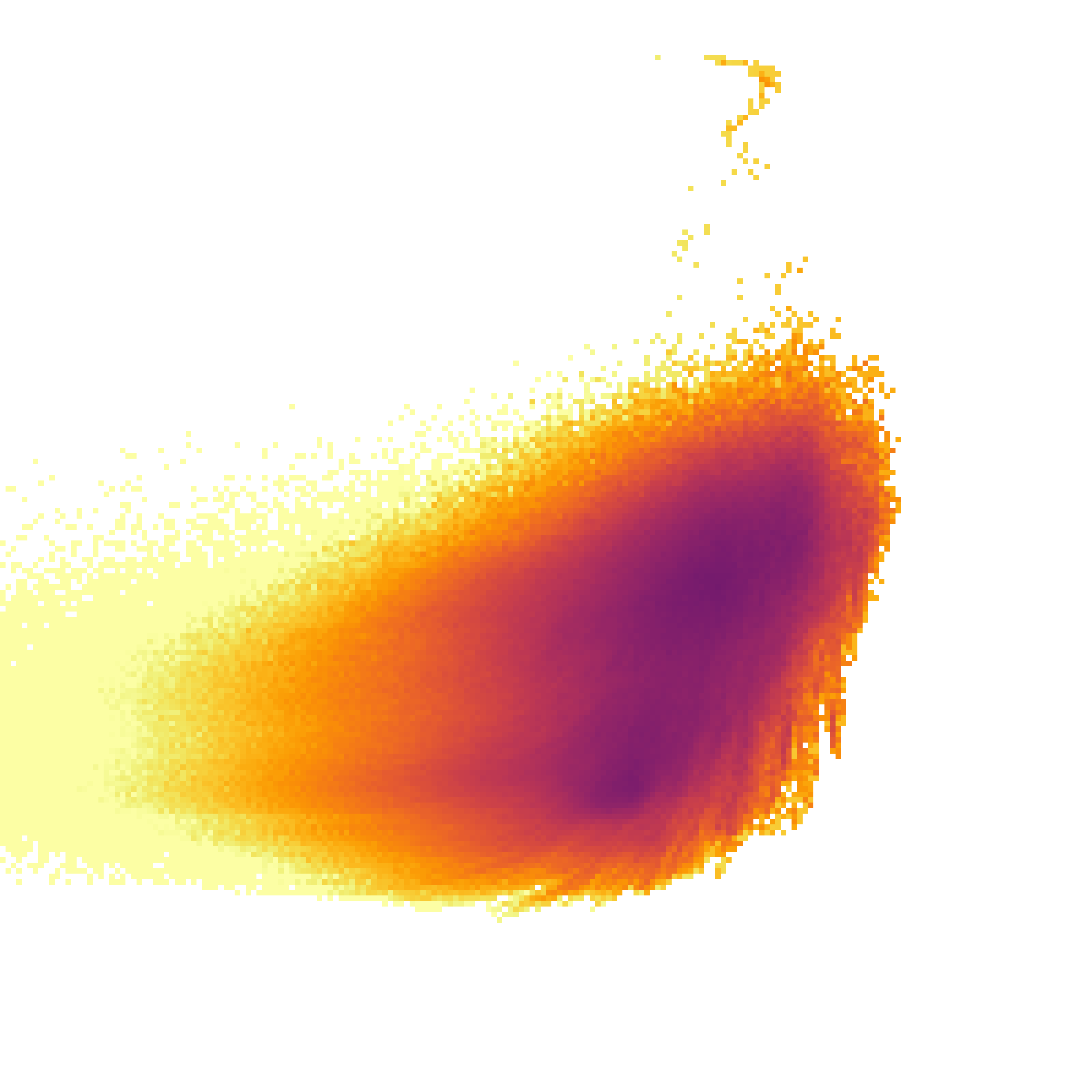
The ASURA-FDPS-ML approach attacks this with a two-stage strategy:
-
Training phase: The team ran a suite of high-resolution direct numerical simulations (calculations that compute the physics from first principles, with no shortcuts) of isolated supernova explosions inside turbulent molecular clouds, the dense, swirling gas clouds where stars are born. These reference simulations fully resolve the Sedov-Taylor phase and capture how the blast wave evolves depending on local gas density, temperature, and turbulence.
-
Surrogate model: A machine learning surrogate learns from those reference simulations to predict the final state of a supernova blast wave given its local environment. Instead of grinding through hundreds of tiny time-steps, the surrogate jumps ahead and directly outputs the resulting momentum and energy deposited into surrounding gas particles.
-
Gibbs sampling for stochasticity: Real supernova environments are turbulent and chaotic. To preserve this statistical richness, the team incorporated Gibbs sampling, a technique that randomly draws outcomes from the full range of possibilities the model has learned, rather than always returning the most likely result. Each surrogate-modeled explosion still reflects the natural scatter of blast wave behavior. The simulation doesn’t become artificially uniform.
The surrogate plugs directly into the ASURA-FDPS simulation code, a smoothed particle hydrodynamics framework that models gas as a collection of fluid particles rather than a fixed grid. The code already tracks individual stars. When a massive star reaches the end of its life, instead of triggering a full expensive integration, the code queries the surrogate, gets a physically plausible outcome, and moves on.
The validation bears this out. Comparing surrogate-accelerated simulations against fully resolved direct simulations of the same dwarf galaxy (identical initial conditions, same physics, different supernova solvers) the star formation histories match closely. So do the outflow rates, the measure of how much material supernovae blast out of the galaxy over time. These are precisely the quantities most sensitive to getting supernova feedback right.
The 75% cost reduction reflects the specific bottleneck being eliminated. In direct simulations, supernova time-step constraints dominate total wall-clock time. Replacing those constraints with fast surrogate evaluations removes the tax that individual explosions impose on the entire simulation.
Why It Matters
Star-by-star galaxy simulations, models that track individual stellar masses rather than treating stars as statistical populations, are the frontier of galaxy formation modeling. But computational cost has kept them confined to small, isolated systems run for short durations.
These simulations can capture effects that coarser models miss entirely: the clustering of supernovae in space and time, chemical enrichment patterns imprinted by specific stellar generations, and the way feedback from a single massive star cluster can reshape a small galaxy. The price tag has been prohibitive.
ASURA-FDPS-ML changes that arithmetic. A 75% cost reduction isn’t just a speedup. It’s the difference between a simulation that takes a year and one that takes three months, or between a run you can afford once and one you can sweep across varied parameters to build real statistical studies.
As surrogate models improve and training datasets grow richer, this approach could scale to larger galaxies and longer timescales. The methodology itself, pairing ML surrogates with probabilistic sampling to preserve stochasticity, applies to similar time-step bottlenecks throughout computational astrophysics.
Bottom Line: ASURA-FDPS-ML shows that machine learning surrogates can replace the most computationally expensive physics in galaxy simulations without degrading the results that matter most, making high-fidelity, star-by-star simulations of galaxy formation practical at scales that were previously out of reach.
IAIFI Research Highlights

This work bridges machine learning and astrophysical simulation, using data-driven surrogate modeling and probabilistic sampling to solve a fundamental computational bottleneck in galaxy formation physics. It shows that AI methods can be embedded within first-principles numerical frameworks without compromising their fidelity.

The paper advances surrogate modeling for multi-scale physical simulations by showing that Gibbs sampling can preserve stochastic variability in ML-accelerated physics. The technique applies beyond astrophysics to any domain where fast approximations must replicate the statistical texture of expensive solvers.

By enabling accurate star-by-star galaxy simulations at reduced cost, this framework opens up study of how individual supernova explosions collectively shape galaxy structure, chemical evolution, and outflow dynamics, fundamental questions in how the universe assembles the galaxies we observe today.
Future work could extend the surrogate approach to larger galaxy masses, longer cosmic timescales, and additional feedback channels such as stellar winds and radiation pressure. The paper is available as [arXiv:2410.23346](https://arxiv.org/abs/2410.23346) (Hirashima et al.).
Original Paper Details
ASURA-FDPS-ML: Star-by-star Galaxy Simulations Accelerated by Surrogate Modeling for Supernova Feedback
2410.23346
["Keiya Hirashima", "Kana Moriwaki", "Michiko S. Fujii", "Yutaka Hirai", "Takayuki R. Saitoh", "Junnichiro Makino", "Ulrich P. Steinwandel", "Shirley Ho"]
We introduce new high-resolution galaxy simulations accelerated by a surrogate model that reduces the computation cost by approximately 75 percent. Massive stars with a Zero Age Main Sequence mass of more than about 10 $\mathrm{M_\odot}$ explode as core-collapse supernovae (CCSNe), which play a critical role in galaxy formation. The energy released by CCSNe is essential for regulating star formation and driving feedback processes in the interstellar medium (ISM). However, the short integration timesteps required for SNe feedback have presented significant bottlenecks in astrophysical simulations across various scales. Overcoming this challenge is crucial for enabling star-by-star galaxy simulations, which aim to capture the dynamics of individual stars and the inhomogeneous shell's expansion within the turbulent ISM. To address this, our new framework combines direct numerical simulations and surrogate modeling, including machine learning and Gibbs sampling. The star formation history and the time evolution of outflow rates in the galaxy match those obtained from resolved direct numerical simulations. Our new approach achieves high-resolution fidelity while reducing computational costs, effectively bridging the physical scale gap and enabling multi-scale simulations.