

AT2023vto: An Exceptionally Luminous Helium Tidal Disruption Event from a Massive Star
Authors
Harsh Kumar, Edo Berger, Daichi Hiramatsu, Sebastian Gomez, Peter K. Blanchard, Yvette Cendes, K. Azalee Bostroem, Joseph Farah, Estefania Padilla Gonzalez, Andrew Howell, Curtis McCully, Megan Newsome, Giacomo Terreran
Abstract
We present optical/UV observations and the spectroscopic classification of the transient AT2023vto as a tidal disruption event (TDE) at z = 0.4846. The spectrum is dominated by a broad He II $λ$4686 emission line, with a width of ~ $3.76 \times 10^4$ km/s and a blueshift of ~ $1.05 \times 10^4$ km/s, classifying it as a member of the TDE-He class. The light curve exhibits a long rise and decline timescale, with a large peak absolute magnitude of M$_g$ ~ -23.6, making it the most luminous of the classical optical TDEs (H, H+He, He) discovered to date by about 2 mag (and ~ 4 mag compared to the mean of the population). The light curve exhibits a persistent blue color of g - r ~ -0.4 mag throughout its evolution, similar to other TDEs, but distinct from supernovae. We identify the host galaxy of AT2023vto in archival Pan-STARRS images and find that the transient is located at the galaxy center, and that its inferred central black hole mass is ~ $10^7~M_{\odot}$. Modeling the light curves of AT2023vto, we find that it resulted from the disruption of a ~ 9 $M_{\odot}$ star by a ~$10^7~M_{\odot}$ supermassive black hole. The star mass is about 5 times larger than the highest star masses previously inferred in TDEs, and the black hole mass is at the high end of the distribution. AT2023vto is comparable in luminosity and timescale to some putative TDEs (with a blue featureless continuum), as well as to the mean of the recently identified population of ambiguous nuclear transients (ANTs), although the latter are spectroscopically distinct and tend to have longer timescales. ANTs have been speculated to arise from tidal disruptions of massive stars, perhaps in active galactic nuclei, and AT2023vto may represent a similar case but in a dormant black hole, thereby bridging the TDE and ANT populations. We anticipate that Rubin Observatory / LSST will uncover similar luminous TDEs to z ~ 3.
Concepts
The Big Picture
Imagine a star nearly ten times the mass of our Sun drifting too close to a sleeping monster: a supermassive black hole weighing ten million solar masses. The black hole’s gravity pulls harder on the near side of the star than the far side, stretching it apart like taffy. For a brief cosmic moment, the catastrophe outshines entire galaxies.
This is a tidal disruption event (TDE), when a wandering star gets torn apart by a black hole’s gravity. Astronomers have catalogued dozens of them. But AT2023vto isn’t just another entry in that catalog. It’s a record-breaker that doesn’t quite fit, and that’s what makes it worth paying attention to.
When astronomers first spotted AT2023vto in September 2023 using the Zwicky Transient Facility (ZTF), a robotic sky survey that scans for sudden changes in the night sky, they thought it was a superluminous supernova. The brightness was simply too extreme for a “normal” TDE. But analysis of the light’s chemical fingerprints told a different story: this was a black hole shredding a star, producing a distinctive helium signature that no supernova would make.
The event turned out to be the most luminous tidal disruption event ever discovered, outshining the average TDE by a factor of roughly 40 and beating the previous record-holder by a factor of six.
A Harvard-led team, including researchers from the NSF AI Institute for Artificial Intelligence and Fundamental Interactions (IAIFI), has now published a detailed study of AT2023vto. They modeled the brightness over time and the light’s spectrum to reconstruct what happened, and what it means for a mysterious class of even brighter, unexplained cosmic blasts.
Key Insight: AT2023vto resulted from the destruction of a ~9 solar-mass star by a 10-million-solar-mass black hole, producing the brightest known classical TDE and potentially connecting ordinary stellar disruptions to a puzzling category of even more powerful nuclear transients.
How It Works
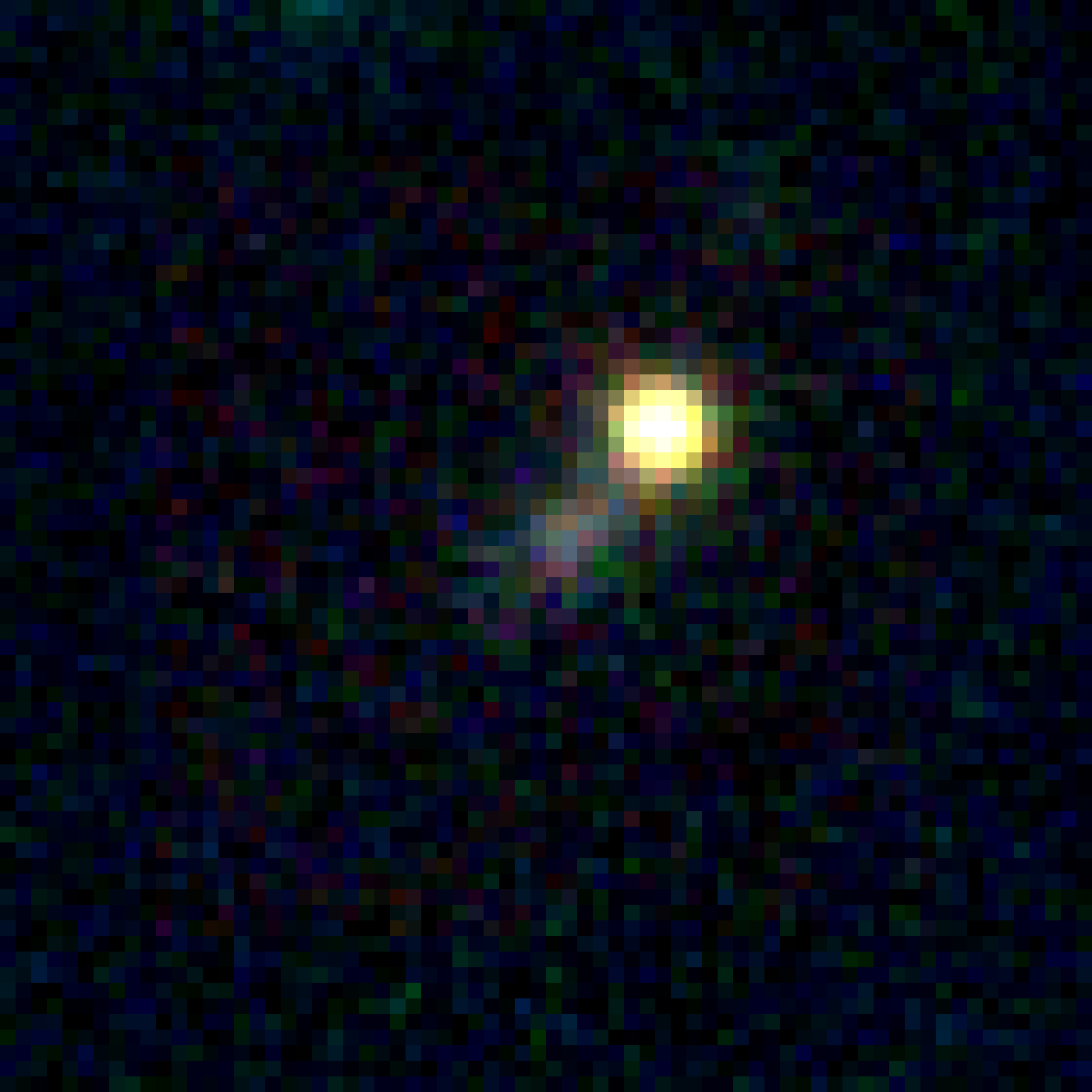
Tracking AT2023vto required a coordinated observing campaign spanning optical and ultraviolet wavelengths. The team used ZTF for ongoing photometric monitoring (regularly measuring the event’s total brightness over time) and obtained spectroscopic observations to classify the event. They also tapped into archival Pan-STARRS images to identify the host galaxy, sitting roughly 6.4 billion light-years away.
The spectrum is the smoking gun. It’s dominated by a broad He II λ4686 emission line, light emitted by helium atoms stripped of one electron, spanning about 37,600 km/s in width with a blueshift of roughly 10,500 km/s. That blueshift (a shift toward shorter wavelengths indicating gas moving toward us) means material is flying in our direction at about 3.5% the speed of light, driven outward by intense radiation pressure. This places AT2023vto firmly in the TDE-He class: disruption events where helium dominates the spectrum with little hydrogen signal.
The light curve tells its own story:
- Peak brightness: absolute magnitude Mg ≈ −23.6, roughly 2 magnitudes brighter than the previous most luminous classical TDE
- Color: a persistent blue g − r ≈ −0.4 throughout the event, consistent with TDEs and unlike supernovae
- Timescale: unusually long rise and decline, hinting at a larger mass of stellar debris than typical
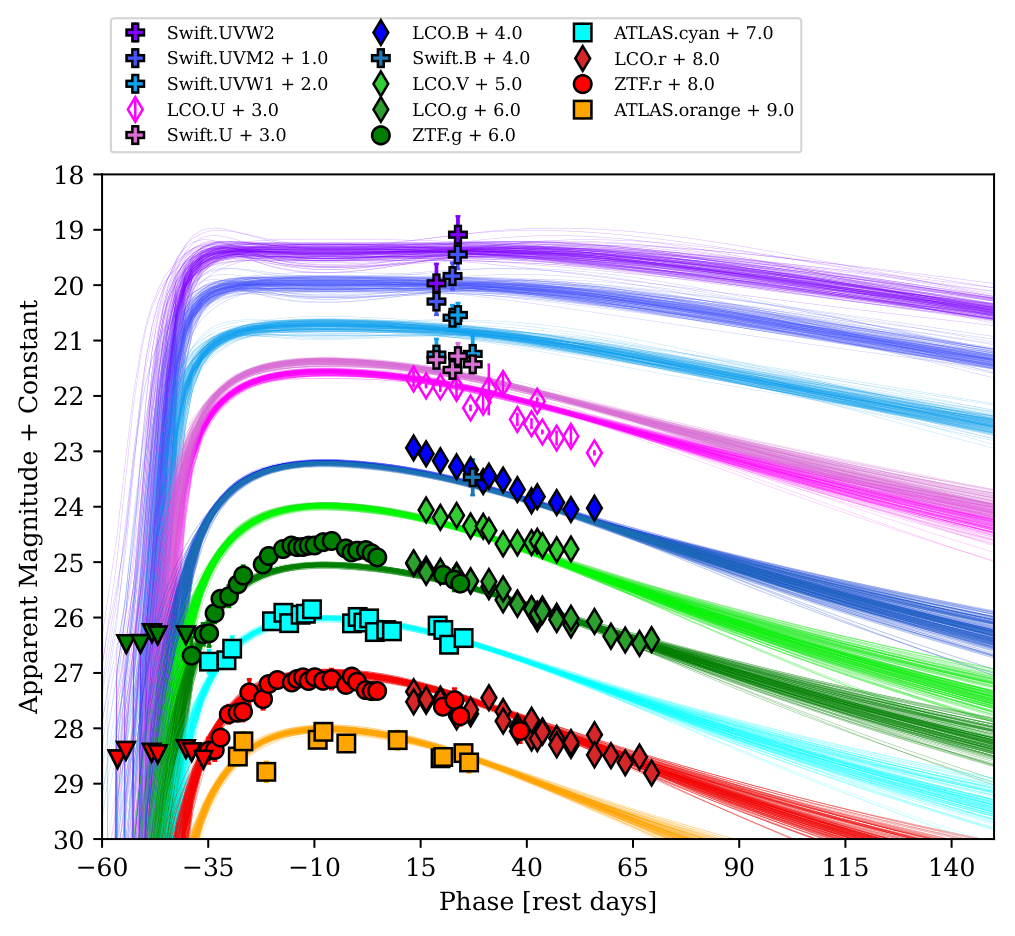
To extract physical parameters, the team modeled the light curve using MOSFiT (Modular Open-Source Fitter for Transients), which generates millions of model light curves and finds the combination of black hole and stellar properties that best matches observations. The host galaxy’s spectral energy distribution, its brightness across many wavelengths from ultraviolet to infrared, was modeled with Prospector to measure the galaxy’s total stellar mass: about 55 billion solar masses. That translates to a black hole mass of roughly 10 million solar masses.
The fit points to a disrupted star of approximately 9 solar masses. That’s about five times heavier than the most massive star previously inferred in any classical TDE, where typical disrupted stars weigh between 0.1 and 2 solar masses. A more massive star means more debris, more energy, and a longer, brighter flare. It explains the record-shattering luminosity.
Why It Matters
AT2023vto matters beyond the record books. It sits at an intersection astronomers have been puzzling over for years. There’s a growing population of ambiguous nuclear transients (ANTs): extremely luminous flares from galactic centers that don’t match supernovae, don’t match typical TDEs, and don’t match active galactic nuclei (galaxies whose central black holes are already consuming surrounding gas). Some ANTs are 10 to 100 times brighter than classical TDEs and last far longer.
One speculation has been that ANTs might represent TDEs from massive stars, perhaps in galaxies with already-active black holes, but no clear link had emerged.
AT2023vto changes that. Its luminosity and timescale overlap with the ANT population, but its spectrum, with that clear broad He II line, is unambiguously a classical TDE. It’s happening around a dormant black hole, not one that’s already actively feeding. The extreme luminosity doesn’t require a pre-existing accretion disk (a swirling ring of gas already orbiting the black hole) or any other special environment.
You just need a massive enough star. AT2023vto may be the missing link between these two populations: classical TDEs at one end, luminous ANTs at the other, with this event showing what happens when a genuinely massive star meets its end around a quiet black hole.
The Rubin Observatory / LSST is expected to detect events like AT2023vto out to redshift z ~ 3, corresponding to light that left its source more than 11 billion years ago. That would transform this single spectacular outlier into a statistical population, letting astronomers trace how the most extreme stellar disruptions unfold across cosmic time.
Bottom Line: AT2023vto is the most luminous classical tidal disruption event ever found, powered by the destruction of a ~9 solar-mass star, and it may connect ordinary TDEs to the mysterious ultra-luminous nuclear transients that astronomers have struggled to explain.
IAIFI Research Highlights

This work combines multi-wavelength observational astronomy with Bayesian light-curve modeling (MOSFiT) and SED fitting (Prospector) to extract physical parameters from a single transient event, showing how computational tools are transforming observational astrophysics.

The study uses machine-learning-informed photometric classification and Bayesian inference frameworks to connect spectroscopic and photometric data. These AI-assisted modeling pipelines enable rapid physical interpretation of transient phenomena that would otherwise require far more manual analysis.

AT2023vto reveals that tidal disruption events can arise from stars far more massive than previously observed, extending the known parameter space of black hole–star interactions and potentially explaining a class of ultra-luminous nuclear transients that has resisted classification.
Future observations with Rubin Observatory / LSST are expected to uncover many similar events to z ~ 3; the paper is available on arXiv as [arXiv:2408.01482](https://arxiv.org/abs/2408.01482).
Original Paper Details
AT2023vto: An Exceptionally Luminous Helium Tidal Disruption Event from a Massive Star
2408.01482
["Harsh Kumar", "Edo Berger", "Daichi Hiramatsu", "Sebastian Gomez", "Peter K. Blanchard", "Yvette Cendes", "K. Azalee Bostroem", "Joseph Farah", "Estefania Padilla Gonzalez", "Andrew Howell", "Curtis McCully", "Megan Newsome", "Giacomo Terreran"]
We present optical/UV observations and the spectroscopic classification of the transient AT2023vto as a tidal disruption event (TDE) at z = 0.4846. The spectrum is dominated by a broad He II $λ$4686 emission line, with a width of ~ $3.76 \times 10^4$ km/s and a blueshift of ~ $1.05 \times 10^4$ km/s, classifying it as a member of the TDE-He class. The light curve exhibits a long rise and decline timescale, with a large peak absolute magnitude of M$_g$ ~ -23.6, making it the most luminous of the classical optical TDEs (H, H+He, He) discovered to date by about 2 mag (and ~ 4 mag compared to the mean of the population). The light curve exhibits a persistent blue color of g - r ~ -0.4 mag throughout its evolution, similar to other TDEs, but distinct from supernovae. We identify the host galaxy of AT2023vto in archival Pan-STARRS images and find that the transient is located at the galaxy center, and that its inferred central black hole mass is ~ $10^7~M_{\odot}$. Modeling the light curves of AT2023vto, we find that it resulted from the disruption of a ~ 9 $M_{\odot}$ star by a ~$10^7~M_{\odot}$ supermassive black hole. The star mass is about 5 times larger than the highest star masses previously inferred in TDEs, and the black hole mass is at the high end of the distribution. AT2023vto is comparable in luminosity and timescale to some putative TDEs (with a blue featureless continuum), as well as to the mean of the recently identified population of ambiguous nuclear transients (ANTs), although the latter are spectroscopically distinct and tend to have longer timescales. ANTs have been speculated to arise from tidal disruptions of massive stars, perhaps in active galactic nuclei, and AT2023vto may represent a similar case but in a dormant black hole, thereby bridging the TDE and ANT populations. We anticipate that Rubin Observatory / LSST will uncover similar luminous TDEs to z ~ 3.