

Attractors, Geodesics, and the Geometry of Moduli Spaces
Authors
Fabian Ruehle, Benjamin Sung
Abstract
We connect recent conjectures and observations pertaining to geodesics, attractor flows, Laplacian eigenvalues and the geometry of moduli spaces by using that attractor flows are geodesics. For toroidal compactifications, attractor points are related to (degenerate) masses of the Laplacian on the target space, and also to the Laplacian on the moduli space. We also explore compactifications of M-Theory to $5$D on a Calabi-Yau threefold and argue that geodesics are unique in a special set of classes, providing further evidence for a recent conjecture by Raman and Vafa. Finally, we describe the role of the marked moduli space in $4$d $\mathcal{N} = 2$ compactifications. We study split attractor flows in an explicit example of the one-parameter family of quintics and discuss setups where flops to isomorphic Calabi-Yau manifolds exist.
Concepts
The Big Picture
Imagine rolling a marble across hilly terrain in the dark. You don’t know the ground’s shape, but wherever the marble settles tells you something about the contours underneath. Something similar happens inside black holes in string theory: “attractor flows” pull the geometry of extra dimensions toward fixed configurations. Two researchers have now shown that these flows aren’t just useful computational tools. They are, in a precise mathematical sense, the shortest possible paths through the space of allowed geometries.
Fabian Ruehle (Northeastern University) and Benjamin Sung (UC Santa Barbara) connect three threads that looked independent: the geometry of moduli spaces (mathematical spaces describing all possible shapes extra dimensions can take), the behavior of the Laplacian operator (which measures how quantities spread across curved space), and attractor flows (which describe how black hole physics locks those shapes into place). Pulling these together gives a unified picture that sharpens longstanding questions about which quantum gravity theories actually work and which only appear to.
Those questions sit at the center of the swampland program, a sustained effort to sort theories that can consistently combine Einstein’s general relativity with quantum mechanics from those that cannot. The key variable is what geometries extra dimensions are allowed to take. This paper narrows the options considerably.
Key Insight: Attractor flows, the paths scalar fields trace as they’re drawn toward black hole fixed points, turn out to be geodesics (shortest curves on a curved surface). This single observation links three separate research programs and provides new evidence for a conjecture about the uniqueness of paths through moduli space.
How It Works
The central technical move is elegant. In string theory and supergravity, a BPS black hole (a special class whose mass is exactly determined by its electric and magnetic charges, thanks to supersymmetry) generates equations of motion for scalar fields in extra dimensions. These attractor flow equations take the form of a gradient flow along the central charge $|Z|$, a quantity encoding the black hole’s charges that strictly decreases as you approach the horizon. Think of water running downhill: the flow always follows the steepest descent.
Here’s the key step. Using a recently proved theorem, Ruehle and Sung show that any gradient flow whose slope has constant steepness automatically satisfies the geodesic equation. Attractor flows have exactly this property (the gradient of $|Z|$ has constant norm along the flow), so every attractor trajectory is a geodesic on the Weil-Petersson metric of moduli space, the natural geometric ruler for measuring distances between different extra-dimensional shapes. A first-order equation and a second-order one turn out to describe the same object.
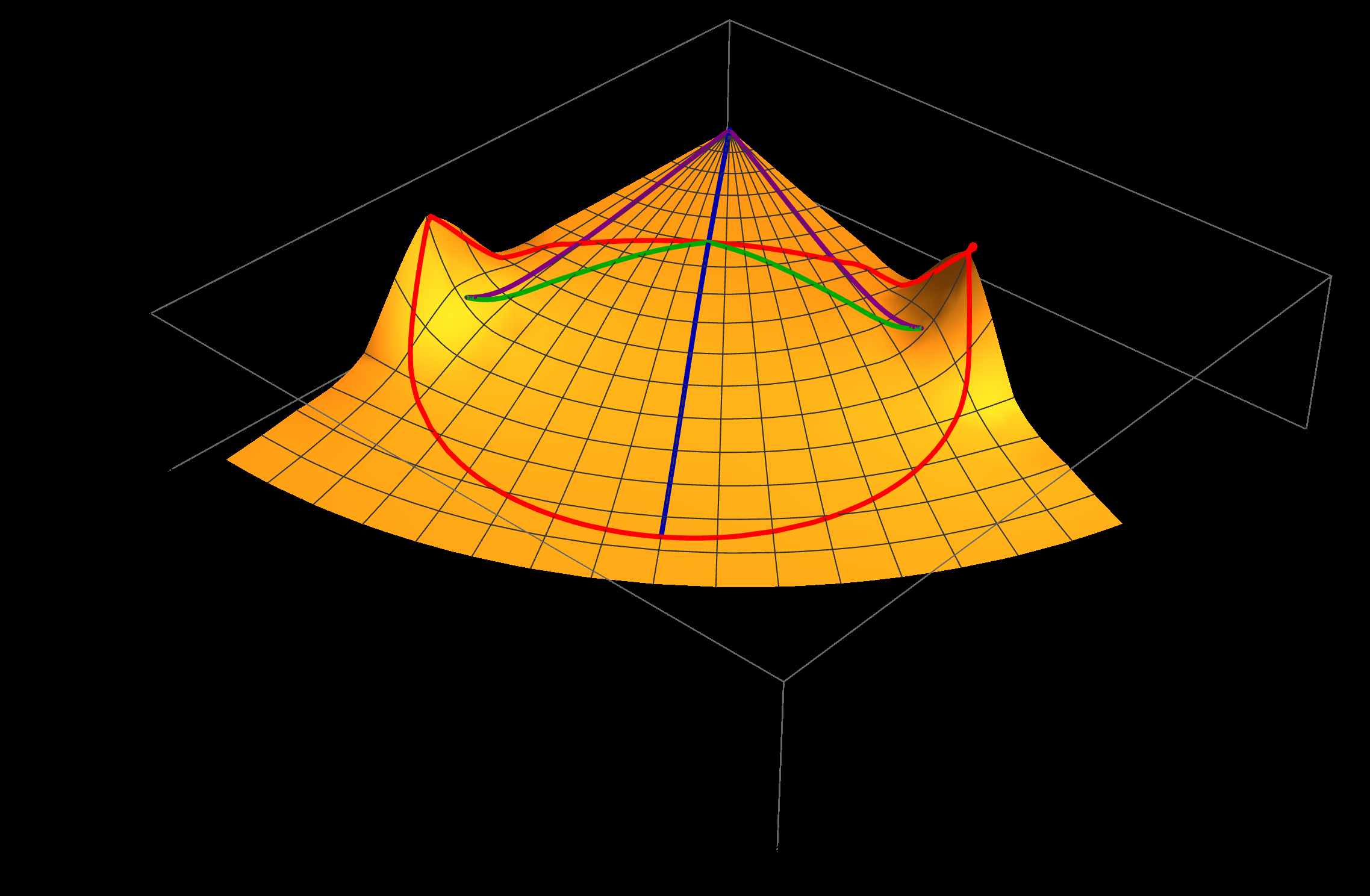
With this identification in hand, the paper explores three consequences:
-
Uniqueness of geodesics in Calabi-Yau moduli spaces: Calabi-Yau manifolds are six-dimensional spaces with special symmetry properties, widely used to model extra dimensions. Because $|Z|$ strictly decreases along the flow, each charge vector $\Gamma$ traces a unique path to a unique minimum. Attractor points are dense in moduli space, and since each has a unique geodesic leading to it, smoothness of the metric strongly suggests global uniqueness. This provides fresh evidence for the Raman-Vafa conjecture, which predicts exactly this.
-
The role of the marked moduli space: At flop transitions, where extra-dimensional geometry undergoes a sudden topological shift and certain cycles shrink to zero size, geodesics in the unmarked moduli space can reflect and multiply. The marked moduli space, which keeps track of which specific Calabi-Yau geometry you’re in, resolves the problem: geodesics pass through the wall rather than bouncing back, restoring uniqueness.
-
Split attractor flows: When a charged particle’s flow crosses a wall of marginal stability (a region where a composite object just barely holds together), it decays: $\Gamma \rightarrow \Gamma_1 + \Gamma_2$. Each daughter particle then follows its own geodesic. The authors work this out explicitly for the quintic Calabi-Yau family, a well-studied benchmark in string compactification. One daughter’s flow ends at a singularity while the other continues, producing a multi-pronged geodesic that encodes the full decay geometrically.
One more connection ties it together. For toroidal compactifications (the simplest case, where extra dimensions are shaped like higher-dimensional donuts), attractor points correspond exactly to special resonant frequencies of the scalar Laplacian. This holds both in the extra-dimensional space itself and in the moduli space of all possible such shapes.
The match isn’t a coincidence. Because attractor flows are geodesics, and geodesics correspond to natural vibrational patterns of the moduli-space Laplacian, all three structures (attractor points, target-space Laplacian masses, and moduli-space Laplacian eigenvalues) are facets of a single geometric object.
Why It Matters
The swampland program is one of the most active areas in theoretical physics. Its goal: figure out which low-energy theories can actually come from consistent quantum gravity, and which are imposters. Understanding moduli space geometry is central to this, since those geometries constrain what particles exist, how heavy they are, and how they interact.
By proving that attractor flows are geodesics, Ruehle and Sung bring powerful geometric tools to bear on swampland conjectures. Their result strengthens the Raman-Vafa conjecture (that geodesics in the marked moduli space are unique) by establishing it on a dense set of points. Smoothness arguments suggest it extends everywhere.
The connection between Laplacian eigenvalues and attractor points, proved rigorously for tori and conjectured for Calabi-Yau manifolds, points toward a deeper spectral geometry behind the swampland. Future work could use numerical methods, potentially including machine learning, to study Laplacian spectra on nontrivial Calabi-Yau metrics and test the conjecture computationally. Open questions remain. Can attractor flow lines for different charges intersect more than once, producing counterexamples to the strong uniqueness conjecture? How do quantum corrections modify the geodesic structure near moduli space boundaries?
Bottom Line: Identifying attractor flows as geodesics unifies three separate swampland research programs and delivers new geometric evidence for the Raman-Vafa uniqueness conjecture, a step toward understanding which universes quantum gravity permits.
IAIFI Research Highlights

This work connects pure mathematics (differential geometry of moduli spaces, spectral theory of the Laplacian) with theoretical physics (string compactifications, black hole attractor mechanisms) through a correspondence between gradient flows and geodesics that had not been recognized before.

The geometric structures uncovered here, including Laplacian eigenvalues on Calabi-Yau manifolds, attractor loci, and Weil-Petersson metrics, are natural targets for machine learning approaches to swampland exploration. Numerical methods could test these conjectures across large families of compactifications.

The paper provides new evidence for the Raman-Vafa uniqueness conjecture, with explicit verification in M-theory compactifications and the quintic Calabi-Yau family, tightening constraints on consistent quantum gravity theories.
Future directions include extending the Laplacian eigenvalue/attractor point correspondence beyond tori to general Calabi-Yau manifolds, and testing whether attractor flow lines can intersect in ways that challenge the strong uniqueness conjecture. See [arXiv:2408.00830](https://arxiv.org/abs/2408.00830).
Original Paper Details
Attractors, Geodesics, and the Geometry of Moduli Spaces
[2408.00830](https://arxiv.org/abs/2408.00830)
["Fabian Ruehle", "Benjamin Sung"]
We connect recent conjectures and observations pertaining to geodesics, attractor flows, Laplacian eigenvalues and the geometry of moduli spaces by using that attractor flows are geodesics. For toroidal compactifications, attractor points are related to (degenerate) masses of the Laplacian on the target space, and also to the Laplacian on the moduli space. We also explore compactifications of M-Theory to $5$D on a Calabi-Yau threefold and argue that geodesics are unique in a special set of classes, providing further evidence for a recent conjecture by Raman and Vafa. Finally, we describe the role of the marked moduli space in $4$d $\mathcal{N} = 2$ compactifications. We study split attractor flows in an explicit example of the one-parameter family of quintics and discuss setups where flops to isomorphic Calabi-Yau manifolds exist.