

Bayesian Component Separation for DESI LAE Automated Spectroscopic Redshifts and Photometric Targeting
Authors
Ana Sofía M. Uzsoy, Andrew K. Saydjari, Arjun Dey, Anand Raichoor, Douglas P. Finkbeiner, Eric Gawiser, Kyoung-Soo Lee, Steven Ahlen, Davide Bianchi, David Brooks, Todd Claybaugh, Andrei Cuceu, Axel de la Macorra, Peter Doel, Andreu Font-Ribera, Jaime E. Forero-Romero, Enrique Gaztañaga, Satya Gontcho A Gontcho, Gaston Gutierrez, Mustapha Ishak, Robert Kehoe, David Kirkby, Anthony Kremin, Martin Landriau, Laurent Le Guillou, Aaron Meisner, Ramon Miquel, John Moustakas, Nathalie Palanque-Delabrouille, Francisco Prada, Ignasi Pérez-Ràfols, Graziano Rossi, Eusebio Sanchez, David Schlegel, Michael Schubnell, Hee-Jong Seo, David Sprayberry, Gregory Tarlé, Benjamin Alan Weaver, Hu Zou
Abstract
Lyman Alpha Emitters (LAEs) are valuable high-redshift cosmological probes traditionally identified using specialized narrow-band photometric surveys. In ground-based spectroscopy, it can be difficult to distinguish the sharp LAE peak from residual sky emission lines using automated methods, leading to misclassified redshifts. We present a Bayesian spectral component separation technique to automatically determine spectroscopic redshifts for LAEs while marginalizing over sky residuals. We use visually inspected spectra of LAEs obtained using the Dark Energy Spectroscopic Instrument (DESI) to create a data-driven prior and can determine redshift by jointly inferring sky residual, LAE, and residual components for each individual spectrum. We demonstrate this method on 910 spectroscopically observed $z = 2-4$ DESI LAE candidate spectra and determine their redshifts with $>$90% accuracy when validated against visually inspected redshifts. Using the $Δχ^2$ value from our pipeline as a proxy for detection confidence, we then explore potential survey design choices and implications for targeting LAEs with medium-band photometry. This method allows for scalability and accuracy in determining redshifts from DESI spectra, and the results provide recommendations for LAE targeting in anticipation of future high-redshift spectroscopic surveys.
Concepts
The Big Picture
Imagine trying to hear a whisper in a crowded stadium. You know the whisper exists, you can even predict what frequency it’ll be, but the roar of the crowd keeps drowning it out. That’s roughly the challenge astronomers face when hunting for some of the universe’s most ancient galaxies from the ground.
Lyman Alpha Emitters (LAEs) are young, intensely star-forming galaxies that glow brightly at a specific wavelength of ultraviolet light. This glow acts like a fingerprint, a signature color that lets astronomers identify these galaxies across cosmic distances. We see them as they appeared 10 to 12 billion years ago, measured by redshift: the stretching of light as it travels through an expanding universe, where a higher number means the light has traveled farther and longer.
LAEs illuminate the epoch of reionization, the early chapter when the universe’s hydrogen gas turned from opaque to transparent, finally letting light travel freely. They may also be the ancestors of galaxies like our own Milky Way.
The problem: Earth’s atmosphere emits its own light at exactly the wavelengths you care about. These sky residuals (faint glows and artifacts left over from imperfect atmospheric subtraction) can look nearly identical to the galaxy signals you’re hunting for. Automated software routinely mistakes them for real detections, real discoveries get lost, and catalogs fill with contaminants.
A team led by Ana Sofía Uzsoy and Andrew Saydjari at the Center for Astrophysics | Harvard & Smithsonian has built a Bayesian pipeline that handles this automatically. It achieves over 90% redshift accuracy on nearly a thousand LAE candidates, no manual inspection of individual spectra required.
Key Insight: By treating sky contamination not as noise to subtract but as a component to model simultaneously with the galaxy signal, the new pipeline correctly recovers LAE redshifts even when sky residuals mimic the very emission feature being sought.
How It Works
The core idea is Bayesian spectral component separation. Instead of removing sky contamination first and then finding the galaxy, the pipeline asks what combination of (1) an LAE signal, (2) sky residuals, and (3) a smooth background continuum best explains the observed spectrum.
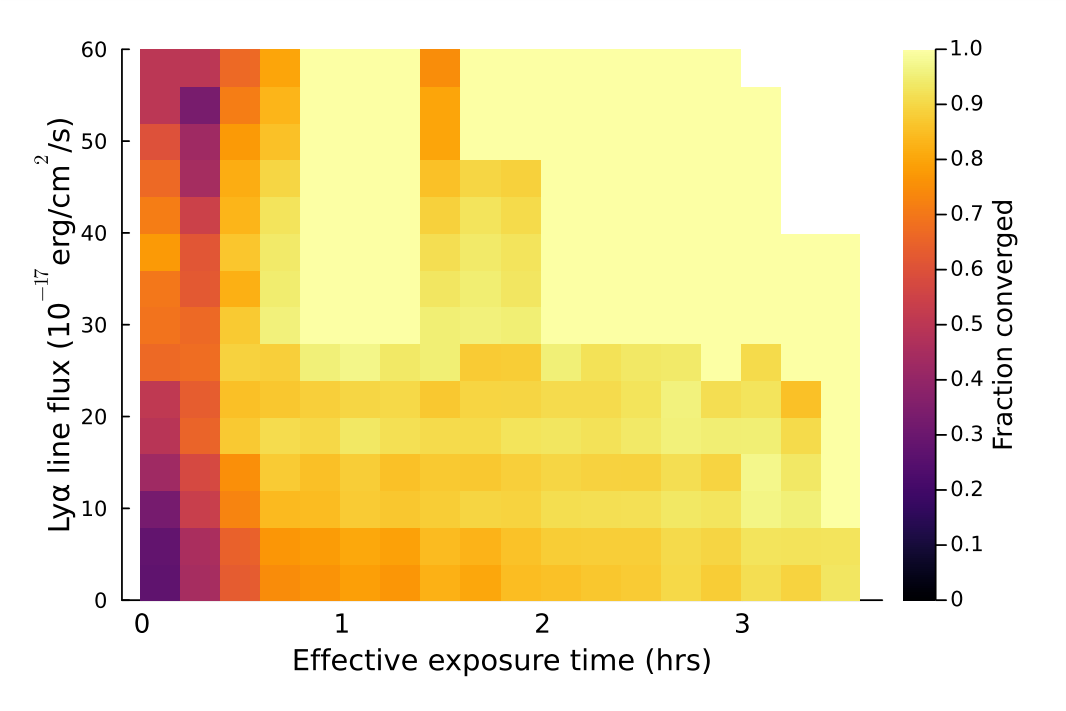
This requires a data-driven prior, a statistical description of what typical LAE spectra look like, built from real examples rather than assumptions. It’s the same philosophy used to separate the cosmic microwave background (the faint afterglow of the Big Bang) from foreground emissions in all-sky maps, now applied at the scale of individual galaxy spectra.
The team built their prior from visually inspected spectra collected by the Dark Energy Spectroscopic Instrument (DESI), a spectrograph at Kitt Peak Observatory in Arizona capable of observing 5,000 galaxies simultaneously. From confirmed LAEs, they constructed a principal component analysis (PCA) basis: a compact set of the most common spectral shapes that can reconstruct any individual galaxy’s spectrum without overfitting. Sky residuals get their own PCA basis, derived from blank sky regions observed alongside the galaxies.
For each candidate spectrum, the inference proceeds:
- Evaluate a grid of candidate redshifts
- At each redshift, fit the spectrum as a linear combination of LAE templates + sky residual templates + smooth continuum
- Compute Δχ² (delta chi-squared), the improvement in fit quality when including the LAE component versus excluding it
- The redshift with the highest Δχ² wins
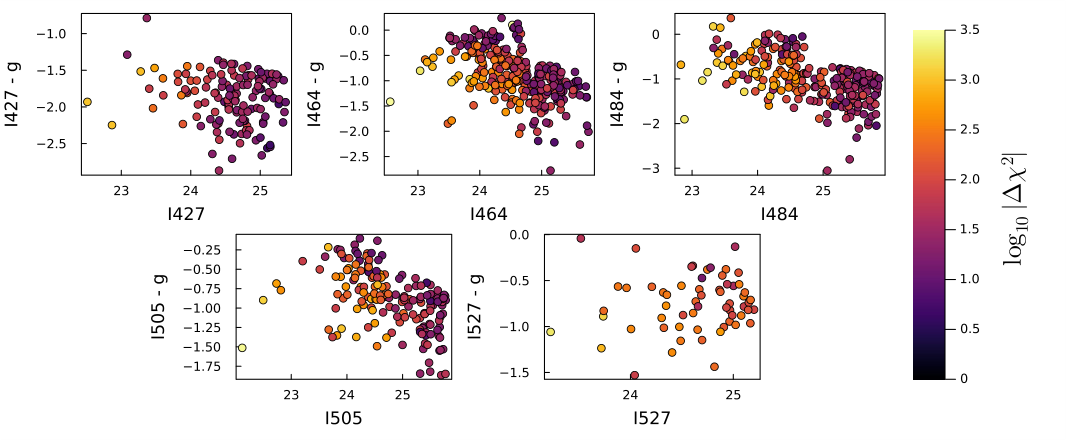
Δχ² does double duty. It identifies the best-fit redshift and it tells you how confident you should be in the result. High Δχ² means a clean detection; low Δχ² flags spectra where sky contamination may be masquerading as a galaxy. The pipeline ranks its own confidence without requiring ad-hoc quality cuts.
Why It Matters
Applied to 910 DESI LAE candidates spanning redshifts z = 2–4 (galaxies whose light has traveled for most of the universe’s 13.8 billion year history), the pipeline achieved greater than 90% redshift accuracy against the gold standard of human visual inspection. That’s good enough for building cosmological catalogs.
The team also showed how the Δχ² metric can guide future survey design. Medium-band photometric filters offer a compromise between survey efficiency and targeting precision: broader than traditional narrow-band filters but narrower than wide-field imaging. Redder filters capture more objects at higher redshift but admit more contaminants. The pipeline’s confidence metric provides a principled way to navigate these tradeoffs, yielding concrete recommendations for DESI-II and next-generation facilities.
What makes this approach work is that it doesn’t try to outsmart the sky. It builds a better model of it. By treating sky residuals as structured signal with its own PCA basis rather than featureless noise, the pipeline avoids the systematic errors that plague simpler subtraction methods. The same philosophy applies to other spectroscopic surveys and other emission-line galaxy populations.
Upcoming surveys (DESI’s extended campaigns, the Subaru Prime Focus Spectrograph, eventually the Extremely Large Telescope) will collect tens of thousands of LAE spectra. Automated, reliable redshift determination at scale isn’t optional for that volume of data. A pipeline that hits 90%+ accuracy while quantifying its own uncertainty and informing photometric targeting strategy is exactly the kind of tool these surveys need.
Bottom Line: A Harvard-led team has built a Bayesian pipeline that automatically determines redshifts for distant Lyman Alpha Emitter galaxies observed by DESI with >90% accuracy, by modeling sky contamination as a component to fit rather than noise to remove, directly enabling the scalable LAE surveys needed to probe the universe’s first billion years.
IAIFI Research Highlights

This work combines Bayesian inference, principal component analysis, and observational spectroscopy to solve a core data analysis challenge in cosmology. It demonstrates how statistical methods drawn from machine learning can directly advance fundamental astrophysics.

Data-driven priors built from expert-labeled examples enable accurate automated classification even when signal and contaminant are spectrally similar. That principle transfers well beyond astronomy to scientific machine learning problems where contamination overlaps with the target signal.

By enabling scalable, accurate redshift determination for LAEs at z = 2–4, the method opens the door to population-level constraints on reionization history and the large-scale structure of the early universe from DESI data.
The pipeline's survey design recommendations position it as a planning tool for DESI-II and next-generation spectroscopic facilities; the full analysis is available at [arXiv:2504.06870](https://arxiv.org/abs/2504.06870).