

Building an AI-native Research Ecosystem for Experimental Particle Physics: A Community Vision
Authors
Thea Klaeboe Aarrestad, Alaa Abdelhamid, Haider Abidi, Jahred Adelman, Jennifer Adelman-McCarthy, Shuchin Aeron, Garvita Agarwal, Usman Ali, Cristiano Alpigiani, Omar Alterkait, Mohamed Aly, Oz Amram, Saeed Ansari Fard, Aram Apyan, John Arrington, Marvin Ascencio-Sosa, Mohammad Atif, Aneesha Avasthi, Muhammad Bilal Azam, Bhim Bam, Joshua Barrow, Rainer Bartoldus, Amit Bashyal, Aashwin Basnet, Ayse Bat, Lothar A. T. Bauerdick, John Beacom, Chris Bee, Michael Begel, Matthew Bellis, Rene Bellwied, Rakitha Beminiwattha, Gabriele Benelli, Douglas Benjamin, Catrin Bernius, Binod Bhandari, Avinay Bhat, Meghna Bhattacharya, Saptaparna Bhattacharya, Prajita Bhattarai, Sudip Bhattarai, Wahid Bhimji, Jianming Bian, Burak Bilki, Mary Bishai, Kevin Black, Kenneth Bloom, Brian Bockelman, Johan Sebastian Bonilla Castro, Tulika Bose, Nilay Bostan, Othmane Bouhali, Dimitri Bourilkov, Dominic Brailsford, Gustaaf Brooijmans, Elizabeth Brost, Maria Brigida Brunetti, Quentin Buat, Brendon Bullard, Jackson Burzynski, Paolo Calafiura, Rodolfo Capdevilla, Fabian Andres Castaño Usuga, Raquel Castillo Fernandez, Fabio Catalano, Viviana Cavaliere, Flavio Cavanna, Giuseppe Cerati, Aidan Chambers, Maria Chamizo-Llatas, Philip Chang, Andrew Chappell, Arghya Chattopadhyay, Sergei Chekanov, Jian-ping Chen, Yi Chen, Zhengyang Chen, J. Taylor Childers, Hector Chinchay, Yuan-Tang Chou, Tasnuva Chowdhury, Neil Christensen, Wonyong Chung, Rafael Coelho Lopes de Sa, Simon Corrodi, Kyle Cranmer, Matteo Cremonesi, Roy Cruz, Mate Csanad, Mariarosaria D'Alfonso, Carlo Dallapiccola, Daine Danielson, Sridhara Dasu, Gavin Davies, Kaushik De, Patrick de Perio, Klaus Dehmelt, Marco Del Tutto, Carlos Ruben Dell'Aquila, Sarah Demers, Paolo Desiati, Bhesha Devkota, Sparshita Dey, Ranjan Dharmapalan, Karri Folan Di Petrillo, Markus Diefenthaler, Jeff Dillon, Zelimir Djurcic, Caterina Doglioni, Francois Drielsma, Edmond Dukes, Irene Dutta, Peter Elmer, Johannes Elmsheuser, Victor Daniel Elvira, Harold Evans, Peter Fackeldey, Cristiano Fanelli, Hao Fang, Mattia Fani, Muhammad Farooq, Matthew Feickert, Ian Fisk, Sam Foreman, Alexander Friedland, Nuwan Chaminda G. W., Louis-Guillaume Gagnon, Massimiliano Galli, Abhijith Gandrakota, Sudeshna Ganguly, Arianna Garcia Caffaro, Rob Gardner, Rocky Bala Garg, Lino Gerlach, Aishik Ghosh, Romulus Godang, Julia Gonski, Loukas Gouskos, Richard Gran, Heather Gray, Andrei Gritsan, Gaia Grosso, Craig Group, Jiawei Guo, Shubham Gupta, Gajendra Gurung, Phillip Gutierrez, Oliver Gutsche, Tyler Hague, Joseph Haley, Eva Halkiadakis, Francis Halzen, Michael Hance, Philip Harris, Harry Hausner, Karsten Heeger, Lukas Heinrich, Alexander Held, Matthew Herndon, Ken Herner, Max Herrmann, David Hertzog, Christian Herwig, Aaron Higuera, Alexander Himmel, Timothy Hobbs, Stefan Hoeche, Tova Holmes, Tae Min Hong, Ben Hooberman, Walter Hopkins, Jessica N. Howard, Shih-Chieh Hsu, Fengping Hu, Patrick Huber, Dirk Hufnagel, Daniel Humphreys, Ia Iashvili, Joseph Incandela, Josh Isaacson, Wasikul Islam, Kirill Ivanov, Wooyoung Jang, Naomi Jarvis, Brij Kishor Jashal, Pratik Jawahar, Dulitha Jayakodige, Torri Jeske, Sergo Jindariani, Jay Hyun Jo, Bhishm Shankar Joshi, Xiangyang Ju, Andreas Jung, Thomas Junk, Michael Kagan, Daisy Kalra, Matthias Kaminski, Edward Karavakis, Stefan Katsarov, Stergios Kazakos, Paul King, Michael Kirby, Max Knobbe, Young Ju Ko, Dmitry Kondratyev, Rostislav Konoplich, Charis Koraka, Scott Kravitz, Lukas Kretschmann, Brandon Kriesten, Georgios K Krintiras, Iason Krommydas, Michelle Kuchera, Audrey Kvam, Martin Kwok, Theodota Lagouri, Sabine Lammers, Eric Lancon, Greg Landsberg, David Lange, Kevin Lannon, Joseph Lau, Luca Lavezzo, Benjamin Lawrence-Sanderson, Duc-Truyen Le, Matt LeBlanc, Sung-Won Lee, Trevin Lee, Charles Leggett, Kayla Leonard DeHolton, James Letts, Hao Li, Haoyang Li, Aklima Khanam Lima, Guilherme Lima, Mia Liu, Qibin Liu, Yinrui Liu, Zhen Liu, Shivani Lomte, Guillermo Loustau de Linares, Lu Lu, Pietro Lugato, Adam Lyon, Yang Ma, Christopher Madrid, Akhtar Mahmood, Kendall Mahn, Devin Mahon, Akshay Malige, Sudhir Malik, Abhishikth Mallampalli, Yurii Maravin, Ralph Marinaro, Pete Markowitz, Matthew Maroun, Kyla Martinez, Verena Ingrid Martinez Outschoorn, Sanjit Masanam, Mario Masciovecchio, Konstantin Matchev, Malek Mazouz, Simone Mazza, Thomas McCauley, Shawn McKee, Karim Mehrabi, Poonam Mehta, Andrew Melo, Mark Messier, Elias Mettner, Christopher Meyer, Jessie Micallef, Sophie Middleton, David W. Miller, Hamlet Mkrtchyan, Abdollah Mohammadi, Abhinav Mohan, Ajit Mohapatra, Farouk Mokhtar, Peter Monaghan, Claudio Silverio Montanari, Michael Mooney, Casey Morean, Eric Moreno, Alexander Moreno Briceño, Stephen Mrenna, Justin Mueller, Daniel Murnane, Benjamin Nachman, Emilio Nanni, Nitish Nayak, Miquel Nebot-Guinot, Orgho Neogi, Chris Neu, Mark Neubauer, Norbert Neumeister, Harvey Newman, Duong Nguyen, Gavin Niendorf, Paul Nilsson, Scarlet Norberg, Andrzej Novak, Sungbin Oh, Isabel Ojalvo, Olaiya Olokunboyo, Yasar Onel, Joseph Osborn, Ianna Osborne, Arantza Oyanguren, Nurcan Ozturk, Paul Padley, Simone Pagan Griso, Pritam Palit, Bishnu Pandey, Vishvas Pandey, Zisis Papandreou, Ganesh Parida, Ki Ryeong Park, Ajib Paudel, Manfred Paulini, Christoph Paus, Gregory Pawloski, Kevin Pedro, Gabriel Perdue, Troels Christian Petersen, Alexey Petrov, Deborah Pinna, Marc-André Pleier, Andrea Pocar, Prafull Purohit, Nived Puthumana Meleppattu, Mateusz Płoskoń, Sitian Qian, Xin Qian, Geting Qin, Aleena Rafique, Srini Rajagopalan, Dylan Rankin, Rebecca Rapp, Salvatore Rappoccio, Rohit Raut, Sagar Regmi, Benedikt Riedel, Andres Rios-Tascon, Stephen Roche, Jenna Roderick, Rimsky Rojas, Dmitry Romanov, Subhojit Roy, Rita Sadek, Dikshant Sagar, Nihar Ranjan Sahoo, Tai Sakuma, Juan Pablo Salas, Mayly Sanchez, Jay Sandesara, Alexander Savin, Ryan Schmitz, Kate Scholberg, Henry Schreiner, Reinhard Schwienhorst, Gabriella Sciolla, Saba Sehrish, Seon-Hee, Seo, Elizabeth Sexton-Kennedy, Oksana Shadura, Bijaya Sharma, Varun Sharma, Suyog Shrestha, Ryan Simeon, Jack Simoni, Siddharth Singh, Kim Siyeon, Louise Skinnari, Jinseop Song, Simone Sottocornola, Alexandre Sousa, Sairam Sri Vatsavai, Giordon Stark, Justin Stevens, Tyler Stokes, Nadja Strobbe, Indara Suarez, Manjukrishna Suresh, Andrew Sutton, Holly Szumila-Vance, Vardan Tadevosyan, Anyes Taffard, Buddhiman Tamang, Hirohisa Tanaka, Erdinch Tatar, Abdel Nasser Tawfik, Vikas Teotia, Kazuhiro Terao, Mitanshu Thakore, Jesse Thaler, Ameya Thete, Inar Timiryasov, Anthony Timmins, Andrew Toler, Dat Tran, Nhan Tran, Patrick Tsang, Ho Fung Tsoi, Vakho Tsulaia, Pham Tuan, Christopher Tully, Shengquan Tuo, Richard Tyson, Darren Upton, Hilary Utaegbulam, Zoya Vallari, Peter van Gemmeren, Vassil Vassilev, Nikhilesh Venkatasubramanian, Renzo Vizarreta, Emmanouil Vourliotis, Ilija Vukotic, Carl Vuosalo, Liv Våge, Tammy Walton, Linyan Wan, Biao Wang, Gensheng Wang, Michael Wang, Yuxuan Wang, Gordon Watts, Yingjie Wei, Derek Weitzel, Shawn Westerdale, Andrew White, Leigh Whitehead, Michael Wilking, Mike Williams, Stephane Willocq, Jeffery Winkler, Frank Winklmeier, Holger Witte, Peter Wittich, Douglas Wright, Yongcheng Wu, Yujun Wu, Wei Xie, Fang Xu, Barbara Yaeggy, Zhen Yan, Liang Yang, Wei Yang, Alejandro Yankelevich, Yiheng Ye, Oguzhan Yer, Efe Yigitbasi, Shin-Shan Yu, Jon Zarling, Chao Zhang, Licheng Zhang, Larry Zhao, Junjie Zhu, Jure Zupan
Abstract
Experimental particle physics seeks to understand the universe by probing its fundamental particles and forces and exploring how they govern the large-scale processes that shape cosmic evolution. This whitepaper presents a vision for how Artificial Intelligence (AI) can accelerate discovery in this field. We outline grand challenges that must be addressed to enable transformative breakthroughs and describe how current and planned experimental facilities can implement this vision to advance our understanding of the vast and complex physical world from the smallest to the largest scales. We show how facilities currently under construction, such as the HL-LHC, DUNE and soon EIC, can both benefit from and serve as proving grounds for this vision, while also enabling a longer-term goal for how future experiments -- like FCC-ee at CERN, IceCube-Gen2, a Muon Collider in the U.S., and smaller to mid-scale projects -- can be fully AI-native. We describe how a truly national-scale collaboration, jointly managed across large funding partners, and involving both DOE laboratories and universities, can make this happen.
Concepts
The Big Picture
Imagine assembling a jigsaw puzzle with a trillion pieces, blindfolded, with millions of other people working simultaneously across three continents. That’s roughly what experimental particle physicists face every day. The Large Hadron Collider, a 17-mile ring buried beneath the Swiss-French border, produces 40 million particle collisions per second. Each collision generates a torrent of sensor readings that must be filtered, processed, and analyzed before any new physics can emerge. The scale is already enormous, and it’s about to get much larger.
A new community whitepaper, authored by more than 500 physicists from dozens of institutions, argues that the field is at a crossroads. The experiments coming online over the next decade, including the High-Luminosity LHC (an upgraded accelerator that will collide particles far more frequently), the Deep Underground Neutrino Experiment (DUNE), and the Electron-Ion Collider (EIC), will generate data volumes that current software and analysis pipelines simply cannot handle. The authors propose a direct solution: don’t just add AI tools to existing workflows. Redesign the entire research ecosystem as AI-native, where machine learning is woven into every layer, from the moment a detector records a collision to the final published result, rather than bolted on as an afterthought.
The whitepaper lays out a concrete, nationally coordinated vision for how to make that transformation happen and why the physics community cannot afford to wait.
Key Insight: The particle physics community must move beyond applying AI as a patchwork of individual tools and instead build future experiments where AI is a foundational design principle.
How It Works
The whitepaper organizes its vision around a set of grand challenges: not incremental improvements, but transformative capabilities that would change what’s possible. These include AI-driven real-time event reconstruction, autonomous experiment control, and end-to-end differentiable analysis pipelines where every step, from raw detector hits to publishable results, is trainable.
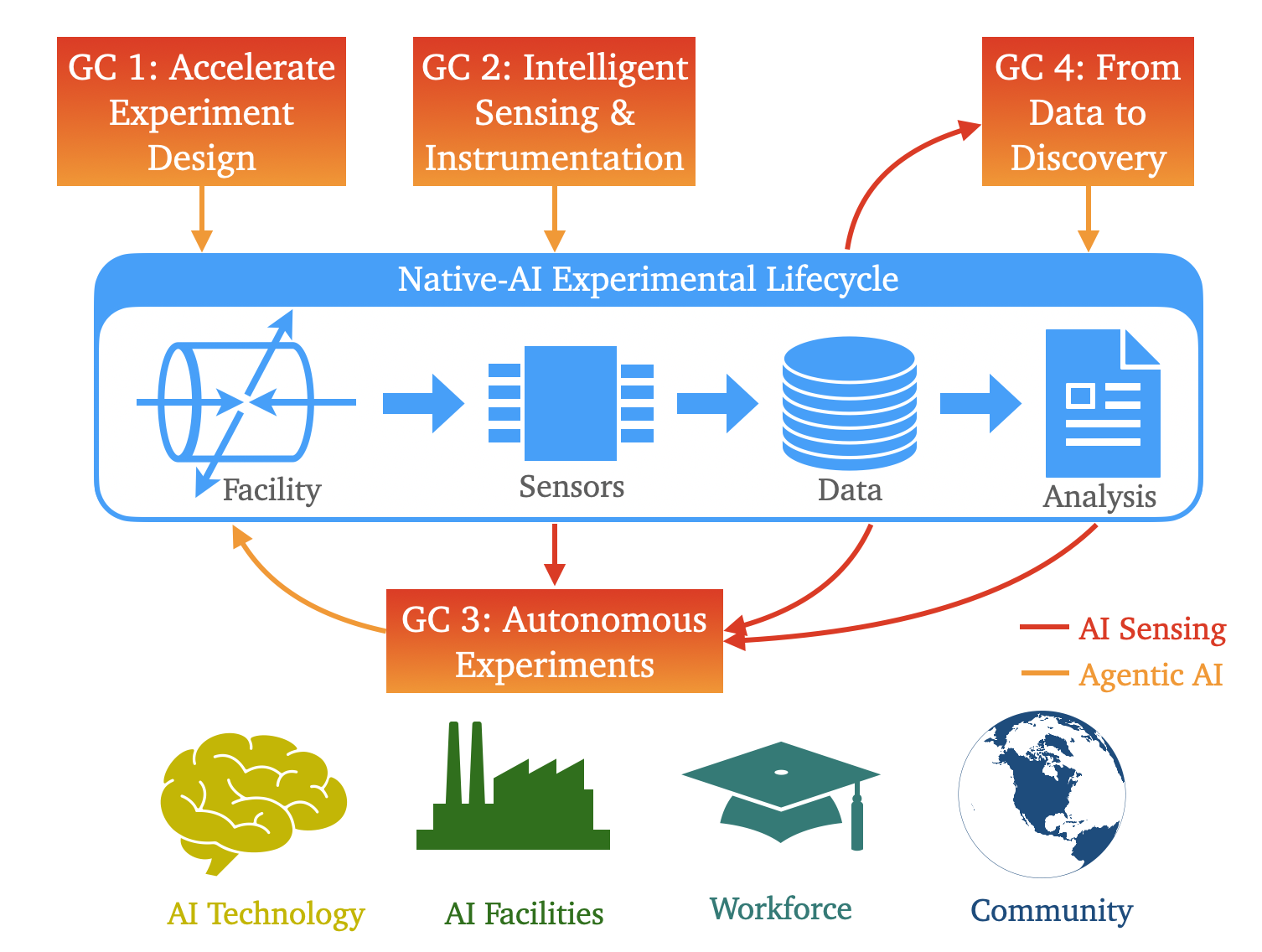
Current experiments already use AI, but in isolated pockets. A neural network might flag interesting collision events at the trigger stage (the automated filter that decides in real time which collisions are worth recording at all), while a separate model reconstructs particle tracks and yet another performs signal-background separation. Each tool was developed independently, trained on different datasets, maintained by different groups. The whitepaper argues this fragmentation leaves enormous potential on the table.
The AI-native vision changes the architecture in several concrete ways:
- Foundation models for physics: Large pretrained models, analogous to language models like GPT but trained on simulated detector data, would act as universal backbones that can be adapted for specific reconstruction tasks across different experiments.
- Real-time AI inference: Neural networks deployed directly on FPGAs (field-programmable gate arrays, essentially reconfigurable microchips) at the trigger stage, enabling sub-microsecond decisions about which events to keep.
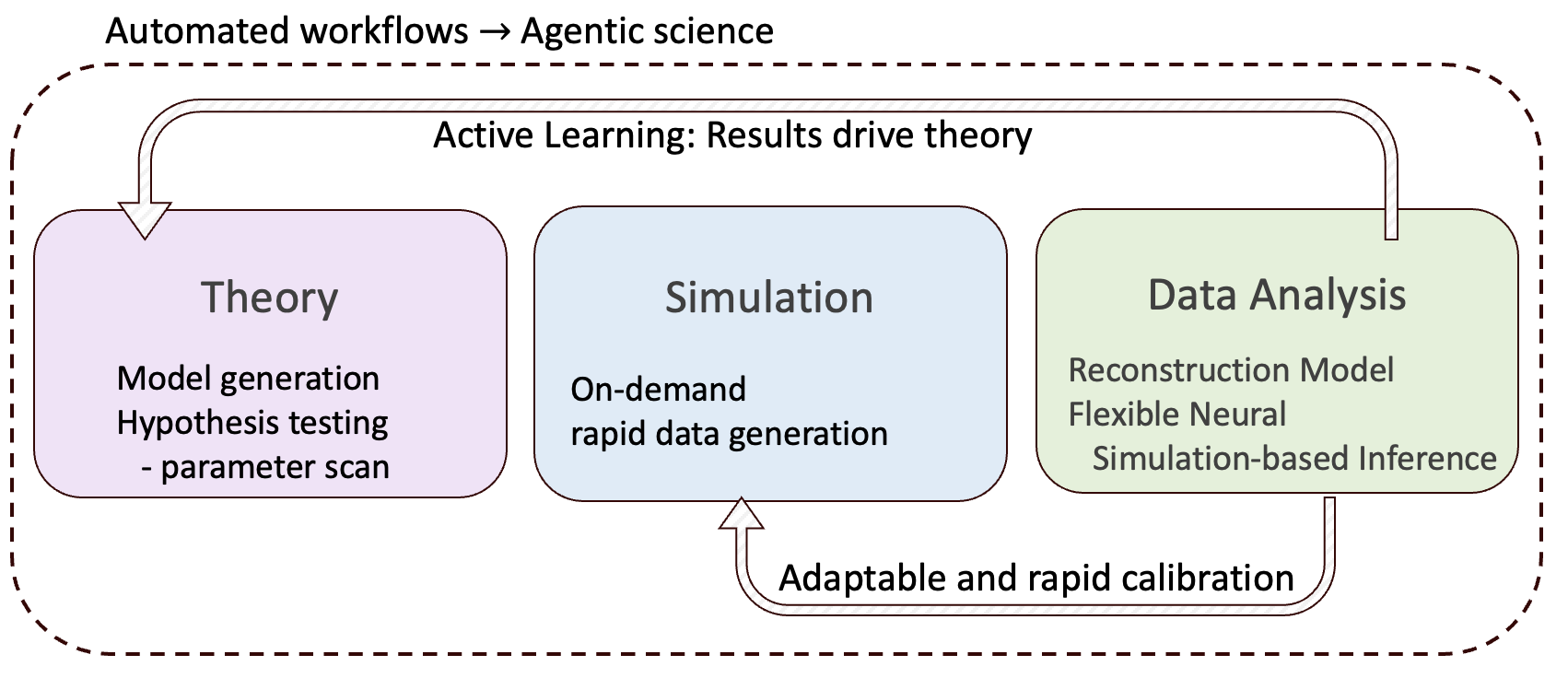
- Differentiable simulation: Detector simulations built so that every computational step is mathematically connected, allowing analysis methods to be optimized across the entire pipeline from start to finish.
- Autonomous experimental control: AI agents that monitor detector performance, identify problems, and adjust operating conditions without constant human intervention.
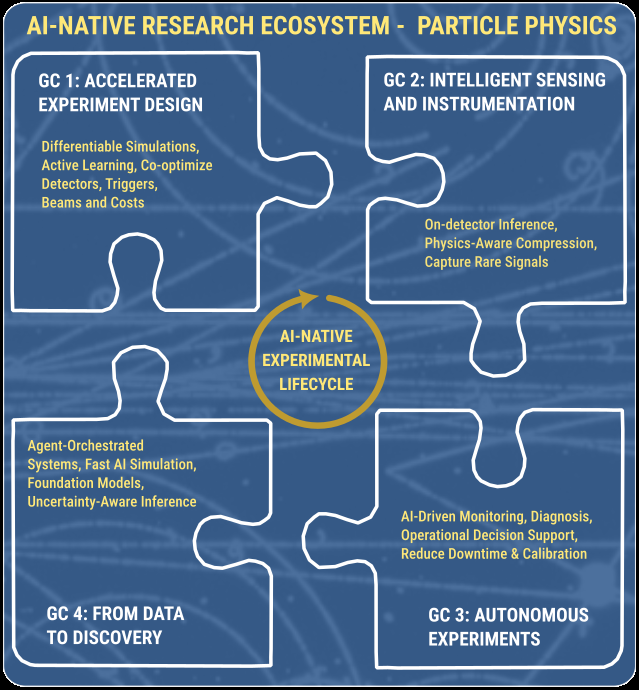
Near-term experiments like the HL-LHC and DUNE would be proving grounds, testbeds where these concepts can be validated before being built into the architecture of future facilities like FCC-ee (a proposed next-generation collider in Europe) and a potential Muon Collider.
The authors identify national computing infrastructure as a major bottleneck. The vision requires not just better algorithms but a fundamentally different relationship between physics software, hardware accelerators, and distributed computing. Training large physics foundation models demands GPU clusters at a scale no single university group or national laboratory currently maintains for physics research.
The proposed governance structure matches this ambition: a national-scale collaboration, jointly managed across Department of Energy laboratories and universities, with dedicated teams for shared infrastructure, training, and software maintenance. The authors draw lessons from established frameworks like CMSSW and Gaudi, shared codebases that hundreds of physicists contribute to and maintain. Centralized infrastructure with distributed contributions, they argue, is the model that scales.
Why It Matters
The urgency here is real. The HL-LHC, scheduled to begin operations later this decade, will increase the LHC’s collision rate by a factor of five to seven. DUNE, currently being excavated in South Dakota, will detect neutrinos traveling 1,300 kilometers from Fermilab, particles that could reveal why matter dominates over antimatter in the universe. The EIC, planned for Brookhaven National Laboratory, will probe the internal structure of protons and nuclei with unprecedented precision. All of these experiments will drown in their own data unless software infrastructure keeps pace.
The benefits also extend well past particle physics. Techniques developed for real-time FPGA inference, physics foundation models, and differentiable simulation apply broadly across science. Particle physics can absorb advances from the broader AI community while contributing techniques back: large-scale scientific datasets with known underlying physics offer unusually clean training environments that could advance machine learning more generally.
There’s an access question too. An AI-native ecosystem built on shared, open infrastructure could make it easier for smaller universities and institutions to participate meaningfully in large experiments, rather than concentrating analysis capability at a handful of well-resourced labs.
Bottom Line: The particle physics community has a narrow window to redesign its research ecosystem around AI before the next generation of experiments comes online. The discoveries hiding in those experiments may depend on whether that redesign succeeds.
IAIFI Research Highlights
Interdisciplinary Research Achievement: This whitepaper marks a major convergence of experimental particle physics and modern AI, laying out how foundation models, differentiable programming, and autonomous systems must be co-designed with detector hardware and analysis workflows rather than applied after the fact.
Impact on Artificial Intelligence: The vision calls for physics-specific foundation models and real-time neural inference on FPGAs, advancing AI deployment in resource-constrained, high-throughput scientific environments while contributing broadly applicable techniques back to the ML community.
Impact on Fundamental Interactions: By enabling AI-native experiment design for HL-LHC, DUNE, and future facilities like FCC-ee and IceCube-Gen2, this framework could open the door to discoveries in neutrino physics, Higgs boson properties, and the matter-antimatter asymmetry that current software limitations might otherwise leave buried in the data.
Outlook and References: The roadmap targets near-term demonstrations at HL-LHC and DUNE before scaling to fully AI-native future experiments; the full community vision is available as a whitepaper endorsed by the APS Division of Particles and Fields Coordinating Panel for Software and Computing (arXiv:2602.17582).