

Constraining the Time of Gravitational Wave Emission from Core-Collapse Supernovae
Authors
Kiranjyot Gill, Griffin Hosseinzadeh, Edo Berger, Michele Zanolin, Marek Szczepanczyk
Abstract
The advent of sensitive gravitational wave (GW) detectors, coupled with wide-field, high cadence optical time-domain surveys, raises the possibility of the first joint GW-electromagnetic (EM) detections of core-collapse supernovae (CCSNe). For targeted searches of GWs from CCSNe optical observations can be used to increase the sensitivity of the search by restricting the relevant time interval, defined here as the GW search window (GSW). The extent of the GSW is a critical factor in determining the achievable false alarm probability (FAP) for a triggered CCSN search. The ability to constrain the GSW from optical observations depends on how early a CCSN is detected, as well as the ability to model the early optical emission. Here we present several approaches to constrain the GSW, ranging in complexity from model-independent analytical fits of the early light curve, model-dependent fits of the rising or entire light curve, and a new data-driven approach using existing well-sampled CCSN light curves from {\it Kepler} and the Transiting Exoplanet Survey Satellite (TESS). We use these approaches to determine the time of core-collapse and its associated uncertainty (i.e., the GSW). We apply our methods to two Type II SNe that occurred during LIGO/Virgo Observing Run 3: SN\,2019fcn and SN\,2019ejj (both in the same galaxy at $d=15.7$ Mpc). Our approach shortens the duration of the GSW and improves the robustness of the GSW compared to techniques used in past GW CCSN searches.
Concepts
The Big Picture
Imagine searching for a needle in a haystack without knowing when it was dropped in. Now imagine you could narrow your search to just a few seconds when someone walked past. That’s the challenge facing gravitational wave hunters when a massive star dies.
When a star more than eight times the mass of our Sun reaches the end of its life, its core collapses in a fraction of a second. The result is a supernova, one of the most energetic explosions in the universe. That implosion should also send ripples through spacetime: gravitational waves (GWs), distortions that travel outward at the speed of light. But unlike the clean signals from merging black holes that LIGO (the Laser Interferometer Gravitational-Wave Observatory) detected in 2015, supernova gravitational waves are messy, faint, and unpredictable. Detectors can’t just match them against a known waveform template.
Detecting them means sifting through noise across a time window. The wider that window, the harder it gets to tell a real signal from a random blip.
A team led by Kiranjyot Gill at the Center for Astrophysics at Harvard & Smithsonian has developed a suite of methods to tackle this, using the supernova’s own light to pin down when its core collapsed.
Key Insight: By carefully modeling the earliest optical light from a supernova, researchers can shrink the gravitational wave search window from weeks down to hours, substantially boosting the chances of a confirmed detection.
How It Works
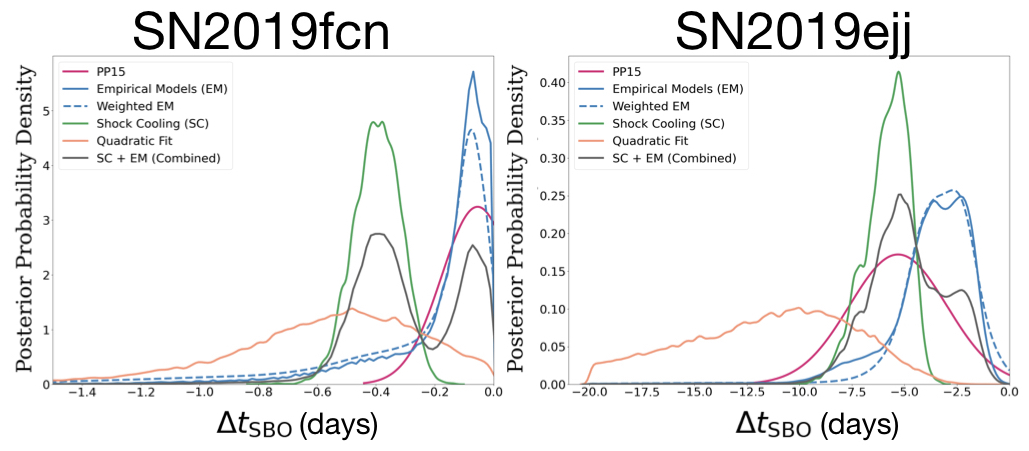
While you can’t directly observe the core collapse, you can watch for the first flash of light that escapes the dying star. This first light, called shock breakout (SBO), occurs when the shockwave from the collapsing core plows through the star’s outer layers and erupts from the surface. The delay between core collapse and shock breakout is calculable from physics simulations (typically a few hours), so pinning down when shock breakout happened lets you trace back to when gravitational waves were emitted.
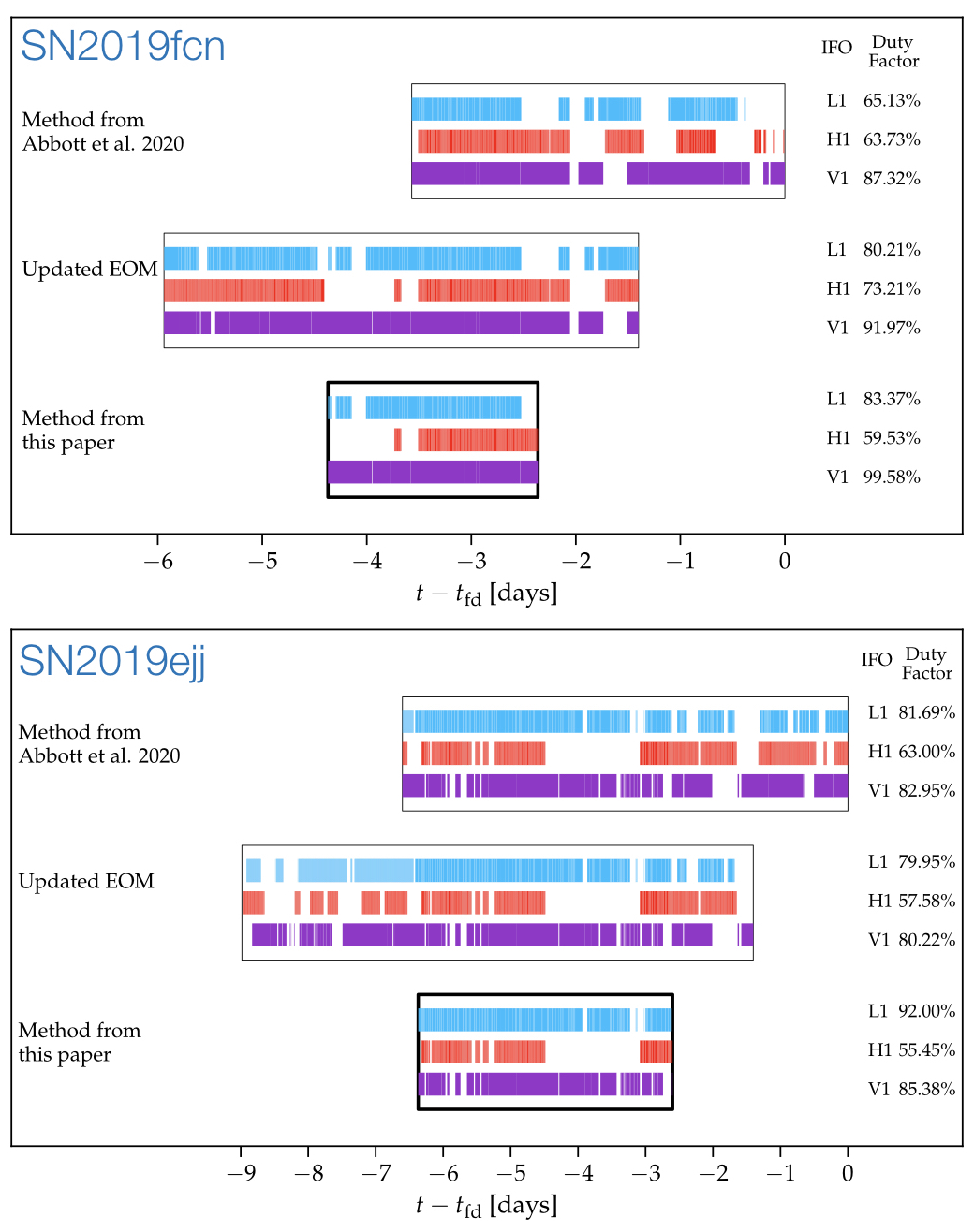
The team presents four methods for constraining the gravitational wave search window (GSW), the time interval during which detectors must hunt for a signal. A narrower window means fewer false alarms.
- Power-law fits — A model-independent approach (no assumptions about the star’s internal structure) that fits the early rising light curve (brightness over time) to a simple mathematical function.
- Shock cooling emission model — A physics-based fit modeling how expanding, cooling shocked gas produces light. More assumptions, but potentially tighter constraints.
- Full light curve modeling — Fitting the entire observed light curve to detailed explosion models, squeezing out every bit of timing information.
- Template matching with Kepler/TESS data — A data-driven approach using ultra-high-cadence observations from space telescopes that have caught supernovae in the act, serving as timing templates for the critical early hours.
That fourth method is particularly clever. The Kepler space telescope and the Transiting Exoplanet Survey Satellite (TESS) were designed to stare at the same patches of sky for months, hunting for tiny dips in starlight caused by orbiting planets. As a side effect, they’ve caught several supernovae in unprecedented detail, including the very first moments of shock breakout. The team repurposes these observations as a library of supernova timing templates, anchoring new detections to well-characterized examples.
The researchers tested all four approaches on two real supernovae: SN 2019fcn and SN 2019ejj. Both are Type II supernovae, produced when massive stars with hydrogen-rich outer layers explode. They went off within days of each other in the same galaxy, ESO 430-G 020, roughly 51 million light-years away. Both occurred during LIGO/Virgo Observing Run 3, a coordinated detection campaign run jointly by the LIGO detectors in the United States and the Virgo detector in Italy, making them genuine candidates for a joint gravitational wave and optical search. SN 2019fcn was caught just 21.7 hours after explosion by the Las Cumbres Observatory’s global telescope network, serendipitously, because it exploded in a galaxy astronomers were already watching.
Why It Matters
The false alarm probability (FAP), the chance that a random noise fluctuation mimics a real signal, scales directly with how long you have to look. A search spanning two weeks might produce hundreds of noise fluctuations that resemble a signal. A search spanning 12 hours might produce just one. The methods developed here can compress the search window by a factor of ten or more compared to older techniques, a major improvement in statistical confidence.
There’s a deeper physics payoff too. Gravitational waves from a collapsing stellar core encode information that no light-based telescope can access: the degree of asymmetry in the explosion, how much angular momentum the core carries, whether turbulent convective flows or oscillations in the shock front shaped the collapse.
The optical and gravitational wave signals are complementary, each revealing a different face of the same catastrophe. But you can only read those stories together if you know when to listen.
With next-generation detectors like Einstein Telescope and Cosmic Explorer in development, and wide-field surveys like the Vera Rubin Observatory’s LSST set to catch supernovae within minutes of explosion, these methods will grow more powerful. The pipeline from optical detection to gravitational wave search window is being built now, in anticipation of a universe that’s about to become much louder.
Bottom Line: By using a supernova’s own light as a clock, researchers have shown they can shrink the gravitational wave search window from weeks to hours, improving the odds that LIGO and Virgo will one day catch gravitational waves from a collapsing stellar core.
IAIFI Research Highlights

This work connects gravitational wave physics and optical astronomy by developing a systematic framework that converts photometric observations into precise timing constraints for GW searches, uniting two entirely different observational windows on the same explosive event.

The data-driven template-matching approach draws on machine-learning-adjacent methodology, using a library of well-characterized Kepler and TESS light curves to classify and time-align new supernovae without relying on physical models.

Constraining the gravitational wave search window directly improves the achievable false alarm probability for core-collapse supernova searches, bringing the first joint GW-optical detection of a stellar death within reach of current detectors for nearby events.
Future applications to Rubin Observatory detections and next-generation GW detectors could extend this method to supernovae caught within minutes of explosion, strengthening multi-messenger astronomy of stellar core collapse; see [arXiv:2201.03609](https://arxiv.org/abs/2201.03609).
Original Paper Details
Constraining the Time of Gravitational Wave Emission from Core-Collapse Supernovae
[2201.03609](https://arxiv.org/abs/2201.03609)
["Kiranjyot Gill", "Griffin Hosseinzadeh", "Edo Berger", "Michele Zanolin", "Marek Szczepanczyk"]
The advent of sensitive gravitational wave (GW) detectors, coupled with wide-field, high cadence optical time-domain surveys, raises the possibility of the first joint GW-electromagnetic (EM) detections of core-collapse supernovae (CCSNe). For targeted searches of GWs from CCSNe optical observations can be used to increase the sensitivity of the search by restricting the relevant time interval, defined here as the GW search window (GSW). The extent of the GSW is a critical factor in determining the achievable false alarm probability (FAP) for a triggered CCSN search. The ability to constrain the GSW from optical observations depends on how early a CCSN is detected, as well as the ability to model the early optical emission. Here we present several approaches to constrain the GSW, ranging in complexity from model-independent analytical fits of the early light curve, model-dependent fits of the rising or entire light curve, and a new data-driven approach using existing well-sampled CCSN light curves from {\it Kepler} and the Transiting Exoplanet Survey Satellite (TESS). We use these approaches to determine the time of core-collapse and its associated uncertainty (i.e., the GSW). We apply our methods to two Type II SNe that occurred during LIGO/Virgo Observing Run 3: SN\,2019fcn and SN\,2019ejj (both in the same galaxy at $d=15.7$ Mpc). Our approach shortens the duration of the GSW and improves the robustness of the GSW compared to techniques used in past GW CCSN searches.