

Constraint of pionless EFT using two-nucleon spectra from lattice QCD
Authors
William Detmold, Fernando Romero-López, Phiala E. Shanahan
Abstract
Finite-volume pionless effective field theory (FVEFT$_{ π\!/ }$) at next-to-leading order (NLO) is used to analyze the two-nucleon lattice QCD spectrum of Ref.~\cite{Amarasinghe:2021lqa}, performed at quark masses corresponding to a pion mass of approximately $800 $ MeV. Specifically, the effective theory is formulated in finite volume, and variational sets of wave functions are optimized using differential programming. Using these wave functions projected to the appropriate finite-volume symmetry group, variational bounds from FVEFT$_{π\!/ }$ are obtained for the ground state, as well as excited states. By comparison with the lattice QCD GEVP spectrum, different low energy constants (LECs) are constrained. Relativistic corrections are incorporated, allowing for the extractions of NLO LECs, as well as the leading $s$-$d$-wave mixing term in the deuteron channel.
Concepts
The Big Picture
Imagine trying to understand how a skyscraper stands without being able to study its steel beams directly. You can only watch the building sway in the wind. Nuclear physicists face something analogous every day. Quantum Chromodynamics (QCD) describes the strong nuclear force, which binds quarks into protons and neutrons, then binds those into atomic nuclei. But the math is so ferociously complicated that even calculating how two protons interact from scratch pushes supercomputers to their limits.
One workaround is pionless effective field theory, a simplified description of nuclear forces that sets aside certain short-range particles called pions and focuses on what matters at low energies. Think of it like replacing an intricate gear mechanism with a simple spring: you lose some details, but you gain the ability to actually calculate something useful. The catch is figuring out how stiff that spring should be. You need to determine the fundamental constants that make the theory accurate, and that requires comparing predictions against hard numerical data from full QCD simulations.
A team from MIT’s Center for Theoretical Physics and IAIFI has now built a pipeline for exactly this calibration. They used lattice QCD (a method that simulates the strong force on a discrete grid of space-time points, like pixels in a photograph) together with differential programming, an optimization technique borrowed from machine learning, to pin down nuclear force parameters at next-to-leading order precision.
Key Insight: By directly matching a finite-volume effective theory to lattice QCD energy spectra (including excited states) and optimizing variational wave functions with machine learning tools, the researchers extracted next-to-leading order nuclear force parameters, including s-d wave mixing in the deuteron channel.
How It Works
The starting point is a dataset: a two-nucleon energy spectrum computed in a previous lattice QCD simulation. That simulation used artificially heavy quark masses, corresponding to a pion mass of roughly 800 MeV (about five times the physical value). Heavier quarks make simulations cheaper while still letting you validate the methodology. The spectrum includes ground states, excited states, and states with nonzero total momentum, giving the theory many more data points to fit against.
The researchers formulate finite-volume pionless EFT directly inside the simulation box, matching the same finite, discrete space used by the lattice QCD calculation. This matters. Rather than extrapolating lattice results to infinite volume first and then matching to the EFT, they work entirely within the finite volume at every stage, eliminating a source of systematic uncertainty.
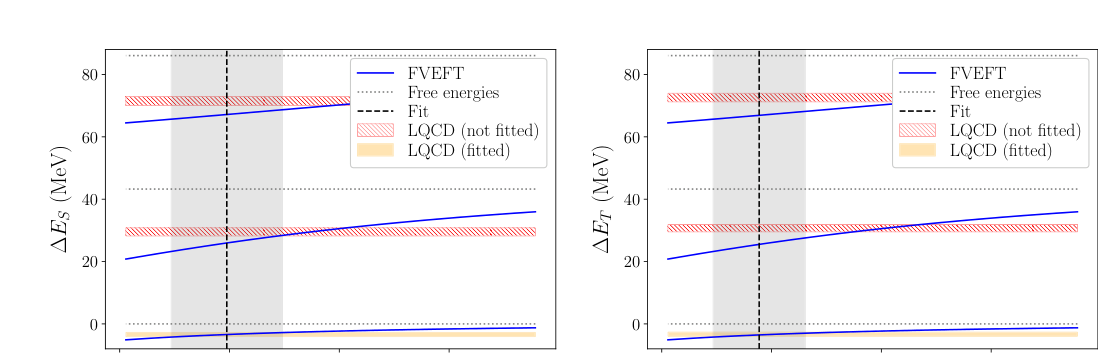
The EFT includes interactions up to next-to-leading order (NLO), going beyond the simplest possible interactions to include terms with two derivatives that capture more subtle distance-dependent effects. Several low energy constants (LECs) must be determined by matching to data:
- Leading-order constants for the deuteron (spin-1 proton-neutron bound state) and dineutron (two-neutron system) channels
- NLO derivative corrections and relativistic corrections to the kinetic energy
- A term controlling s-d wave mixing in the deuteron, a subtle quantum effect where the nucleons carry a small admixture of angular momentum-2
At the heart of the method is a variational approach powered by differential programming. You make an educated guess at the shape of a quantum wave function (the mathematical object describing how likely the particles are to be found in any configuration) and then systematically improve that guess until you reach the lowest possible energy. The team builds trial wave functions from correlated Gaussians, flexible multi-parameter functions that capture complex spatial correlations between the two nucleons. Rather than tuning these by hand, they use automatic differentiation, the same algorithmic backbone as deep learning, to minimize the energy and find optimal wave function parameters for each set of LECs.
The full workflow:
- Start with a candidate set of LECs
- Optimize correlated Gaussian wave functions using differential programming to get variational energy bounds
- Project those wave functions onto the appropriate irreducible representations of the cubic symmetry group (translating them into the limited set of rotations possible within a cube-shaped box)
- Compare the resulting energy levels against the lattice QCD spectrum
- Adjust the LECs until the match is optimized
Fitting simultaneously to ground states, excited states, and multiple symmetry sectors lets the team disentangle effects that would look identical with fewer data points. The excited-state spectrum is particularly valuable here: different NLO operators shift different energy levels in distinct ways, so each LEC can be separately constrained.
Why It Matters
The immediate physics payoff is a set of well-constrained NLO LECs for pionless EFT at these heavy quark masses, including a variational bound on the s-d mixing parameter in the deuteron channel. But the deeper significance is methodological. The finite-volume EFT approach can work as a genuine alternative to the conventional quantization condition formalism, a standard technique that relates energy levels to scattering amplitudes but grows cumbersome for coupled channels and higher partial waves.
The differential programming framework scales, too. As lattice QCD computations inch closer to physical quark masses (where simulations are more expensive but results more directly applicable to real nuclei), the same pipeline could absorb richer lattice spectra, higher-order EFT corrections, and eventually three-nucleon systems. Each calibrated EFT parameter is one more link in the chain from quarks and gluons to the structure of atomic nuclei.
Bottom Line: By pairing lattice QCD spectra with machine-learning-optimized variational wave functions, this work pushes nuclear EFT calibration to next-to-leading order precision and establishes a scalable framework for connecting QCD simulations to nuclear structure.
IAIFI Research Highlights

This work applies differential programming, a tool from machine learning, directly to the calibration of nuclear effective field theory against first-principles QCD data, connecting computational physics and AI methodology in a single pipeline.

The use of automatic differentiation for variational wave-function optimization shows how deep learning infrastructure can accelerate precision calculations in quantum many-body physics, well beyond neural-network-based approaches.

The study extracts next-to-leading order low energy constants and places a variational bound on s-d wave mixing in the two-nucleon system, pushing forward the program of deriving nuclear forces directly from QCD.
Future work will extend this framework to physical pion masses and three-nucleon systems, with the potential to inform nuclear structure calculations across the periodic table; the paper is available at [arXiv:2305.06313](https://arxiv.org/abs/2305.06313).