

Deep Learning for Clouds and Cloud Shadow Segmentation in Methane Satellite and Airborne Imaging Spectroscopy
Authors
Manuel Perez-Carrasco, Maya Nasr, Sebastien Roche, Chris Chan Miller, Zhan Zhang, Core Francisco Park, Eleanor Walker, Cecilia Garraffo, Douglas Finkbeiner, Sasha Ayvazov, Jonathan Franklin, Bingkun Luo, Xiong Liu, Ritesh Gautam, Steven Wofsy
Abstract
Effective cloud and cloud shadow detection is a critical prerequisite for accurate retrieval of concentrations of atmospheric methane (CH4) or other trace gases in hyperspectral remote sensing. This challenge is especially pertinent for MethaneSAT, a satellite mission launched in March 2024, to fill a significant data gap in terms of resolution, precision and swath between coarse-resolution global mappers and fine-scale point-source imagers of methane, and for its airborne companion mission, MethaneAIR. MethaneSAT delivers hyperspectral data at an intermediate spatial resolution (approx. 100 x 400, m), whereas MethaneAIR provides even finer resolution (approx. 25 m), enabling the development of highly detailed maps of concentrations that enable quantification of both the sources and rates of emissions. In this study, we use machine learning methods to address the cloud and cloud shadow detection problem for sensors with these high spatial resolutions. Cloud and cloud shadows in remote sensing data need to be effectively screened out as they bias methane retrievals in remote sensing imagery and impact the quantification of emissions. We deploy and evaluate conventional techniques-including Iterative Logistic Regression (ILR) and Multilayer Perceptron (MLP)-with advanced deep learning architectures, namely U-Net and a Spectral Channel Attention Network (SCAN) method. Our results show that conventional methods struggle with spatial coherence and boundary definition, affecting the detection of clouds and cloud shadows. Deep learning models substantially improve detection quality: U-Net performs best in preserving spatial structure, while SCAN excels at capturing fine boundary details... Our data and code is publicly available at: https://doi.org/10.7910/DVN/IKLZOJ
Concepts
The Big Picture
Imagine trying to photograph a gas leak through a foggy window. The fog doesn’t just obscure the view; it distorts the light, creating false signals that could convince you the leak is somewhere it isn’t. That’s the problem facing satellites that track methane.
Methane packs more than 80 times the warming punch of carbon dioxide over its first two decades in the atmosphere. Cutting methane emissions is one of the fastest levers we have for slowing climate change in the near term, which is why over 150 countries signed the Global Methane Pledge to cut emissions 30% by 2030.
Enforcing that pledge requires knowing exactly where methane is leaking, and in what quantities. That requires satellites. And satellites have a cloud problem.
When clouds or their shadows fall across a methane-sensing instrument, they don’t just block the signal. They corrupt it, introducing false readings that can make clean sky look like a methane hotspot, or vice versa. A team of researchers from Harvard, the Environmental Defense Fund, and the Universidad de Concepción trained deep learning models (AI systems that learn to recognize patterns from labeled examples) to identify and filter out clouds and shadows in data from MethaneSAT and its airborne sibling, MethaneAIR. They hit processing speeds of 4.1 milliseconds per 1,000 km² while outperforming traditional detection methods by a wide margin.
Key Insight: Clouds and cloud shadows don’t just hide methane data; they actively corrupt it. Deep learning can screen them out fast enough for real-world satellite operations, enabling more accurate global emission tracking.
How It Works
MethaneSAT, launched in March 2024, operates at roughly 100 × 400 meters per pixel, covering a 220-kilometer swath. MethaneAIR, its airborne counterpart used for algorithm development and validation, offers finer detail at around 25 meters per pixel. Both instruments capture hyperspectral data, meaning hundreds of narrow wavelength bands across the shortwave infrared, where methane absorbs strongly.
That spectral richness is what makes precise methane retrieval possible. It’s also what makes cloud contamination so insidious: clouds and shadows distort the signal differently across wavelengths, leaving distinct spectral signatures that rule-based detection methods miss.
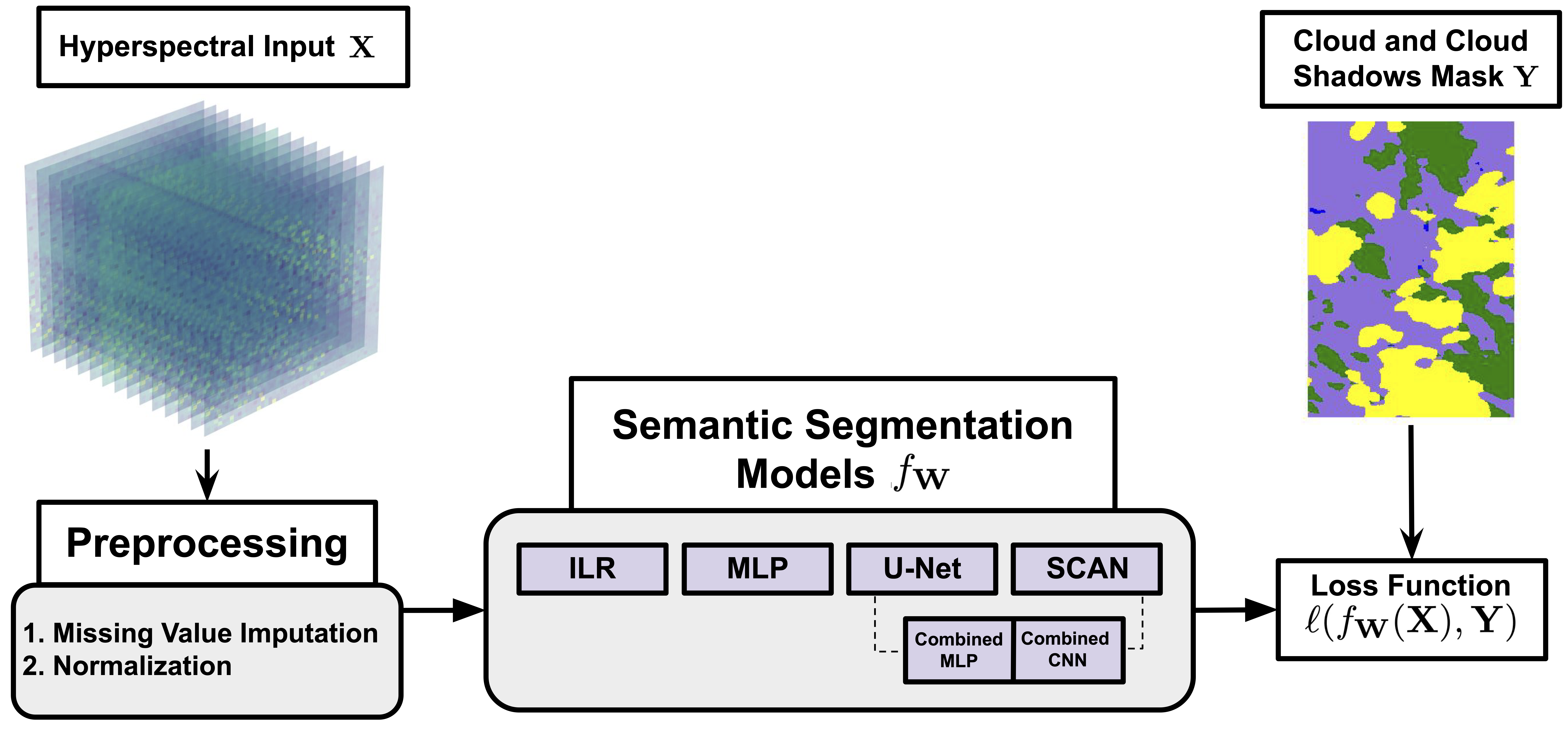
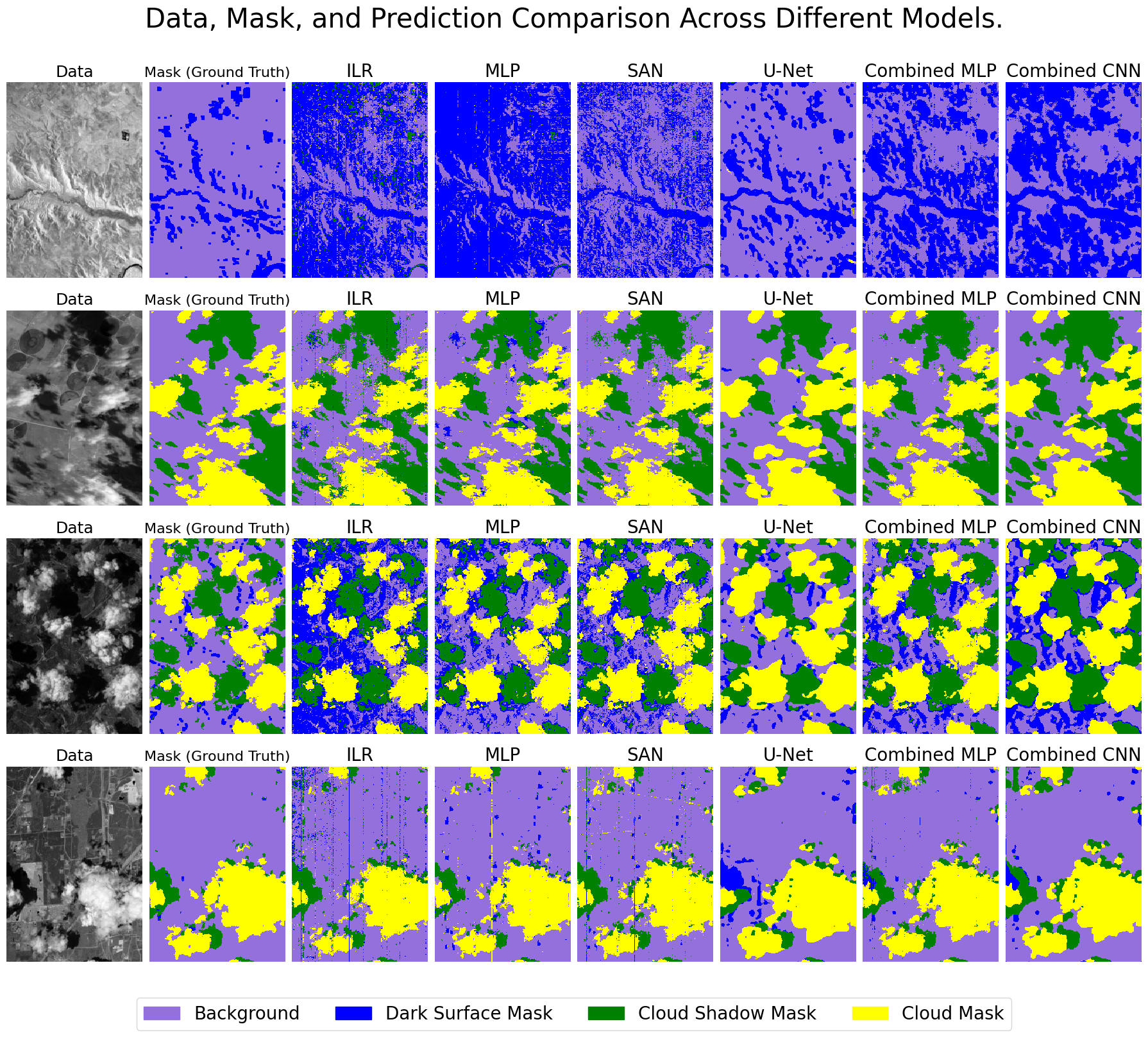
The researchers benchmarked four machine learning approaches. The conventional methods, Iterative Logistic Regression (ILR) and Multilayer Perceptron (MLP), classify pixels one at a time without considering spatial context. These pixel-by-pixel approaches struggle at cloud edges, where the transition is gradual, producing patchy, inconsistent masks.
The deep learning architectures did far better:
- U-Net, a neural network originally developed for medical image segmentation, analyzes full images rather than individual pixels. It passes information down through the network to extract features, then back up to reconstruct spatial detail. The result is clean, coherent masks that respect the physical extent of cloud systems.
- SCAN (Spectral Channel Attention Network) applies attention mechanisms to the spectral dimension, learning which wavelength bands carry the strongest signal for each pixel. Attention lets the model focus on the most informative inputs and downweight the rest. Where U-Net wins on spatial coherence, SCAN wins on boundary sharpness. On MethaneSAT specifically, SCAN actually outperforms U-Net, suggesting that at coarser spatial resolutions, spectral discrimination matters more than spatial reasoning.
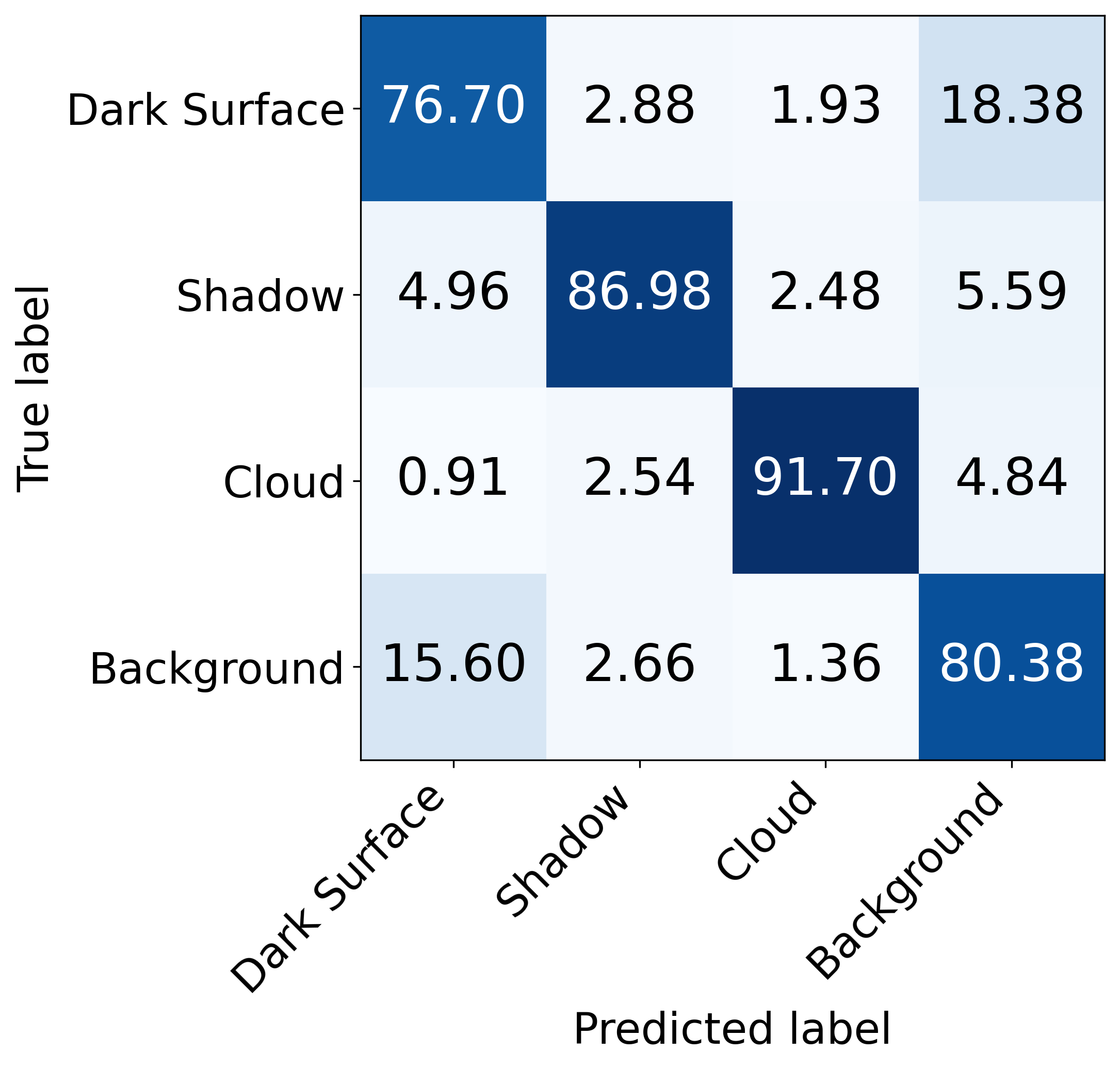
The researchers combined both models using a convolutional ensemble, a small neural network trained to merge U-Net and SCAN predictions. This ensemble achieved the best results on both platforms: an F1 score of 78.50% (±3.08%) on MethaneAIR and 78.80% (±1.28%) on MethaneSAT, where F1 balances catching real clouds against falsely flagging clear sky. That’s improvements of 2% and 10% over conventional methods, respectively. The larger gain on MethaneSAT shows just how much conventional approaches struggled with the satellite’s lower resolution.
Why It Matters
At 4.1 milliseconds per 1,000 square kilometers, this system can keep pace with satellite data volumes without becoming a bottleneck. MethaneSAT covers massive stretches of oil and gas basins and agricultural regions globally, and screening that data for clouds in near-real-time is a prerequisite for everything downstream, from emission maps to regulatory accountability reports.
But the longer-lasting contribution is the finding that different deep learning architectures encode different types of information about hyperspectral scenes. U-Net captures geometry. SCAN captures spectral identity. Combining them recovers signal that neither captures alone. That principle applies well beyond methane: any mission doing gas retrieval from hyperspectral data faces the same cloud contamination problem. The team released their code and labeled datasets publicly, giving the next generation of hyperspectral missions a working foundation to build from.
Bottom Line: By pairing spatial and spectral deep learning architectures in an ensemble, this team cut cloud contamination errors by up to 10% over conventional methods while achieving real-time inference speeds, clearing a major obstacle between satellite methane data and the global emissions accounting that climate pledges demand.
IAIFI Research Highlights

This work takes deep learning architectures from computer vision, originally built for medical image segmentation, and applies them to an atmospheric remote sensing problem with direct climate policy implications. The tools transfer readily across scientific domains.

The study offers a systematic comparison of pixel-wise, fully convolutional, and spectral-attention architectures on hyperspectral segmentation tasks. The central finding: ensembles that combine spatial and spectral inductive biases outperform any single architecture.

Accurate cloud masking is what makes high-quality retrieval of atmospheric methane concentrations possible at all. Without it, satellite data can't be trusted for the emissions accounting that global climate commitments depend on.
Future work could extend these models to additional trace gases and next-generation hyperspectral missions. Data and code are publicly available at https://doi.org/10.7910/DVN/IKLZOJ, and the paper is available at [arXiv:2509.19665](https://arxiv.org/abs/2509.19665), submitted to IEEE Transactions on Geoscience and Remote Sensing.