

Derived Moduli Spaces of Nonlinear PDEs I: Singular Propagations
Authors
Jacob Kryczka, Artan Sheshmani, Shing-Tung Yau
Abstract
We construct a sheaf theoretic and derived geometric machinery to study nonlinear partial differential equations and their singular supports. We establish a notion of derived microlocalization for solution spaces of non-linear equations and develop a formalism to pose and solve singular non-linear Cauchy problems globally. Using this approach we estimate the domains of propagation for the solutions of non-linear systems. It is achieved by exploiting the fact that one may greatly enrich and simplify the study of derived non-linear PDEs over a space $X$ by studying its derived linearization which is a module over the sheaf of functions on the $S^1$-equivariant derived loop stack $\mathcal{L}X$.
Concepts
The Big Picture
Imagine trying to predict where a crack will spread through a sheet of glass. You can see the crack, but the real challenge is the invisible forces at its tip, the singular point where mathematics breaks down. Scale that problem up to the equations governing spacetime, quantum fields, or the geometry of the universe itself, and you arrive at the challenge tackled in a sweeping new paper by Jacob Kryczka, Artan Sheshmani, and Shing-Tung Yau.
Nonlinear partial differential equations (NLPDEs), where outputs feed back into the equation itself, are the native language of physics. Einstein’s field equations, fluid dynamics, the Yang-Mills equations governing particle interactions: all share this character, and all are ferociously hard to solve. The central difficulty isn’t finding solutions. It’s understanding where they break down, where they blow up to infinity, develop sudden jumps, or spread failure in ways that make predictions impossible.
Classical tools handle this reasonably well on smooth, simple geometric spaces. But modern theoretical physics demands more: equations on abstract spaces with sharp corners, holes, and other pathologies. This paper delivers a rigorous framework, rooted in derived algebraic geometry, that tracks exactly how breakdowns propagate, even on geometric backgrounds that would defeat classical methods.
Key Insight: By lifting nonlinear equations into derived geometry and studying them through an associated “loop stack,” the authors reduce brutally hard nonlinear problems to tractable linear ones, without losing any singular, topological, or structural information.
How It Works
Rather than attacking a nonlinear equation head-on, the team embeds it inside a richer geometric object: the derived moduli space of solutions. This is the space of all possible solutions at once, treated as a piece of geometry in its own right. The “derived” part uses homotopy theory (the study of how paths and loops within spaces can be continuously deformed) to track degeneracies and infinitesimal symmetries that ordinary geometry throws away.
The central technical tool is the derived loop stack $\mathcal{L}X$, the space of closed paths in $X$, equipped with a natural $S^1$-rotational symmetry. Functions on $\mathcal{L}X$ give precisely the algebraic structure needed to see a nonlinear PDE’s linearization as a module, making the connection between nonlinear and linear geometry both precise and functorial.
The approach proceeds in stages:
-
Encode the PDE as a derived substack. The nonlinear PDE is realized as a derived closed substack $\mathcal{Y}$ inside an infinite jet bundle. The solution space $\text{RSol}_X(\mathcal{Y})$ becomes a geometric object with a well-defined homotopy type.
-
Impose D-finiteness. The authors introduce D-finiteness, a condition analogous to requiring a vector space to be finite-dimensional, which ensures the existence of a globally dualizable cotangent complex. Without this, the later machinery wouldn’t go through.
-
Linearize around a solution. Given a solution $\phi$, linearizing the derived PDE yields a sheaf $T_{\mathcal{Y}, \phi}$, the tangent complex at $\phi$, encoding how the solution would change under tiny perturbations.
-
Micro-linearize via the Hodge stack. The linearization sheaf lifts to the Hodge stack $X^{\text{Hod}}$, a geometric object that interpolates between two complementary algebraic pictures of the same space. Passing to the associated graded object produces a perfect complex on the cotangent stack $T^*X$. This is the authors’ derived micro-linearization $\mathbf{R}\mu(T{\mathcal{Y}, \phi})$.
-
Read off the characteristic variety. The support of $\mathbf{R}\mu(T{\mathcal{Y}, \phi})$ defines the characteristic variety $\text{Ch}_\phi(\mathcal{Y})$, the locus in $T^*X$ identifying which directions are singular for the PDE at $\phi$. Think of it as a map of danger zones: directions where small disturbances grow rather than smooth out.
The payoff is Theorem A: for D-finitary derived PDEs admitting deformation theory, the linearization sheaf is locally constant in non-characteristic directions. This is the derived, nonlinear analog of the classical result that solutions propagate smoothly away from characteristic directions. It holds on singular, derived, and non-archimedean spaces alike.
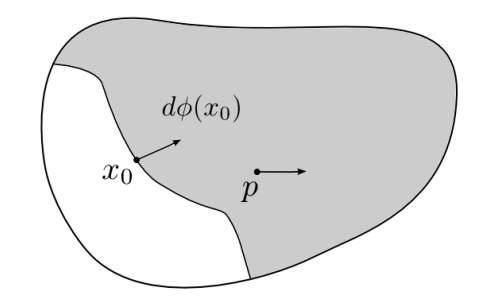
Theorems B and C generalize the classical Cauchy-Kowalevski-Kashiwara theorem to this nonlinear derived setting. If the initial data surface avoids the dangerous directions, the singular nonlinear Cauchy problem is globally well-posed: given appropriate starting conditions, the equation has a unique, globally-controlled solution.
The framework also handles tempered distributions and generalized function spaces, highly irregular objects that don’t form ordinary sheaves. To manage these, the authors use condensed mathematics (developed by Clausen and Scholze), which provides a more flexible notion of continuity suited to these ill-behaved objects.
Why It Matters
In pure mathematics, this is the first systematic derived geometric framework for global propagation of singularities in NLPDEs. It unifies algebraic, analytic, and non-archimedean settings under one framework and opens the door to derived index theory for nonlinear operators, a generalization of the Atiyah-Singer index theorem (the landmark 20th-century result connecting the geometry of a space to the behavior of differential equations on it). The authors flag this as the subject of a companion paper.
For physics, the implications run deep. The equations of quantum gravity, string theory, and topological field theory involve NLPDEs on highly singular or derived geometric backgrounds. Tracking singularity propagation globally is essential for making sense of these theories. The treatment of overconvergent jets and analytic de Rham functors also opens a path toward a homotopical generalization of the Cartan-Kähler theorem, which governs the existence of solutions to systems of geometric constraint equations on surfaces and higher-dimensional spaces.
Bottom Line: By recasting nonlinear PDEs as derived geometric objects and micro-linearizing them through loop stacks and Hodge deformations, Kryczka, Sheshmani, and Yau prove that solution singularities propagate along characteristic directions on even the most exotic spaces physics demands, giving mathematicians and physicists a new handle on some of the hardest equations in science.
IAIFI Research Highlights

This work unifies derived algebraic geometry, microlocal analysis, and D-module theory to attack nonlinear PDE problems at the interface of pure mathematics and theoretical physics.

The derived moduli framework gives a rigorous foundation for studying solution spaces of complex nonlinear systems. This mathematical infrastructure connects to the geometry of loss surfaces and solution manifolds in machine learning.

The global propagation-of-singularities theorems apply directly to the NLPDEs of general relativity and gauge theory, offering new tools to analyze singularity formation and well-posedness in the equations governing fundamental forces.
This paper ([arXiv:2312.05226](https://arxiv.org/abs/2312.05226)) is the first in a multi-part series; upcoming work will develop derived tricomplexes and nonlinear index theory with direct applications to mathematical physics.