

Dirac Traces and the Tutte Polynomial
Authors
Joshua Lin
Abstract
Perturbative calculations involving fermion loops in quantum field theories require tracing over Dirac matrices. A simple way to regulate the divergences that generically appear in these calculations is dimensional regularisation, which has the consequence of replacing 4-dimensional Dirac matrices with d-dimensional counterparts for arbitrary complex values of d. In this work, a connection between traces of d-dimensional Dirac matrices and computations of the Tutte polynomial of associated graphs is proven. The time complexity of computing Dirac traces is analysed by this connection, and improvements to algorithms for computing Dirac traces are proposed.
Concepts
The Big Picture
Imagine counting all the ways strands of spaghetti can cross on a plate. It seems like a purely combinatorial puzzle, yet it turns out to be secretly equivalent to a deep problem in physics. That’s the spirit of a new result from MIT’s Center for Theoretical Physics: a proof that a specific, grueling calculation in quantum field theory (the framework describing how subatomic particles behave and interact) is mathematically identical to computing a famous object from graph theory called the Tutte polynomial.
The calculation in question is the Dirac trace, bookkeeping that physicists must perform whenever they compute how electrons and other matter particles interact. To make predictions about particle behavior, physicists draw Feynman diagrams: visual tools tracking how particles exchange energy and influence. Whenever a loop of matter particles appears in one of these diagrams, the calculation requires multiplying a long chain of Dirac matrices, 4×4 mathematical objects encoding how electrons respond to space, time, and electromagnetic fields.
These chains can run dozens of matrices long, making them one of the most tedious bottlenecks in modern physics. The results almost always blow up to infinity unless physicists use a clever trick: instead of working in the usual four spacetime dimensions, they temporarily treat dimensionality as a free variable, d. This technique, dimensional regularization, tames the infinities but forces you to work with abstract d-dimensional Dirac matrices rather than concrete 4×4 grids. Joshua Lin at MIT has now proven that computing these d-dimensional Dirac traces is mathematically identical to evaluating the Tutte polynomial of an associated graph.
Key Insight: The anticommutation relations of Dirac matrices satisfy the same deletion-contraction recurrence that defines the Tutte polynomial. Every Dirac trace problem maps exactly onto a graph theory problem, opening the door to new algorithms and structural results from combinatorics.
How It Works
The connection between these two worlds rests on one observation. The defining relation of Dirac matrices is:
{γ^μ, γ^ν} = 2g^{μν} · 1, g^{μμ} = d
Swapping two adjacent gamma matrices introduces a correction term proportional to the metric tensor, a table encoding distances and angles in spacetime. This swap-or-contract structure is the same recurrence used to compute the Tutte polynomial via deletion-contraction: to evaluate a graph property, you either remove an edge entirely or merge its two endpoints, then combine the results recursively. Dirac algebra, it turns out, is doing graph theory in disguise.
To make this precise, Lin constructs a graph from any string of Dirac matrices. Place the matrix indices around the circumference of a circle and draw straight chords connecting each pair of repeated indices. Each chord becomes a vertex of a new graph, and two vertices are connected by an edge if their chords cross.
This “chord intersection graph,” written Gr(x), encodes the full contraction pattern of the Dirac matrices. The main theorem states:
Tr_d(γ^μ_{x1} ··· γ^μ_{x2n}) = 4 · (−1)^|E| · (−2)^{n−c} · d^c · T(Gr(x); 1−d/2, −1)
where |E| is the number of edges in Gr(x), c is the number of connected components, and T(Gr(x); x, y) is the Tutte polynomial evaluated at a specific point.
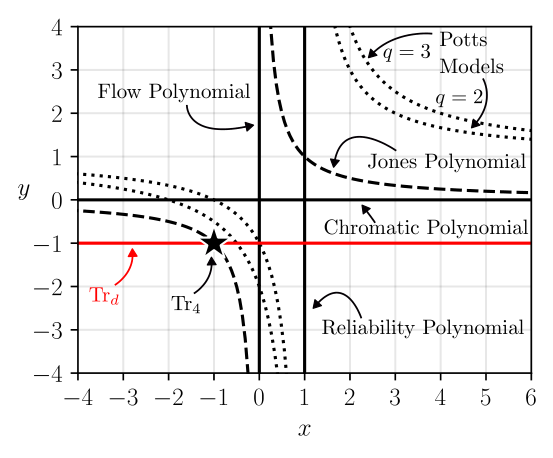
For the physical case d=4, this collapses to something strikingly clean. The Tutte polynomial is evaluated at coordinates (−1, −1), what Lin calls a special point in the “Tutte plane,” corresponding to the bicycle number of the graph. The bicycle space is the collection of subgraphs in which every vertex connects to an even number of edges. The formula becomes:
Tr_4 = 4 · (−2)^{n + c + dim(B)}
The computational payoff shows up in benchmarks. Lin compared standard Mathematica packages (TRACER, FeynCalc, and FormTracer) against a naive implementation using Mathematica’s built-in TuttePolynomial function. For traces up to 18 gamma matrices, the Tutte-based approach matches or outperforms the specialized physics codes. The log-scale runtime plot shows the Tutte method staying competitive even as the others slow exponentially. Dedicated Tutte polynomial algorithms, extensively optimized by the combinatorics community, could potentially be repurposed directly for particle physics.
Why It Matters
The Tutte polynomial already encodes an extraordinary range of mathematical structures: the chromatic polynomial (counting valid map colorings), the Jones polynomial of alternating knots (distinguishing knot shapes in topology), and the partition function of Potts models (describing magnetic materials near phase transitions). Lin’s theorem adds d-dimensional Dirac traces to this list, placing them within the same combinatorial framework.
On the complexity side, the equivalence comes with a catch: computing the Tutte polynomial is #P-hard, a class believed harder than NP-hard problems, and Lin’s analysis confirms that Dirac traces are similarly hard in the worst case. But worst-case complexity rarely governs the typical cases physicists actually encounter. Graphs arising from Feynman diagrams have special structure, and the Tutte polynomial connection opens a path to exploit that structure algorithmically.
New identities for Dirac traces can now be derived directly from known identities for graph polynomials, a direction the paper begins to explore. As multi-loop QFT calculations push toward ever-longer gamma matrix strings for precision predictions at colliders like the LHC, any algorithmic improvement compounds across thousands of diagrams.
Bottom Line: By proving that d-dimensional Dirac traces equal evaluations of the Tutte polynomial, Lin provides both a conceptual unification between particle physics and graph theory, and a practical toolkit: new algorithms, new identities, and a rigorous complexity analysis for one of QFT’s most routine but demanding calculations.
IAIFI Research Highlights

This work establishes a precise mathematical equivalence between quantum field theory calculations (Dirac traces under dimensional regularization) and combinatorial graph theory (the Tutte polynomial), showing that connections between physics and mathematics can yield both conceptual clarity and computational gains.

The deletion-contraction framework underlying the Tutte polynomial is central to graph neural network research and combinatorial optimization; this result suggests that physics-motivated graph problems may benefit from AI-accelerated Tutte polynomial algorithms.

Dirac trace computations are a bottleneck in multi-loop perturbative QCD and QED calculations; the Tutte polynomial formulation opens algorithmic paths to speed up precision predictions for collider experiments and tests of fundamental particle interactions.
Future directions include implementing dedicated Tutte polynomial solvers optimized for chord intersection graphs from Feynman diagrams, and extending the framework to traces involving γ^5 in chiral theories; the paper is available at [arXiv:2410.08161](https://arxiv.org/abs/2410.08161).
Original Paper Details
Dirac Traces and the Tutte Polynomial
[2410.08161](https://arxiv.org/abs/2410.08161)
Joshua Lin
Perturbative calculations involving fermion loops in quantum field theories require tracing over Dirac matrices. A simple way to regulate the divergences that generically appear in these calculations is dimensional regularisation, which has the consequence of replacing 4-dimensional Dirac matrices with d-dimensional counterparts for arbitrary complex values of d. In this work, a connection between traces of d-dimensional Dirac matrices and computations of the Tutte polynomial of associated graphs is proven. The time complexity of computing Dirac traces is analysed by this connection, and improvements to algorithms for computing Dirac traces are proposed.