

Enhancing Events in Neutrino Telescopes through Deep Learning-Driven Super-Resolution
Authors
Felix J. Yu, Nicholas Kamp, Carlos A. Argüelles
Abstract
Recent discoveries by neutrino telescopes, such as the IceCube Neutrino Observatory, relied extensively on machine learning (ML) tools to infer physical quantities from the raw photon hits detected. Neutrino telescope reconstruction algorithms are limited by the sparse sampling of photons by the optical modules due to the relatively large spacing ($10-100\,{\rm m})$ between them. In this letter, we propose a novel technique that learns photon transport through the detector medium through the use of deep learning-driven super-resolution of data events. These ``improved'' events can then be reconstructed using traditional or ML techniques, resulting in improved resolution. Our strategy arranges additional ``virtual'' optical modules within an existing detector geometry and trains a convolutional neural network to predict the hits on these virtual optical modules. We show that this technique improves the angular reconstruction of muons in a generic ice-based neutrino telescope. Our results readily extend to water-based neutrino telescopes and other event morphologies.
Concepts
The Big Picture
Imagine trying to reconstruct a symphony from a handful of microphones scattered unevenly across a concert hall, each one a hundred meters from the next. You’d catch snippets, a violin here, a cello there, but the full picture would be frustratingly incomplete. Now imagine an AI that could listen to those sparse snippets and fill in what the missing microphones would have heard. That’s what a team of Harvard physicists has built for one of the most extraordinary instruments in science: the IceCube Neutrino Observatory buried beneath the South Pole.
IceCube detects neutrinos, ghostly subatomic particles that stream through the universe nearly unimpeded, by watching for faint flashes of light when a neutrino occasionally slams into an ice molecule. The problem is that IceCube’s 5,160 light sensors are strung through a cubic kilometer of ice with gaps of up to 125 meters between them. Most of the light from any given neutrino interaction passes through those gaps unseen.
This sparse sampling limits how precisely scientists can reconstruct the direction and energy of incoming neutrinos, which in turn limits their ability to trace neutrinos back to cosmic sources. Felix Yu, Nicholas Kamp, and Carlos Argüelles at Harvard’s IAIFI have proposed a solution borrowed from image processing: deep learning super-resolution, the same class of technique that sharpens blurry photos by predicting missing pixels, here adapted for neutrino telescopes.
Key Insight: By training a neural network to predict what “virtual” optical modules would have detected, the team shows it’s possible to sharpen the resolution of neutrino telescopes after the fact, without building a single new sensor.
How It Works
Instead of adding real hardware, the team adds imaginary hardware. They define virtual optical modules (virtual OMs), sensors that don’t physically exist but whose readings the network learns to predict from the sensors that do.
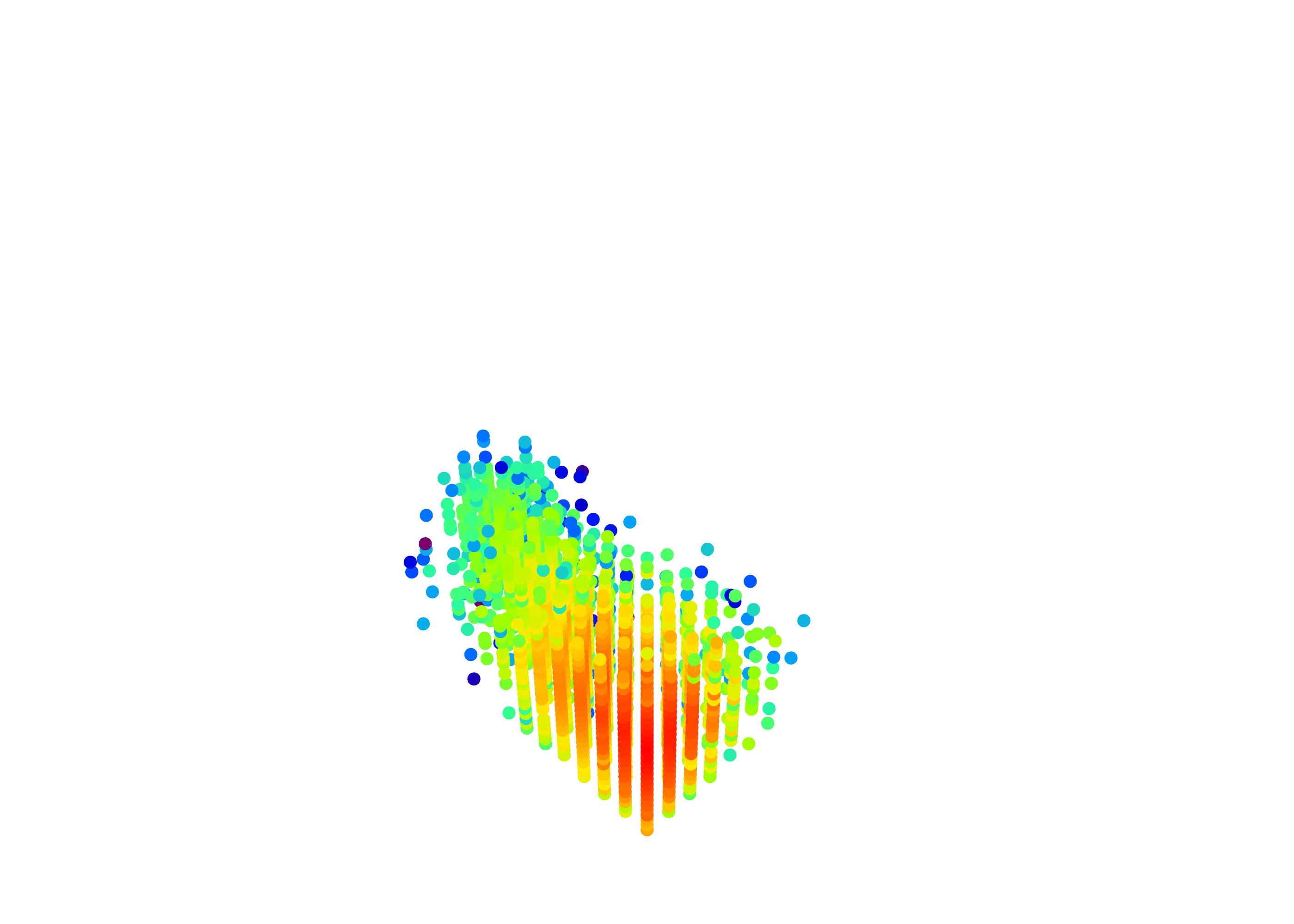
Here’s the pipeline, step by step:
-
Train on dense simulations. Using
Prometheus, an open-source neutrino telescope simulator, the team simulates a detector with a dense 15×15 grid of strings: 13,705 optical modules total, spaced 60 meters apart horizontally and 15 meters vertically. -
Mask half the strings. During training, every other string is hidden, leaving an 8×8 grid with 120-meter gaps. The network sees the sparse (masked) event and must predict what the hidden strings would have recorded.
-
Encode the timing information. Raw photon hit data is complex. Each sensor records a time series of photon arrivals that varies wildly in length and sparsity. The team first trains a variational autoencoder (VAE), a neural network that compresses complex data into a compact summary, to squeeze each sensor’s time series into a 64-number fingerprint called a latent vector. Preserving timing is critical here: it encodes where the neutrino came from.
-
Run the super-resolution network. A UNet++, a convolutional architecture originally developed for medical image segmentation, takes the 2D grid of latent vectors (arranged by string position) and predicts the latent vectors for the virtual strings. In doing so, it implicitly learns the spatial pattern of photon propagation through the ice.
-
Decode and reconstruct. The predicted latent vectors are decoded back into time series, and the now-complete, super-resolved event feeds into standard reconstruction algorithms.
The network operates entirely in latent space, the compressed numerical world of the VAE’s summaries, rather than on raw sensor data. This keeps computation tractable: instead of predicting nanosecond-by-nanosecond photon counts across 5,000 bins per sensor, the UNet works with 64-dimensional summaries. The team trained on roughly 500,000 simulated muon track events (muons being a heavier, unstable cousin of the electron), with 75,000 held aside for testing.
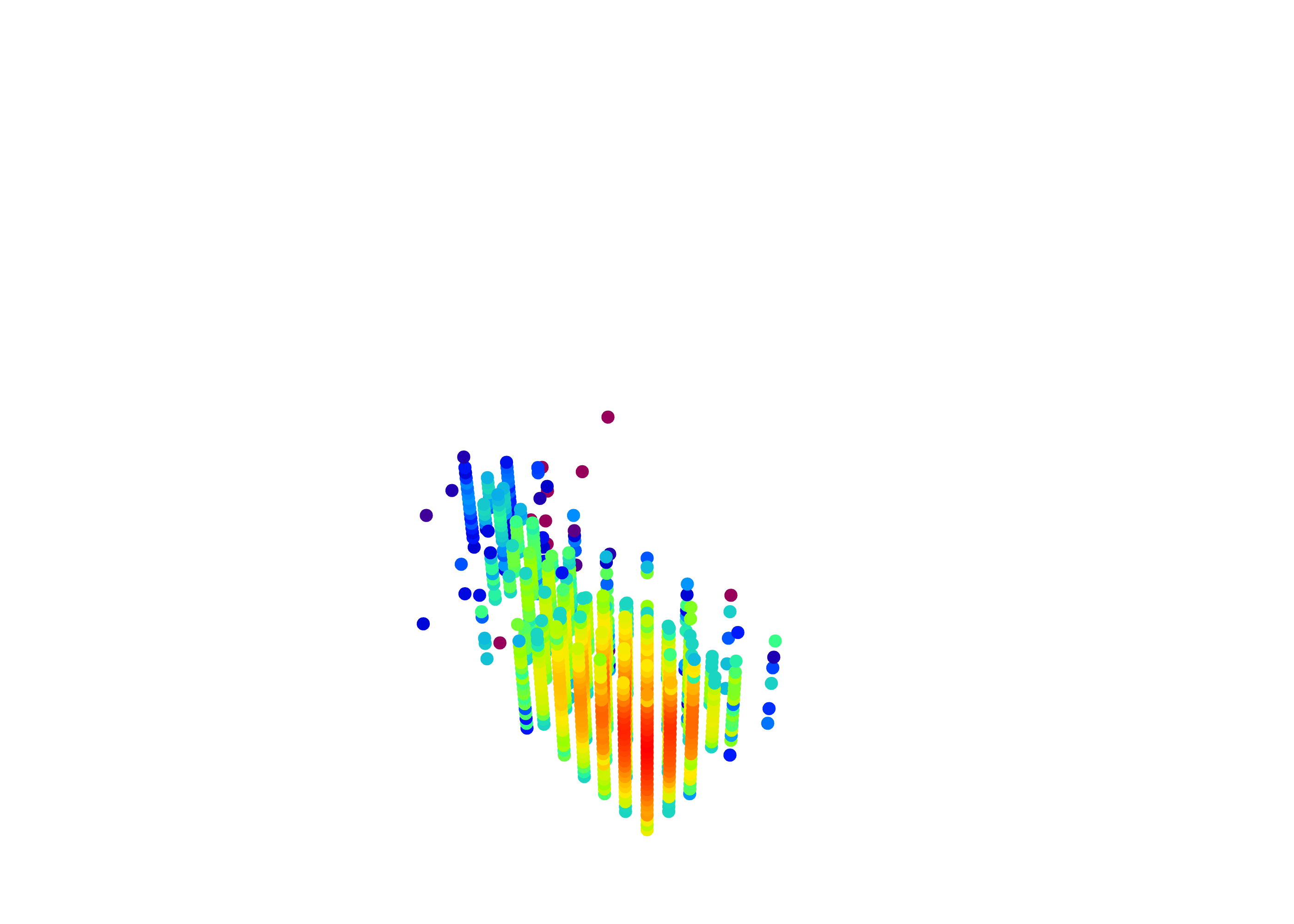
One subtle challenge: sensors far from the neutrino interaction point record very few photons, making their timing distributions hard for the VAE to capture faithfully. But for reconstruction purposes, what matters most is the first hit time and the peak position, and the network captures both reliably.
Why It Matters
Better angular resolution for neutrino events has immediate consequences for neutrino astronomy. Knowing a neutrino’s direction more precisely is the difference between pointing at a specific galaxy, like IceCube’s detection of NGC 1068, and pointing at a vague patch of sky. It means doing science at lower energies, with fainter sources, and with greater statistical confidence.
The technique also generalizes well beyond IceCube. The authors extend it to water-based detectors like KM3NeT, Baikal-GVD, and the planned TRIDENT and HUNT observatories in China. It applies to other event morphologies too: not just the elongated “track” events from muons, but the compact “cascade” events from electron and tau neutrinos. In principle, it could also be adapted for light-based neutrino experiments including Super-Kamiokande and JUNO.
There’s a bigger point about detector design here. Next-generation telescopes like IceCube-Gen2 will instrument ten times the volume of current detectors, but because the instrumented volume grows faster than sensor counts, module spacing will increase. Super-resolution offers a way to partially compensate, squeezing better physics out of sparser hardware. This is what it looks like when machine learning starts augmenting experimental instruments, not just analyzing their outputs.
Bottom Line: By teaching a neural network to predict the readings of sensors that don’t exist, this IAIFI team has demonstrated a new strategy for neutrino telescope reconstruction, one that could sharpen the sight of both existing and future detectors without a single additional piece of hardware.
IAIFI Research Highlights

This work applies deep learning super-resolution, a technique from computer vision, to particle astrophysics, showing that image-processing architectures like UNet++ can learn the physics of photon transport through kilometers of polar ice.

The paper introduces a two-stage encoding pipeline (VAE for temporal compression + UNet++ for spatial super-resolution) that handles the unique challenges of sparse, variable-length time series data in high-energy physics detectors.

Improved angular reconstruction of neutrino events will strengthen IceCube's and future telescopes' ability to identify astrophysical neutrino sources, advancing multi-messenger astronomy and the search for extreme cosmic accelerators.
The authors plan to extend this technique to realistic IceCube geometries, cascade events, and water-based detectors; code is publicly available and the work appears on arXiv ([arXiv:2408.08474](https://arxiv.org/abs/2408.08474)).