

Entanglement cohomology for GHZ and W states
Authors
Christian Ferko, Keiichiro Furuya
Abstract
Entanglement cohomology assigns a graded cohomology ring to a multipartite pure state, providing homological invariants that are stable under local unitaries and characterize inequivalent patterns of entanglement. In this work we derive exact expressions for the dimensions of these cohomology groups in two canonical entanglement classes, generalized GHZ and W states on an arbitrary number of parties and local Hilbert space dimensions, thus proving conjectures of arXiv:1901.02011. Using the additional structure of the Hodge star and wedge product operations, we propose two new classes of local unitary invariants: the spectrum of the natural Laplacian acting on entanglement $k$-forms, and the intersection numbers obtained from wedge products of representatives for cohomology classes. We present numerical experiments which investigate these invariants in particular states, suggesting that they may provide useful quantities for describing multipartite entanglement.
Concepts
The Big Picture
Imagine describing the shape of a donut using only local measurements, running your fingers along small patches of the surface without ever seeing the whole object. You’d notice the curvature, the smoothness. But you’d miss the hole.
That hole is a global feature, an obstruction no local measurement can detect. Mathematicians have spent a century building tools, collectively called cohomology, to systematically detect exactly these kinds of holes in geometric objects.
Now two physicists at Northeastern University have turned this machinery on one of quantum physics’ most elusive puzzles: how do you tell different patterns of quantum entanglement apart? Entanglement, the quantum correlation that links particles across any distance, comes in fundamentally different flavors, and distinguishing them has proven surprisingly hard. Christian Ferko and Keiichiro Furuya prove exact mathematical results for entanglement cohomology, a framework that assigns algebraic fingerprints to quantum states, and propose new tools for characterizing entanglement among three or more particles.
Their paper proves longstanding conjectures about two iconic quantum states, GHZ and W, and introduces new invariants (quantities that stay fixed under any local manipulation) that give researchers a richer vocabulary for the zoo of entanglement patterns in many-particle systems.
Key Insight: By treating quantum entanglement as a hole-detection problem, the same framework used to find holes in geometric surfaces, the authors derive exact algebraic fingerprints for GHZ and W states and propose new invariants based on Hodge theory that could reshape how physicists classify multipartite entanglement.
How It Works
Three particles can be entangled in two fundamentally inequivalent ways. The GHZ state (named for Greenberger, Horne, and Zeilinger) is a superposition of two collective extremes: all particles spinning up, plus all particles spinning down. The W state spreads entanglement democratically: exactly one particle is up, but you don’t know which one.
No sequence of local quantum operations, manipulations applied separately to individual particles, can convert one into the other. They live in different entanglement classes. But what mathematical quantity witnesses this difference?
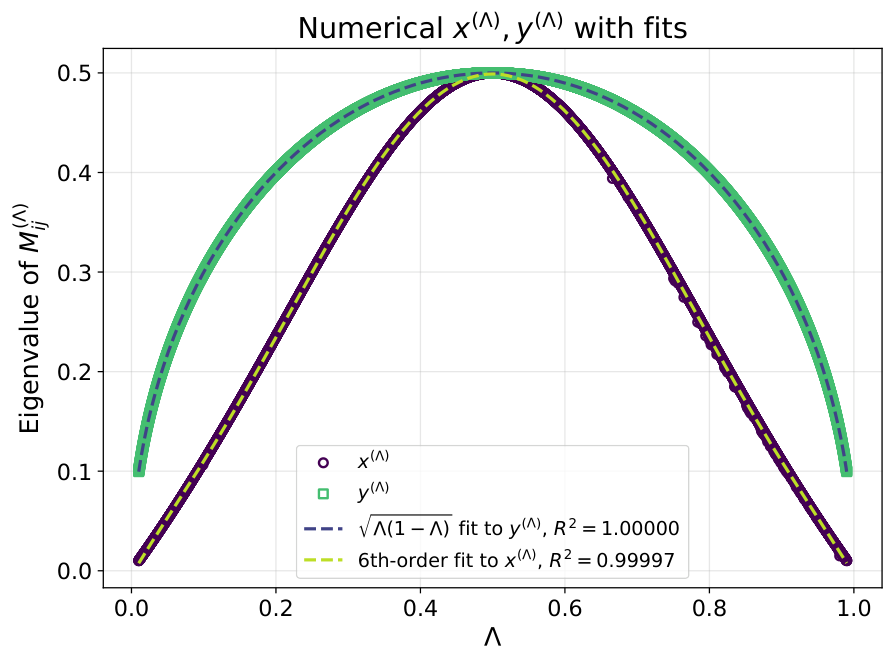
Entanglement cohomology provides an answer. The framework constructs spaces of entanglement k-forms, structured collections of mathematical objects organized by how many parties they involve. One then defines an exterior derivative d that takes a k-form and produces a (k+1)-form. The key property is d² = 0, which is what makes cohomology work:
- Take the k-forms that are closed (annihilated by d)
- Subtract the k-forms that are exact (produced by applying d to (k−1)-forms)
- The quotient is the k-th cohomology group
The dimensions of these groups, the Betti numbers, are invariants: they don’t change under local quantum operations. Different entanglement patterns yield different Betti numbers.
Ferko and Furuya prove exact formulas for all Betti numbers for generalized GHZ and W states across any number of parties n and any local Hilbert space dimension d. The proofs hinge on a Simplicial Lemma, a result about the combinatorial scaffolding organizing data across subsets of parties, which the authors establish from scratch. GHZ cohomology concentrates in specific degrees, reflecting its all-or-nothing character. W states yield a different profile, consistent with their distributed, resilient structure.
Can we do better than Betti numbers? The analogy with differential geometry runs deep enough to import two more tools.
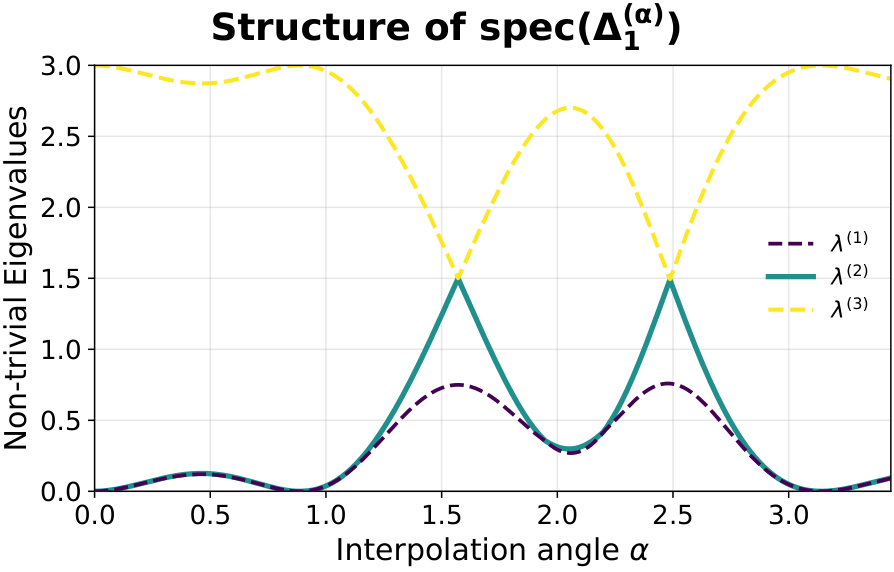
The first is the entanglement Laplacian, Δ = dδ + δd, built from the exterior derivative and its adjoint, a direct analogue of the Hodge Laplacian on smooth surfaces. Its spectrum (the eigenvalues describing how the operator acts on different inputs) encodes far more information than Betti numbers alone. Ferko and Furuya compute these spectra numerically for GHZ and W states, finding that eigenvalue distributions cleanly distinguish states with identical Betti numbers.
The second tool is intersection numbers. When two cohomology classes meet, a wedge product combines them into a single number. These pairings, familiar in algebraic geometry and topology, yield numerical invariants probing how cohomology classes interact. Numerical experiments reveal signatures that vary between entanglement classes even when coarser measures agree.
Why It Matters
Multipartite entanglement, among three or more particles, is one of quantum information theory’s hardest problems. For two parties, the Schmidt decomposition provides a clean, complete classification. For three or more, things get wild.
Even for three qubits, the simplest possible three-party system, there are infinitely many inequivalent entanglement classes under local unitary operations. Finding invariants that are both computable and physically meaningful has been an open challenge for years.
Entanglement cohomology offers something qualitatively new: a structural approach grounded in homological algebra, capable of generating infinite families of invariants through Hodge theory. The connection to topological ideas also has practical implications for quantum error correction, where GHZ and W states play operational roles in stabilizer codes and distributed quantum protocols. As quantum hardware scales to larger systems, tools for characterizing many-body entanglement with mathematical precision become more pressing, both for understanding quantum advantage and for diagnosing the quality of experimentally prepared states.
Bottom Line: By proving exact cohomological formulas for two cornerstone quantum states and introducing Laplacian spectra and intersection numbers as new invariants, Ferko and Furuya hand the quantum information community a sharper algebraic toolkit for classifying multipartite entanglement, one that may scale naturally to the complex many-body systems at the frontier of physics and quantum computing.
IAIFI Research Highlights

This work applies tools from pure mathematics (cohomology, Hodge theory, and simplicial algebra) to characterize quantum entanglement, connecting abstract mathematics, fundamental physics, and information science in a way central to the IAIFI mission.

The new invariants, Laplacian spectra and intersection numbers, provide computable, structured signatures of quantum states that could inform machine learning approaches to quantum state tomography and entanglement classification.

By proving exact cohomological formulas for generalized GHZ and W states at arbitrary party number and local dimension, the authors resolve open conjectures and put the entanglement cohomology program on firm mathematical ground.
Future directions include extending these results to mixed states, connecting intersection numbers to operational entanglement measures, and applying Laplacian spectra to larger multipartite systems; the full paper is available at [arXiv:2512.19889](https://arxiv.org/abs/2512.19889).