

Finding NEEMo: Geometric Fitting using Neural Estimation of the Energy Mover's Distance
Authors
Ouail Kitouni, Niklas Nolte, Mike Williams
Abstract
A novel neural architecture was recently developed that enforces an exact upper bound on the Lipschitz constant of the model by constraining the norm of its weights in a minimal way, resulting in higher expressiveness compared to other techniques. We present a new and interesting direction for this architecture: estimation of the Wasserstein metric (Earth Mover's Distance) in optimal transport by employing the Kantorovich-Rubinstein duality to enable its use in geometric fitting applications. Specifically, we focus on the field of high-energy particle physics, where it has been shown that a metric for the space of particle-collider events can be defined based on the Wasserstein metric, referred to as the Energy Mover's Distance (EMD). This metrization has the potential to revolutionize data-driven collider phenomenology. The work presented here represents a major step towards realizing this goal by providing a differentiable way of directly calculating the EMD. We show how the flexibility that our approach enables can be used to develop novel clustering algorithms.
Concepts
The Big Picture
Imagine you’re trying to compare two sandstorms, one swirling over the Sahara, another churning above the Gobi Desert. How different are they, really? You could count the grains, measure the wind speed, or you could ask a subtler question: how much work would it take to rearrange the sand from one storm into the pattern of the other? That “minimum work” is the Earth Mover’s Distance.
At the Large Hadron Collider, protons smash together millions of times per second, spraying exotic debris across sensitive detectors. Physicists make sense of this chaos by clustering debris into jets, cone-shaped sprays of particles tracing back to quarks and gluons. But comparing collision events precisely is hard, and the same kind of question shows up: how different are these two sprays of particles, and what geometry best describes them?
The best metric for this job is the Energy Mover’s Distance (EMD), the Earth Mover’s Distance applied to particle collisions. It has been difficult to compute both efficiently and differentiably. Differentiability means the computation can be smoothly tuned by an algorithm, like turning a dial rather than flipping switches. Without it, you can’t plug the metric into modern machine learning pipelines and let them optimize automatically.
A team from MIT’s IAIFI has now built NEEMo (Neural Estimation of the Energy Mover’s Distance), a system that computes the EMD exactly and differentiably using a specially constrained neural network. The payoff: geometry-aware clustering algorithms for collider physics that were previously out of reach.
Key Insight: By parameterizing the Kantorovich-Rubinstein dual of the Wasserstein metric with a Lipschitz-bounded neural network, NEEMo computes the exact Energy Mover’s Distance in a fully differentiable way — no approximations required.
How It Works
The EMD between two particle distributions is formally a Wasserstein-1 metric, a measure of the minimum cost to transport energy from one radiation pattern into another, as if energy were earth being moved from pile to pile. Computing it directly is expensive. A mathematical trick called the Kantorovich-Rubinstein (KR) duality reformulates the transport problem: instead of finding the cheapest moving plan, find a scoring function that maximizes the difference in expectations between two distributions, subject to the function being 1-Lipschitz. That means it can’t change faster than the distance between its inputs. No sudden cliffs allowed.
That Lipschitz constraint is the crux. Most neural networks are not automatically Lipschitz-bounded, and enforcing the constraint while keeping the network expressive is non-trivial.
Previous approaches used spectral normalization, a technique that limits how sharply each layer can transform its inputs, or other proxies that sacrifice expressiveness. NEEMo’s architecture enforces an exact upper bound on the Lipschitz constant by directly constraining weight matrix norms in a minimal way that wastes almost none of the model’s capacity.
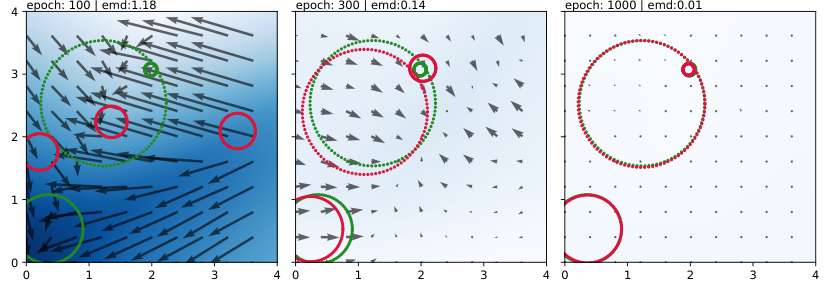
The training procedure works as a minimax game, with two optimizers competing in alternating rounds. Given a collision event Q and a parameterized geometric shape P_θ (say, a set of circles or rings), NEEMo alternates between two steps:
- Maximize over Lipschitz network parameters φ to find the Kantorovich potential, the scoring function that yields the EMD when evaluated on both distributions.
- Minimize over geometric parameters θ to move shape P_θ closer to event distribution Q.
Because everything is differentiable (the Lipschitz network, the geometric parameters, the energy weights), gradients flow freely. This replaces the ε-Sinkhorn estimation used in the prior SHAPER framework, which blurs the transport problem slightly to make it tractable but only approximates the EMD to order ε.
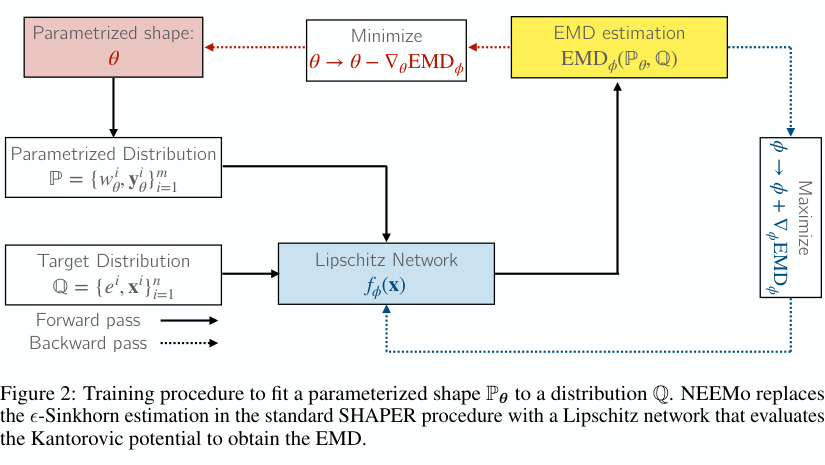
The results speak for themselves. Starting from randomly placed circles, NEEMo iteratively deforms them to match three synthetic target clusters. By epoch 100, the circles are in roughly the right neighborhood. By epoch 1000, they snap into nearly perfect alignment. The heatmap overlaid on each frame shows the Kantorovich potential itself, a kind of force field whose gradients push the geometric shapes toward the data.
Why It Matters
Jet clustering is one of the most basic operations in experimental particle physics. It runs on every collision event recorded at the LHC, trillions of times over an experiment’s lifetime. The algorithms currently used (like anti-k_T) were designed for computational efficiency, not geometric optimality. The EMD offers a principled, geometry-aware alternative, but its use has been limited because computing it fast enough and differentiably enough for real optimization pipelines was too difficult.
NEEMo changes that calculus. An exact, differentiable EMD makes end-to-end trainable clustering algorithms possible, where every component is optimized together directly against physics objectives rather than tuned piecemeal. The authors point to the future Electron-Ion Collider as a target application, where traditional clustering methods perform poorly and where EMD-based observables could yield qualitatively new insights into quark-gluon structure.
The approach also generalizes beyond collider physics. Wasserstein distances appear in generative models, domain adaptation, and distributional robustness, and any of these could benefit from exact, differentiable computation.
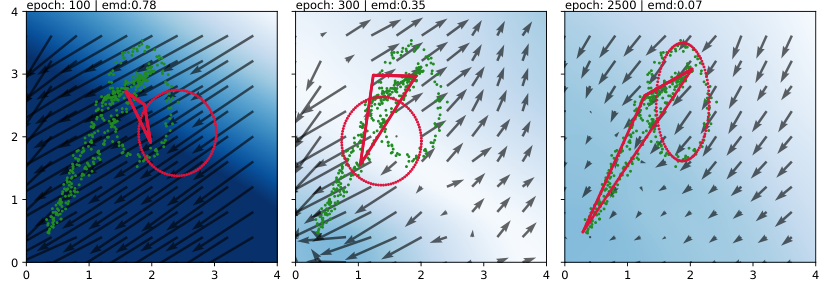
The main limitation right now is speed. Gradient-based minimax optimization of a neural network is slower than fast approximate solvers, making real-time detector application impractical today. Custom optimizers could close this gap, though, and differentiability already enables offline analysis tasks where compute time is less of a constraint.
Bottom Line: NEEMo delivers the first exact, differentiable computation of the Energy Mover’s Distance via Lipschitz-constrained neural networks, turning a hard combinatorial transport problem into a smooth optimization and handing particle physicists a new tool for understanding the geometry of collisions.
IAIFI Research Highlights

NEEMo connects mathematical optimal transport theory, neural network architecture design, and experimental particle physics, translating an abstract duality theorem into a working tool for collider data analysis.

Exact Lipschitz-constrained networks turn out to be not just theoretically elegant but practically powerful. The approach provides a blueprint for deploying Wasserstein-based losses in any differentiable ML pipeline without approximation error.

An exact, gradient-friendly EMD for jet clustering advances the data-driven phenomenology toolkit for current LHC experiments and next-generation facilities like the Electron-Ion Collider.
Future work targets faster optimization to enable near-real-time use at detectors. The paper is available at [arXiv:2209.15624](https://arxiv.org/abs/2209.15624), and the weight-constraint implementation is open-source at github.com/niklasnolte/MonotOneNorm.