

First application of a liquid argon time projection chamber for the search for intranuclear neutron-antineutron transitions and annihilation in $^{40}$Ar using the MicroBooNE detector
Authors
MicroBooNE collaboration, P. Abratenko, O. Alterkait, D. Andrade Aldana, L. Arellano, J. Asaadi, A. Ashkenazi, S. Balasubramanian, B. Baller, G. Barr, D. Barrow, J. Barrow, V. Basque, O. Benevides Rodrigues, S. Berkman, A. Bhanderi, A. Bhat, M. Bhattacharya, M. Bishai, A. Blake, B. Bogart, T. Bolton, J. Y. Book, L. Camilleri, Y. Cao, D. Caratelli, I. Caro Terrazas, F. Cavanna, G. Cerati, Y. Chen, J. M. Conrad, M. Convery, L. Cooper-Troendle, J. I. Crespo-Anadon, R. Cross, M. Del Tutto, S. R. Dennis, P. Detje, A. Devitt, R. Diurba, Z. Djurcic, R. Dorrill, K. Duffy, S. Dytman, B. Eberly, P. Englezos, A. Ereditato, J. J. Evans, R. Fine, O. G. Finnerud, B. T. Fleming, N. Foppiani, W. Foreman, D. Franco, A. P. Furmanski, D. Garcia-Gamez, S. Gardiner, G. Ge, S. Gollapinni, O. Goodwin, E. Gramellini, P. Green, H. Greenlee, W. Gu, R. Guenette, P. Guzowski, L. Hagaman, O. Hen, R. Hicks, C. Hilgenberg, G. A. Horton-Smith, Z. Imani, B. Irwin, R. Itay, C. James, X. Ji, L. Jiang, J. H. Jo, R. A. Johnson, Y. J. Jwa, D. Kalra, N. Kamp, G. Karagiorgi, W. Ketchum, M. Kirby, T. Kobilarcik, I. Kreslo, I. Lepetic, J. -Y. Li, K. Li, Y. Li, K. Lin, B. R. Littlejohn, H. Liu, W. C. Louis, X. Luo, C. Mariani, D. Marsden, J. Marshall, N. Martinez, D. A. Martinez Caicedo, S. Martynenko, A. Mastbaum, N. McConkey, V. Meddage, J. Micallef, K. Miller, K. Mistry, T. Mohayai, A. Mogan, M. Mooney, A. F. Moor, C. D. Moore, L. Mora Lepin, M. M. Moudgalya, S. Mulleria Babu, D. Naples, A. Navrer-Agasson, N. Nayak, M. Nebot-Guinot, J. Nowak, N. Oza, O. Palamara, N. Pallat, V. Paolone, A. Papadopoulou, V. Papavassiliou, H. Parkinson, S. F. Pate, N. Patel, Z. Pavlovic, E. Piasetzky, I. Ponce-Pinto, I. Pophale, X. Qian, J. L. Raaf, V. Radeka, A. Rafique, M. Reggiani-Guzzo, L. Ren, L. Rochester, J. Rodriguez Rondon, M. Rosenberg, M. Ross-Lonergan, C. Rudolph von Rohr, I. Safa, G. Scanavini, D. W. Schmitz, A. Schukraft, W. Seligman, M. H. Shaevitz, R. Sharankova, J. Shi, E. L. Snider, M. Soderberg, S. Soldner-Rembold, J. Spitz, M. Stancari, J. St. John, T. Strauss, A. M. Szelc, W. Tang, N. Taniuchi, K. Terao, C. Thorpe, D. Torbunov, D. Totani, M. Toups, Y. -T. Tsai, J. Tyler, M. A. Uchida, T. Usher, B. Viren, M. Weber, H. Wei, A. J. White, S. Wolbers, T. Wongjirad, M. Wospakrik, K. Wresilo, N. Wright, W. Wu, E. Yandel, T. Yang, L. E. Yates, H. W. Yu, G. P. Zeller, J. Zennamo, C. Zhang
Abstract
We present a novel methodology to search for intranuclear neutron-antineutron transition ($n\rightarrow\bar{n}$) followed by $\bar{n}$-nucleon annihilation within an $^{40}$Ar nucleus, using the MicroBooNE liquid argon time projection chamber (LArTPC) detector. A discovery of $n\rightarrow\bar{n}$ transition or a new best limit on the lifetime of this process would either constitute physics beyond the Standard Model or greatly constrain theories of baryogenesis, respectively. The approach presented in this paper makes use of deep learning methods to select $n\rightarrow\bar{n}$ events based on their unique features and differentiate them from cosmogenic backgrounds. The achieved signal and background efficiencies are (70.22$\pm$6.04)\% and (0.0020$\pm$0.0003)\%, respectively. A demonstration of a search is performed with a data set corresponding to an exposure of $3.32 \times10^{26}\,$neutron-years, and where the background rate is constrained through direct measurement, assuming the presence of a negligible signal. With this approach, no excess of events over the background prediction is observed, setting a demonstrative lower bound on the $n\rightarrow\bar{n}$ lifetime in $^{40}$Ar of $τ_{\textrm{m}} \gtrsim 1.1\times10^{26}\,$years, and on the free $n\rightarrow\bar{n}$ transition time of $τ_{\textrm{\nnbar}} \gtrsim 2.6\times10^{5}\,$s, each at the $90\%$ confidence level. This analysis represents a first-ever proof-of-principle demonstration of the ability to search for this rare process in LArTPCs with high efficiency and low background.
Concepts
The Big Picture
Imagine watching a pool of water for a trillion years, waiting for a single water molecule to spontaneously rearrange into something entirely different, something that would then immediately explode. That’s roughly the patience required to witness a neutron transform into its antimatter twin. Yet physicists believe these vanishingly rare events may hold the key to one of the deepest mysteries in science: why does the universe contain anything at all?
When the Big Bang created the cosmos, physics as we understand it should have produced equal amounts of matter and antimatter, which would have annihilated each other in a perfect, sterile void. Clearly, that didn’t happen. Something tipped the scales, some subtle asymmetry in the early universe that let matter win.
One leading class of theories predicts this asymmetry arose through processes that violated baryon number conservation, the rule that the total count of particles like protons and neutrons can never change. A neutron spontaneously becoming an antineutron, the n→n̄ transition (where n̄, pronounced “n-bar,” is the antimatter counterpart of a neutron), would be the cleanest possible violation of that rule. It erases one matter particle and creates one antimatter particle in a single step.
The MicroBooNE collaboration has now shown for the first time that a liquid argon time projection chamber (LArTPC), a detector that tracks charged particles moving through ultra-cold liquid argon, can hunt for these transitions with real precision. Using deep learning to sift through mountains of detector data, they’ve set a new lower bound on how long a neutron inside an argon nucleus can survive before making such a forbidden transition.
Key Insight: If a neutron-antineutron transition is ever discovered, it would be unambiguous evidence for physics beyond the Standard Model, and it would help explain why the universe is made of matter rather than nothing.
How It Works
The MicroBooNE detector sits at Fermilab, Illinois: an 85-tonne tank of ultra-pure liquid argon equipped with thousands of wire sensors. When a charged particle zips through the argon, it leaves a trail of ionized electrons that drift toward the wires, painting a precise 3D picture of what happened. The detector doesn’t observe n→n̄ directly. It watches for the spectacular aftermath.
When a neutron inside an argon-40 nucleus transforms into an antineutron, that antineutron finds itself surrounded by nucleons, the protons and neutrons making up the nucleus. Within about 10⁻²³ seconds, it annihilates with one of them, releasing roughly 1.9 GeV of energy in a burst of pions and kaons (short-lived subatomic particles). The result is a distinctive multi-pronged explosion inside the nucleus. The challenge: this signal looks superficially similar to debris left by cosmic ray muons raining constantly down on the detector.
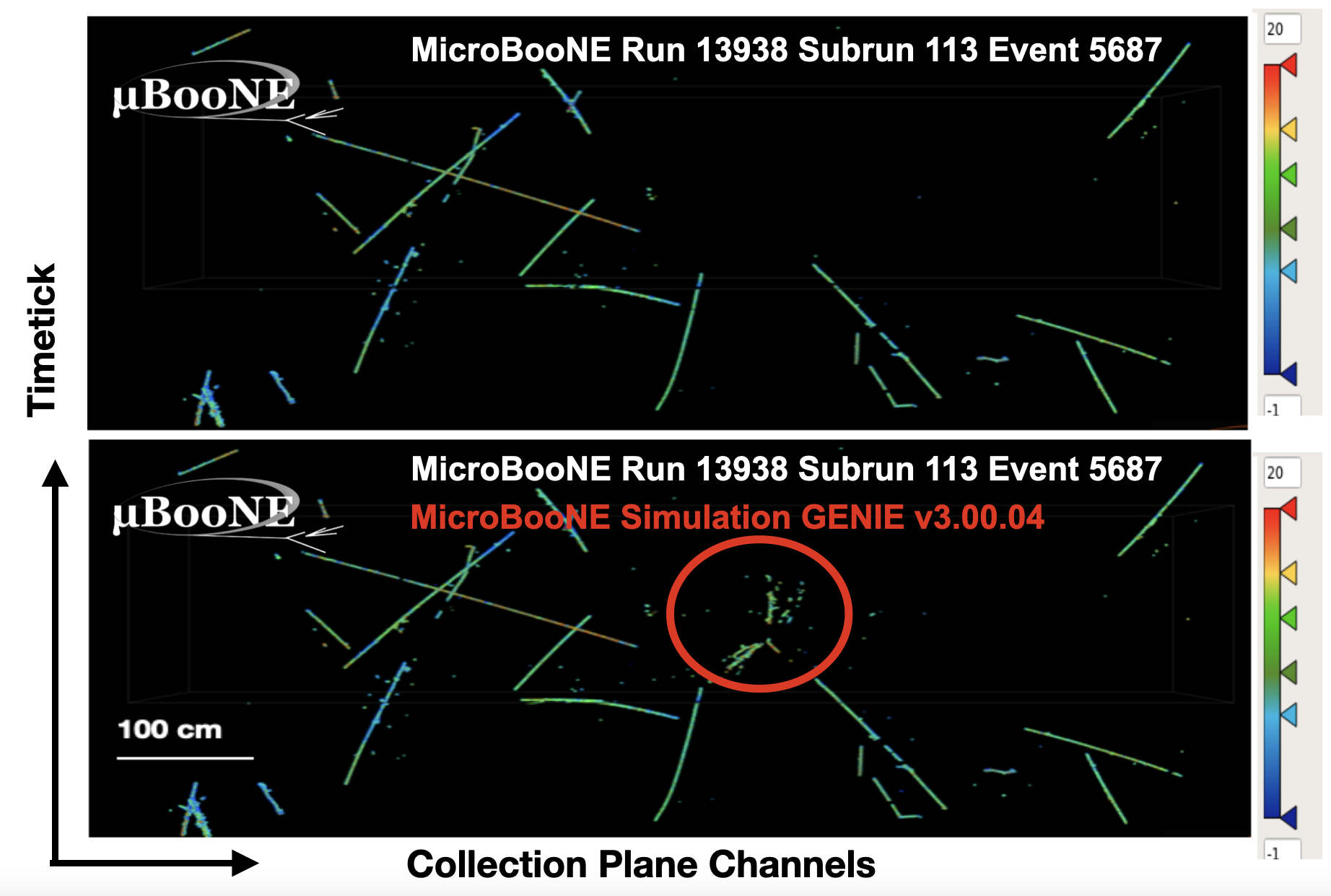
The team built a three-stage machine learning pipeline to separate signal from noise:
- BDT preselection (Boosted Decision Tree): A classic ensemble classifier screens raw events based on track multiplicity and total visible energy, slashing the cosmic background while retaining most candidate signal events.
- CNN-based selection (Convolutional Neural Network): Surviving events are converted into 2D images of the wire readout and fed to a convolutional neural network. This step exploits the visual distinctiveness of the annihilation fireball, which radiates outward equally in all directions, unlike the elongated geometry of a cosmic muon track.
- Topological final selection: Geometric cuts verify that reconstructed tracks point away from a common vertex in a pattern consistent with a nuclear annihilation event.
On simulated data, the pipeline achieves 70.22% signal efficiency, correctly identifying nearly three-quarters of all n→n̄ events, while reducing the cosmogenic background by a factor of 50,000. The background efficiency comes in at just 0.0020%. For every 50,000 background events, only one sneaks through.
Applied to real MicroBooNE data representing an exposure of 3.32×10²⁶ neutron-years, the search saw no excess above background. This sets a lower bound on how long a neutron can survive within a ⁴⁰Ar nucleus before transitioning: τ_m ≳ 1.1×10²⁶ years at 90% confidence. For a free neutron in isolation, the equivalent limit is τ_{n→n̄} ≳ 2.6×10⁵ seconds.
This is explicitly a proof-of-principle. Existing limits from Super-Kamiokande and ILL reach higher, and the dataset is small. But that’s not the point. The machinery works, and it works on a detector technology that will define the next generation of neutrino physics.
Why It Matters
LArTPCs are the future of large-scale particle physics. The upcoming DUNE experiment at Fermilab will use a 40,000-tonne LArTPC, roughly 500 times larger than MicroBooNE. Every technique developed here transfers directly to DUNE, and at that scale, sensitivity to n→n̄ could surpass current world records by orders of magnitude.
There’s a broader point, too. This work treats detector readouts as images and deploys computer vision to find patterns that hand-designed algorithms miss. The CNN wasn’t handed a list of engineered features; it learned directly from raw wire images what a neutron-antineutron annihilation looks like.
As detectors grow larger and datasets richer, that approach only gets more powerful. MicroBooNE has written the playbook for how the field will search for ultra-rare baryon-number-violating processes in the liquid argon era.
Bottom Line: MicroBooNE has proven that LArTPCs can hunt for neutron-antineutron transitions with 70% signal efficiency and 50,000-fold background rejection, opening a new front in the search for why the universe exists at all.
IAIFI Research Highlights

This work combines particle detector technology with modern computer vision, training convolutional neural networks directly on LArTPC wire-readout images to identify rare baryon-number-violating events that no hand-crafted algorithm could isolate as effectively.

The multi-stage pipeline (BDT preselection, CNN image classification, and topological cuts) achieves extreme signal-to-background ratios (50,000:1) in high-energy physics, providing a template for rare-process searches across the field.

By setting the first-ever n→n̄ lifetime bound in a LArTPC (τ_m ≳ 1.1×10²⁶ years in ⁴⁰Ar), MicroBooNE lays the experimental groundwork for probing baryon number violation, one of the necessary ingredients for explaining the matter-antimatter asymmetry of the universe.
Future analyses with larger LArTPC detectors like DUNE could surpass existing world limits and potentially discover or definitively constrain baryogenesis models; see [arXiv:2308.03924](https://arxiv.org/abs/2308.03924) for full details.