

First search for dark-trident processes using the MicroBooNE detector
Authors
MicroBooNE collaboration, P. Abratenko, O. Alterkait, D. Andrade Aldana, L. Arellano, J. Asaadi, A. Ashkenazi, S. Balasubramanian, B. Baller, G. Barr, D. Barrow, J. Barrow, V. Basque, O. Benevides Rodrigues, S. Berkman, A. Bhanderi, A. Bhat, M. Bhattacharya, M. Bishai, A. Blake, B. Bogart, T. Bolton, J. Y. Book, M. B. Brunetti, L. Camilleri, Y. Cao, D. Caratelli, F. Cavanna, G. Cerati, A. Chappell, Y. Chen, J. M. Conrad, M. Convery, L. Cooper-Troendle, J. I. Crespo-Anadon, R. Cross, M. Del Tutto, S. R. Dennis, P. Detje, A. Devitt, R. Diurba, Z. Djurcic, R. Dorrill, K. Duffy, S. Dytman, B. Eberly, P. Englezos, A. Ereditato, J. J. Evans, R. Fine, O. G. Finnerud, B. T. Fleming, W. Foreman, D. Franco, A. P. Furmanski, F. Gao, D. Garcia-Gamez, S. Gardiner, G. Ge, S. Gollapinni, E. Gramellini, P. Green, H. Greenlee, L. Gu, W. Gu, R. Guenette, P. Guzowski, L. Hagaman, O. Hen, C. Hilgenberg, G. A. Horton-Smith, Z. Imani, B. Irwin, M. S. Ismail, C. James, X. Ji, J. H. Jo, R. A. Johnson, Y. J. Jwa, D. Kalra, N. Kamp, G. Karagiorgi, W. Ketchum, M. Kirby, T. Kobilarcik, I. Kreslo, M. B. Leibovitch, I. Lepetic, J. -Y. Li, K. Li, Y. Li, K. Lin, B. R. Littlejohn, H. Liu, W. C. Louis, X. Luo, C. Mariani, D. Marsden, J. Marshall, N. Martinez, D. A. Martinez Caicedo, S. Martynenko, A. Mastbaum, I. Mawby, N. McConkey, V. Meddage, J. Micallef, K. Miller, K. Mistry, T. Mohayai, A. Mogan, M. Mooney, A. F. Moor, C. D. Moore, L. Mora Lepin, M. M. Moudgalya, S. Mulleria Babu, D. Naples, A. Navrer-Agasson, N. Nayak, M. Nebot-Guinot, J. Nowak, N. Oza, O. Palamara, N. Pallat, V. Paolone, A. Papadopoulou, V. Papavassiliou, H. Parkinson, S. F. Pate, N. Patel, Z. Pavlovic, E. Piasetzky, I. Pophale, X. Qian, J. L. Raaf, V. Radeka, A. Rafique, M. Reggiani-Guzzo, L. Ren, L. Rochester, J. Rodriguez Rondon, M. Rosenberg, M. Ross-Lonergan, C. Rudolph von Rohr, I. Safa, G. Scanavini, D. W. Schmitz, A. Schukraft, W. Seligman, M. H. Shaevitz, R. Sharankova, J. Shi, E. L. Snider, M. Soderberg, S. Soldner-Rembold, J. Spitz, M. Stancari, J. St. John, T. Strauss, A. M. Szelc, W. Tang, N. Taniuchi, K. Terao, C. Thorpe, D. Torbunov, D. Totani, M. Toups, Y. -T. Tsai, J. Tyler, M. A. Uchida, T. Usher, B. Viren, M. Weber, H. Wei, A. J. White, S. Wolbers, T. Wongjirad, M. Wospakrik, K. Wresilo, W. Wu, E. Yandel, T. Yang, L. E. Yates, H. W. Yu, G. P. Zeller, J. Zennamo, C. Zhang
Abstract
We present a first search for dark-trident scattering in a neutrino beam using a data set corresponding to $7.2 \times 10^{20}$ protons on target taken with the MicroBooNE detector at Fermilab. Proton interactions in the neutrino target at the Main Injector produce $π^0$ and $η$ mesons, which could decay into dark-matter (DM) particles mediated via a dark photon $A^\prime$. A convolutional neural network is trained to identify interactions of the DM particles in the liquid-argon time projection chamber (LArTPC) exploiting its image-like reconstruction capability. In the absence of a DM signal, we provide limits at the $90\%$ confidence level on the squared kinematic mixing parameter $\varepsilon^2$ as a function of the dark-photon mass in the range $10\le M_{A^\prime}\le 400$ MeV. The limits cover previously unconstrained parameter space for the production of fermion or scalar DM particles $χ$ for two benchmark models with mass ratios $M_χ/M_{A^\prime}=0.6$ and $2$ and for dark fine-structure constants $0.1\leα_D\le 1$.
Concepts
The Big Picture
Imagine shining a flashlight into a pitch-black room and looking not for light reflecting off objects, but for tiny flickers that only appear at the very edge of your beam. That’s roughly what physicists at Fermilab’s MicroBooNE experiment just attempted. They hunted for dark matter not by catching it directly, but by watching for the brief, distinctive trace it leaves as it passes through a tank of ultra-cold liquid argon.
Dark matter makes up roughly 27% of everything in the universe. It shapes galaxies, bends light, and holds together the vast cosmic web that gives the universe its large-scale structure. Yet it has never once been directly detected in a laboratory. Decades of searching with increasingly sensitive detectors have yielded only silence.
A theoretical idea called the dark-trident process offers a fresh angle of attack. Rather than wait for dark matter to crash into a nucleus head-on, scientists can look for it briefly emitting a burst of ordinary particles as it passes through a detector. The MicroBooNE collaboration has now conducted the world’s first experimental search for this process, using a neural network to sift through hundreds of thousands of particle collisions for a signal that would be vanishingly faint.
Key Insight: The dark-trident search is a fundamentally new strategy for hunting light dark matter. It exploits the distinctive signature of a fleeting dark-photon emission rather than a direct nuclear collision, opening parameter space no previous experiment could probe.
How It Works
The experiment unfolds in two stages, separated by hundreds of meters of rock and steel.
Stage one: dark matter production. At Fermilab’s Main Injector, protons slam into a fixed target, generating a flood of secondary particles including neutral pions (π⁰) and eta mesons (η). In standard physics, π⁰ mesons decay almost instantly into two photons. But in certain dark-sector models, a small fraction could instead decay as π⁰ → γ χ χ̄, producing a pair of dark-matter particles χ mediated by a virtual dark photon A*. Think of A’ as a ghostly cousin of the ordinary photon that couples to a hidden sector. These dark-matter particles, with energies in the 0.1–3 GeV range, stream invisibly through hundreds of meters of material straight toward the detector.
Stage two: the trident interaction. When a χ particle reaches MicroBooNE, it occasionally undergoes the dark-trident process: χ + Ar → χ + Ar + A’. The dark-matter particle radiates a real dark photon A’ while bouncing off an argon nucleus, analogous to bremsstrahlung (German for “braking radiation”), where a charged particle emits a photon as it decelerates. The A’ then promptly decays into an electron-positron pair (e⁺e⁻) with essentially 100% probability, since no other decay routes are open at these energies. The dark-matter particle exits unseen, leaving an apparently sourceless pair of electromagnetic tracks materializing from nowhere in the argon.
The full search chain involved:
- Simulating signal events for two benchmark scenarios (mass ratios Mχ/MA’ = 0.6 and 2, representing cases where the dark matter is lighter or heavier than the dark photon it emits) across dark-photon masses from 10 to 400 MeV
- Identifying backgrounds dominated by ordinary neutrino interactions that can mimic the e⁺e⁻ signature
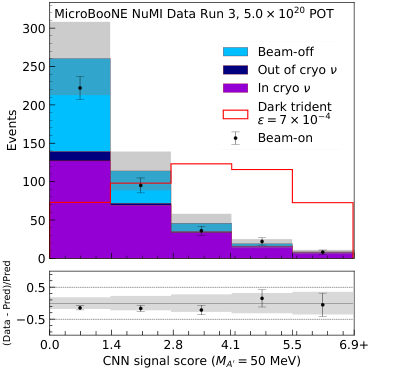
- Training a convolutional neural network (CNN) to distinguish dark-trident events from background, using the LArTPC’s inherently image-like 2D wire readout
The liquid-argon time projection chamber (LArTPC) is the ideal tool for this search. MicroBooNE’s 85-tonne active volume records particle tracks with millimeter-scale precision, and the resulting 2D images of particle interactions are exactly what CNNs were built to analyze.
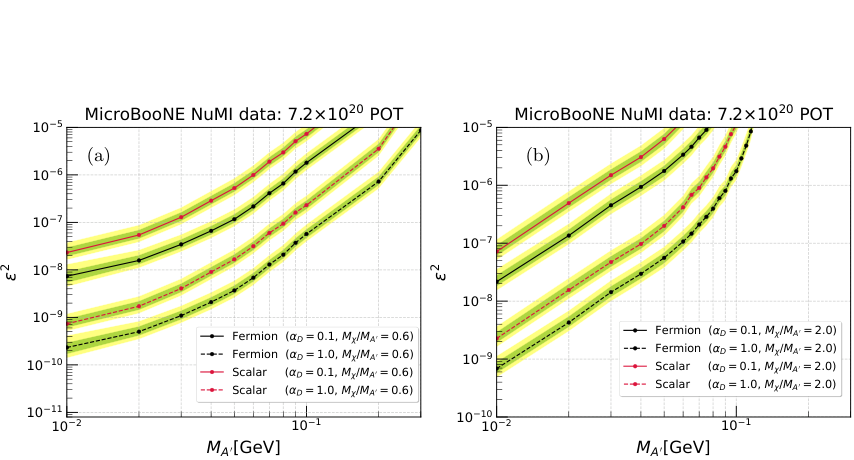
The network learned to recognize the distinctive opening angle (the angle at which the electron and positron fly apart) and energy distributions of e⁺e⁻ pairs from dark-photon decays. These distributions shift with the mass ratio Mχ/MA’: the heavier the dark photon relative to the dark-matter particle, the wider the pair tends to spread. The dataset contained 7.2 × 10²⁰ protons on target (POT), the standard measure of total beam exposure accumulated during MicroBooNE’s operation.
Why It Matters
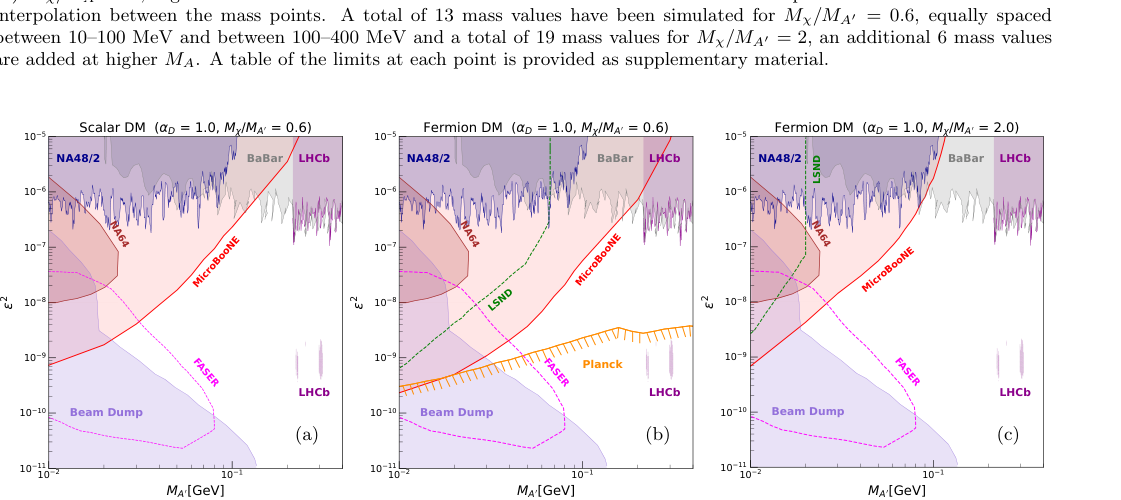
No dark-trident signal appeared in the data. But a null result here carries real scientific weight: it tells us where dark matter is not, ruling out combinations of properties that were genuinely open before this measurement. Specifically, the collaboration set 90% confidence level upper limits on ε², the squared kinematic mixing parameter controlling how strongly the dark photon couples to ordinary electromagnetism, as a function of dark-photon mass across 10–400 MeV. These limits cover previously unconstrained regions for dark fine-structure constants αD between 0.1 and 1, a measure of interaction strength within the dark sector itself.
This is the opening move in a rich experimental program. The dark-trident channel can be pursued with far larger exposures using the DUNE near detector and Fermilab’s Short-Baseline Neutrino (SBN) program detectors, both of which will collect orders of magnitude more protons on target. The CNN-on-LArTPC technique is now proven and portable to future experiments with modest effort.
Bottom Line: MicroBooNE ran the world’s first search for the dark-trident process, setting new limits on light dark matter that no previous experiment could reach, and proving out a neural-network-powered technique ready to scale with the next generation of neutrino detectors.
IAIFI Research Highlights

This work sits at the intersection of deep learning and experimental particle physics, deploying a convolutional neural network trained on LArTPC detector images to conduct the first accelerator search for a theoretically motivated dark-sector process.

Applying CNNs to classify rare dark-matter signatures within large neutrino-beam datasets shows how image-based machine learning can expand what's discoverable in physics experiments that produce inherently visual, high-dimensional data.

MicroBooNE's search sets the first experimental constraints on the dark-trident process, ruling out previously unexplored regions of dark-photon and dark-matter parameter space for both fermion and scalar dark-matter candidates.
Future searches with DUNE and the Fermilab SBN detectors will extend this technique to vastly larger datasets; the full results are available at [arXiv:2312.13945](https://arxiv.org/abs/2312.13945).