

Flow-based sampling for multimodal and extended-mode distributions in lattice field theory
Authors
Daniel C. Hackett, Chung-Chun Hsieh, Sahil Pontula, Michael S. Albergo, Denis Boyda, Jiunn-Wei Chen, Kai-Feng Chen, Kyle Cranmer, Gurtej Kanwar, Phiala E. Shanahan
Abstract
Recent results have demonstrated that samplers constructed with flow-based generative models are a promising new approach for configuration generation in lattice field theory. In this paper, we present a set of training- and architecture-based methods to construct flow models for targets with multiple separated modes (i.e.~vacua) as well as targets with extended/continuous modes. We demonstrate the application of these methods to modeling two-dimensional real and complex scalar field theories in their symmetry-broken phases. In this context we investigate different flow-based sampling algorithms, including a composite sampling algorithm where flow-based proposals are occasionally augmented by applying updates using traditional algorithms like HMC.
Concepts
The Big Picture
Imagine trying to map a mountain range when you can only wander on foot and thick fog limits your vision. You might stumble into one valley and, unable to see the others, convince yourself you’ve explored everything. In reality, you’ve missed most of the terrain. This is essentially the crisis facing physicists who compute the properties of fundamental particles.
Quantum Chromodynamics (QCD), the theory describing how quarks and gluons bind together inside protons and neutrons, is too mathematically complex for direct calculation. Physicists instead use lattice field theory: they carve space and time into a fine grid, then use statistical sampling to estimate the answers they need.
The trouble is that the probability distribution they must sample can split into disconnected islands. Picture a terrain map with two separate peaks and an impassable valley between them, each peak representing a distinct valid quantum state. Standard algorithms like Hybrid Monte Carlo (HMC) tend to get stranded on one peak and never visit the other. Physicists call this topological freezing, and it quietly corrupts results.
Normalizing flows, neural networks that learn to generate samples matching a target probability distribution, offer a way out. They can jump freely between peaks instead of slowly wandering. But flows carry their own failure mode: mode collapse, where the model learns to ignore entire regions, pretending certain peaks don’t exist.
A team including researchers from MIT, National Taiwan University, and other institutions has assembled a toolkit of architectural and training strategies to tackle this problem. Their results show that flow-based sampling can be made reliable against mode collapse, and that hybridizing it with traditional methods produces something better than either alone.
Key Insight: Flow-based generative models can be engineered to correctly represent all modes of a multimodal quantum field theory distribution, and when combined with HMC, the two methods compensate for each other’s weaknesses.
How It Works
A normalizing flow is a neural network that learns a smooth, invertible transformation mapping a simple distribution (say, a Gaussian) to a complicated target. You train the flow to approximate the probability distribution over all possible field configurations, draw samples independently, then accept or reject them via a Metropolis-Hastings correction step. This guarantees exact results in the long run while bypassing HMC’s slow random walk.
The problem shows up in symmetry-broken phases, where multiple distinct ground states coexist. Self-training procedures, which refine the flow using its own samples, catastrophically amplify any initial imbalance. If the model slightly undersamples one mode early on, it generates fewer training samples from that region, learns even less about it, and eventually drops it entirely. The flow can look fine by some metrics while systematically missing half the physics.
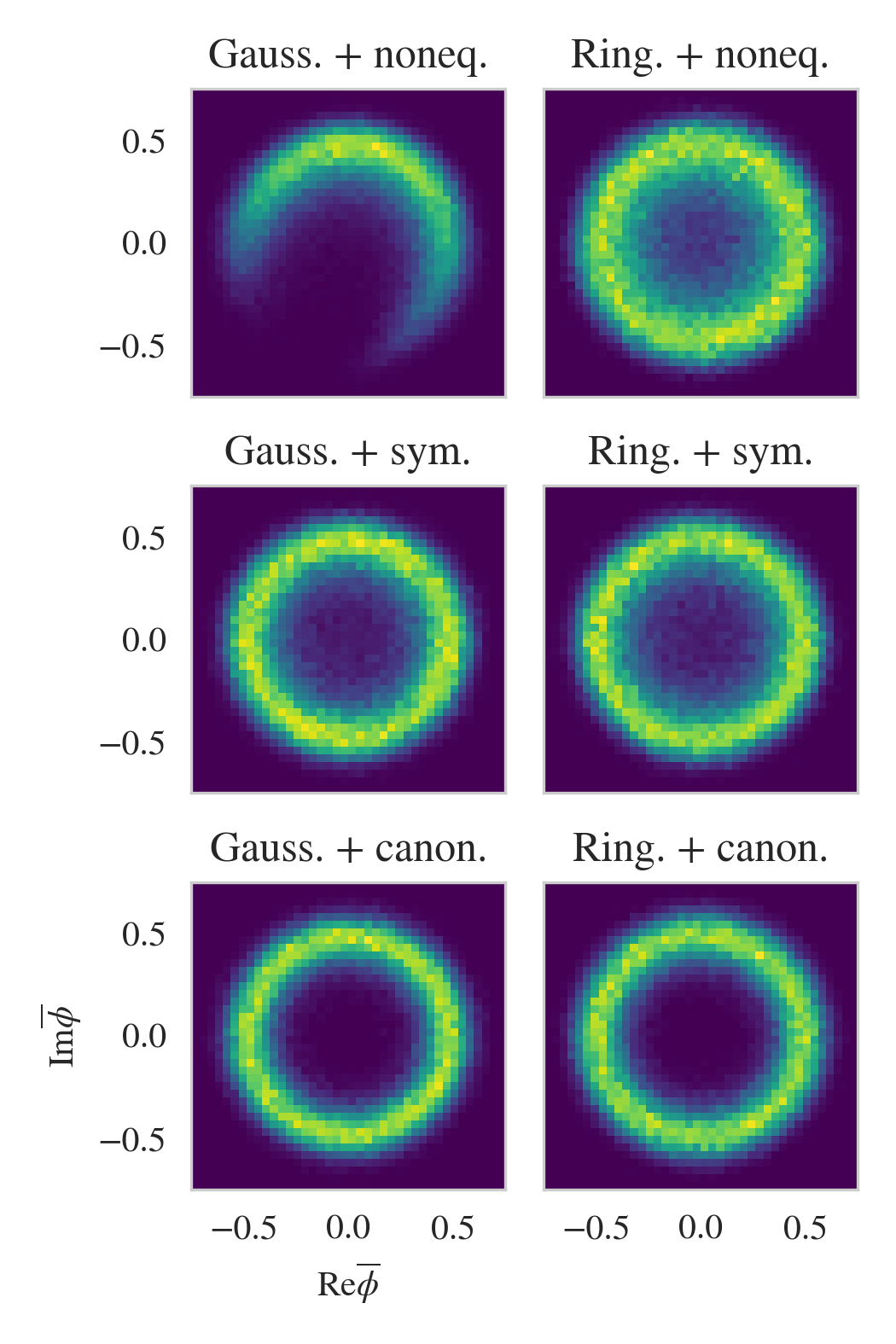
To fight mode collapse, the researchers tested two categories of approaches.
Architectural approaches bake in knowledge of the mode structure directly:
- Equivariant flows constrain the network to respect the target’s symmetries (e.g., Z₂), forcing equal weighting of all modes by construction
- Topology matching preprocesses the base distribution to mirror the topological structure of the target
- Mixture models explicitly combine multiple sub-flows, each targeting different modes, with either separate networks or symmetrized sampling
Training approaches modify the loss function or training schedule:
- Forwards KL training uses samples drawn from the actual target distribution rather than self-generated samples, breaking the feedback loop that produces collapse
- Adiabatic retraining slowly anneals the model from a simpler distribution to the full multimodal target
- Flow-distance regularization adds a penalty discouraging the model from concentrating probability mass too tightly
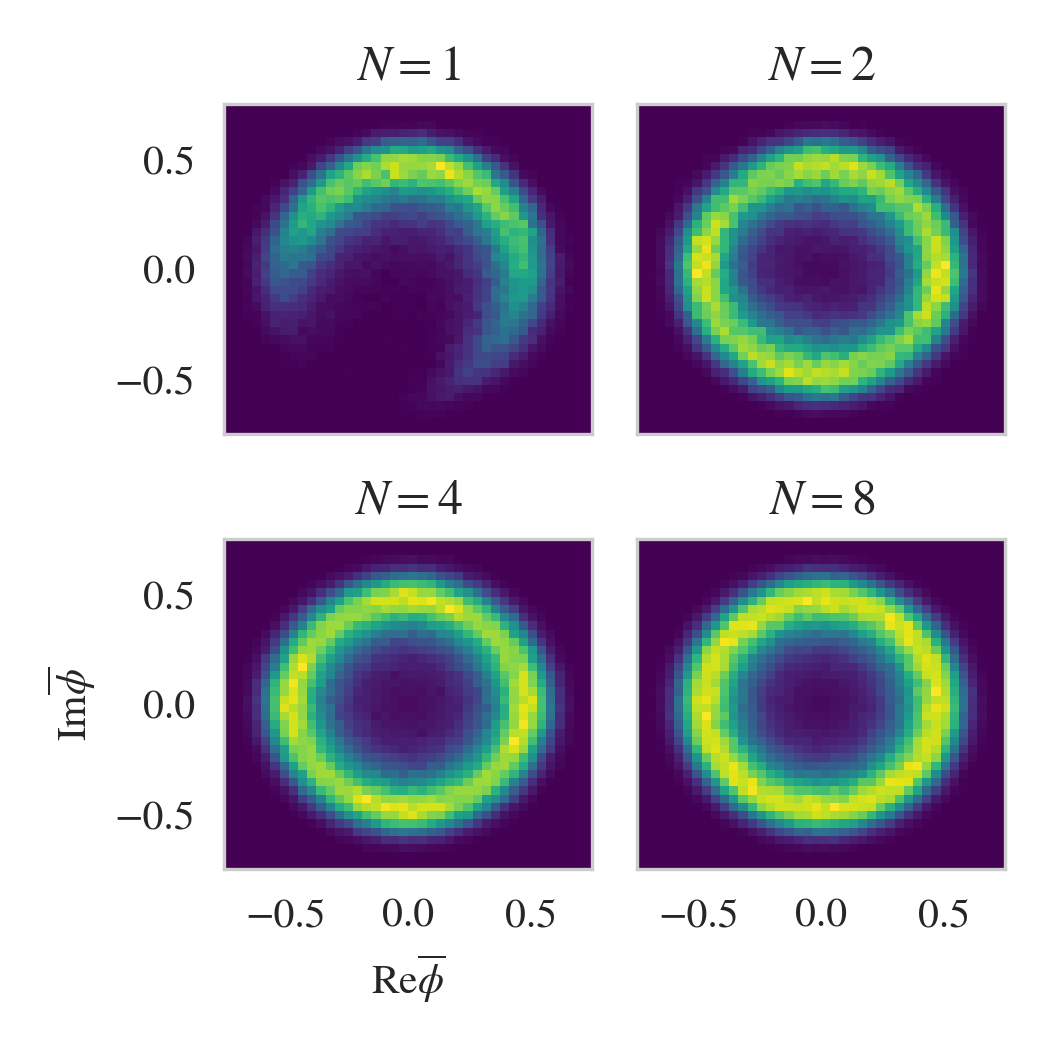
The team tested these methods on two-dimensional real scalar field theory (Z₂ symmetry, discrete modes) and complex scalar field theory (U(1) symmetry, a continuous ring of modes). They tracked quality using the effective sample size, which measures how many independent, usable samples the flow-plus-Metropolis procedure produces per forward pass.
No single method dominates universally. Equivariant flows combined with forwards KL training consistently produced the most reliable results. Mixture models with adaptive weighting also worked well when the symmetry structure wasn’t known in advance.
The most practically powerful contribution is the composite sampling algorithm. Rather than committing entirely to flow-based or HMC sampling, it interleaves HMC steps between flow proposals. The logic is simple: flow models are good at jumping between modes (something HMC almost never manages once topological freezing kicks in), while HMC is good at exploring within a mode (something the flow may do imprecisely). Together, they patch each other’s blind spots.
Why It Matters
Lattice field theory is currently the only systematic, non-perturbative method for calculating nuclear physics from first principles. Quantities like the proton’s internal structure, the neutron’s electric dipole moment, and the masses of exotic hadrons all depend on efficiently sampling field configurations. As physicists push toward finer lattices and more realistic quark masses, topological freezing becomes so severe that even state-of-the-art supercomputer runs can fail to sample all topological sectors.
The authors are careful to frame their 2D scalar field demonstrations as testbeds, not production tools. They have not yet tackled full QCD. But the methods are general and modular. The architectural tricks (equivariance, topology matching, mixtures) and training tricks (forwards KL, adiabatic annealing, flow-distance regularization) all transfer to more complex theories in principle.
The composite sampling framework is especially pragmatic. Rather than waiting for flows that perfectly model QCD, physicists can deploy partially-trained flows to accelerate HMC right now, gaining benefits even when the flow is imperfect.
Bottom Line: By systematically cataloguing and benchmarking strategies to prevent mode collapse in flow-based samplers, this work lays groundwork for applying machine-learning-enhanced sampling to full QCD, potentially unlocking calculations that are computationally out of reach today.
IAIFI Research Highlights

This work applies generative modeling techniques directly to the sampling problems that bottleneck nuclear and particle physics calculations, sitting squarely at the intersection of IAIFI's mission areas.

The paper contributes architectural and training strategies for flow-based generative models in multimodal settings, including forwards KL self-training and flow-distance regularization, with broad applicability to any domain where mode collapse is a concern.

By demonstrating reliable flow-based sampling in symmetry-broken phases of scalar field theories, the work takes a concrete step toward solving topological freezing in lattice QCD, a longstanding obstacle to precision nuclear and hadron physics predictions.
Future directions include scaling these composite and equivariant methods to gauge theories like QCD and developing automated mode-discovery for cases where the symmetry structure is unknown; the full paper is available at [arXiv:2107.00734](https://arxiv.org/abs/2107.00734).
Original Paper Details
Flow-based sampling for multimodal and extended-mode distributions in lattice field theory
2107.00734
["Daniel C. Hackett", "Chung-Chun Hsieh", "Sahil Pontula", "Michael S. Albergo", "Denis Boyda", "Jiunn-Wei Chen", "Kai-Feng Chen", "Kyle Cranmer", "Gurtej Kanwar", "Phiala E. Shanahan"]
Recent results have demonstrated that samplers constructed with flow-based generative models are a promising new approach for configuration generation in lattice field theory. In this paper, we present a set of training- and architecture-based methods to construct flow models for targets with multiple separated modes (i.e.~vacua) as well as targets with extended/continuous modes. We demonstrate the application of these methods to modeling two-dimensional real and complex scalar field theories in their symmetry-broken phases. In this context we investigate different flow-based sampling algorithms, including a composite sampling algorithm where flow-based proposals are occasionally augmented by applying updates using traditional algorithms like HMC.