

Functional renormalization group for signal detection and stochastic ergodicity breaking
Authors
Harold Erbin, Riccardo Finotello, Bio Wahabou Kpera, Vincent Lahoche, Dine Ousmane Samary
Abstract
Signal detection is one of the main challenges of data science. As it often happens in data analysis, the signal in the data may be corrupted by noise. There is a wide range of techniques aimed at extracting the relevant degrees of freedom from data. However, some problems remain difficult. It is notably the case of signal detection in almost continuous spectra when the signal-to-noise ratio is small enough. This paper follows a recent bibliographic line which tackles this issue with field-theoretical methods. Previous analysis focused on equilibrium Boltzmann distributions for some effective field representing the degrees of freedom of data. It was possible to establish a relation between signal detection and $\mathbb{Z}_2$-symmetry breaking. In this paper, we consider a stochastic field framework inspiring by the so-called "Model A", and show that the ability to reach or not an equilibrium state is correlated with the shape of the dataset. In particular, studying the renormalization group of the model, we show that the weak ergodicity prescription is always broken for signals small enough, when the data distribution is close to the Marchenko-Pastur (MP) law. This, in particular, enables the definition of a detection threshold in the regime where the signal-to-noise ratio is small enough.
Concepts
The Big Picture
Imagine trying to pick out a whispered conversation across a crowded, noisy room, except the noise is perfectly calibrated to blur every frequency your voice uses. Not louder than you, just statistically impossible to distinguish from your signal. Standard methods fail. Even sophisticated algorithms struggle. The signal is there, but the math offers no clean handle to grab.
This problem shows up everywhere: biological neural recordings, financial correlations, genomics, high-dimensional machine learning datasets. When a handful of data points clearly stand out from the crowd, existing statistical theory gives you a clean recipe for finding them. But when the signal blends into the background continuously rather than poking out as distinct spikes, you’re largely on your own.
A team of physicists from MIT, CEA Paris-Saclay, and the University of Abomey-Calavi has borrowed one of the most powerful tools in theoretical physics, the functional renormalization group (FRG), and turned it into a precise signal detection threshold. The FRG tracks how a system’s structure changes as you zoom in or out. Here, it works even when the signal-to-noise ratio is frustratingly small.
Key Insight: When a dataset’s statistics match the universal fingerprint of pure random noise, the system’s ability to reach statistical equilibrium breaks down precisely when a signal is present, and the renormalization group flow reveals exactly where that breakdown occurs.
How It Works
Pure noise in high-dimensional data has a universal fingerprint: its eigenvalue spectrum follows the Marchenko-Pastur (MP) distribution, the characteristic curve describing how correlations spread across a large random matrix. This signature is as reliable as a fingerprint. Just as water molecules don’t “know” they’re water when they undergo a phase transition, high-dimensional noise doesn’t care whether it came from a stock market or a brain scan. It follows MP law.
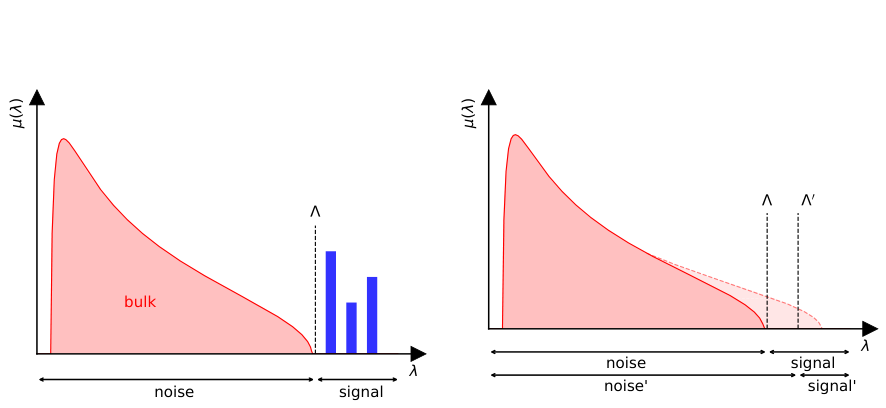
The researchers build an effective field theory for the covariance matrix of the dataset (the table of correlations between all pairs of variables). In an effective field theory, you capture the essential physics without tracking every microscopic detail. Previous work in this line used equilibrium Boltzmann distributions and connected signal detection to Z₂-symmetry breaking, the same mechanism that drives a paramagnet to become a ferromagnet. A system suddenly “picks a side” from an initially balanced, symmetric state.
This paper goes further. Rather than assuming equilibrium, the team introduces dynamics via the Martin-Siggia-Rose (MSR) formalism, a framework from quantum field theory that encodes not just which states a system can occupy, but how it moves between them over time. The model follows “Model A” in the Hohenberg-Halperin classification, a physicist’s toolkit for describing how systems relax toward equilibrium.
The central question: can this stochastic system reach equilibrium at all? The answer depends on the data.
- In a purely noisy dataset (spectrum exactly MP), the system flows toward equilibrium. Renormalization group trajectories converge to a stable fixed point.
- When a signal is present and the dataset departs from MP law, something breaks: the system can no longer thermalize. This is weak ergodicity breaking, where instead of eventually exploring all accessible states, the system gets permanently trapped in a limited region.
The team studies this breakdown using the local potential approximation (LPA) of the FRG, a controlled simplification that retains the key physics while keeping the equations tractable. They write down the Wetterich flow equation, which describes how the system’s energy landscape shifts as fluctuations are peeled away scale by scale. The FRG works as a systematic zoom-out, asking at each step: what are the essential degrees of freedom here?
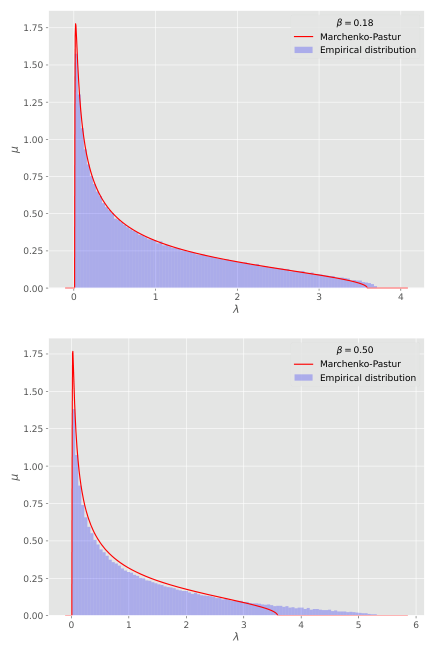
For small signals, the RG flow reveals a sharp transition. Below a critical signal strength, ergodicity always breaks. The system’s inability to equilibrate acts as a direct indicator of the signal’s presence, and the location of this breakdown defines a detection threshold, a precise boundary below which conventional equilibrium analysis declares “no signal” but the stochastic RG analysis says otherwise.
The detection criterion comes not from fitting a model to data, but from the topology of the renormalization group flow itself, an intrinsic property of the theory.
Why It Matters
This work sits at an unusual intersection. It is simultaneously a contribution to pure physics (stochastic field theory, non-equilibrium dynamics, critical phenomena) and a practical data analysis tool with applications across machine learning and signal processing.
The field-theoretic approach brings precision to a problem otherwise handled by heuristics. Framing signal detection as an ergodicity-breaking phase transition gives a principled, physically motivated criterion rather than an ad hoc threshold. For AI research, the implications point toward better tools for understanding structure in high-dimensional datasets, the kind that underlie modern neural network training.
The connection between renormalization group methods and data analysis is relatively new, but this paper advances a concrete program: treat the statistics of data as a field theory, and read off its phase structure to understand what information can or cannot be extracted. Future work could extend the framework to tensor-valued data, non-Gaussian noise models, or dynamical datasets where the covariance matrix itself evolves over time.
Bottom Line: By mapping signal detection onto a stochastic field theory and applying the functional renormalization group, this research establishes a rigorous detection threshold in the hardest regime (low signal-to-noise, nearly continuous spectra), grounding a data science problem in the physics of non-equilibrium phase transitions.
IAIFI Research Highlights

This paper translates the functional renormalization group into a data science tool, establishing a formal equivalence between signal detection thresholds and dynamical phase transitions in stochastic field theory.

The work provides a physics-derived criterion for detecting weak signals in high-dimensional, noise-dominated datasets, a regime where conventional machine learning and statistical methods fail.

The study advances understanding of non-equilibrium stochastic field theories and ergodicity breaking, showing that the Marchenko-Pastur universality class supports a rich phase structure beyond the static equilibrium picture.
Future directions include extending the framework to more complex data geometries and non-Gaussian noise; the full paper is available at [arXiv:2310.07499](https://arxiv.org/abs/2310.07499).
Original Paper Details
Functional renormalization group for signal detection and stochastic ergodicity breaking
[2310.07499](https://arxiv.org/abs/2310.07499)
Harold Erbin, Riccardo Finotello, Bio Wahabou Kpera, Vincent Lahoche, Dine Ousmane Samary