

GWAK: Gravitational-Wave Anomalous Knowledge with Recurrent Autoencoders
Authors
Ryan Raikman, Eric A. Moreno, Ekaterina Govorkova, Ethan J Marx, Alec Gunny, William Benoit, Deep Chatterjee, Rafia Omer, Muhammed Saleem, Dylan S Rankin, Michael W Coughlin, Philip C Harris, Erik Katsavounidis
Abstract
Matched-filtering detection techniques for gravitational-wave (GW) signals in ground-based interferometers rely on having well-modeled templates of the GW emission. Such techniques have been traditionally used in searches for compact binary coalescences (CBCs), and have been employed in all known GW detections so far. However, interesting science cases aside from compact mergers do not yet have accurate enough modeling to make matched filtering possible, including core-collapse supernovae and sources where stochasticity may be involved. Therefore the development of techniques to identify sources of these types is of significant interest. In this paper, we present a method of anomaly detection based on deep recurrent autoencoders to enhance the search region to unmodeled transients. We use a semi-supervised strategy that we name Gravitational Wave Anomalous Knowledge (GWAK). While the semi-supervised nature of the problem comes with a cost in terms of accuracy as compared to supervised techniques, there is a qualitative advantage in generalizing experimental sensitivity beyond pre-computed signal templates. We construct a low-dimensional embedded space using the GWAK method, capturing the physical signatures of distinct signals on each axis of the space. By introducing signal priors that capture some of the salient features of GW signals, we allow for the recovery of sensitivity even when an unmodeled anomaly is encountered. We show that regions of the GWAK space can identify CBCs, detector glitches and also a variety of unmodeled astrophysical sources.
Concepts
The Big Picture
Imagine trying to identify every bird species by sound, but you only have recordings of robins. Your identification system would be excellent at spotting robins and utterly blind to everything else. That’s roughly the situation gravitational-wave astronomers have been living with.
Every detection made by LIGO and Virgo has relied on matched filtering, a technique that compares incoming data against a library of pre-computed signal templates. If your signal isn’t in the library, it’s invisible.
For compact binary mergers (black holes and neutron stars spiraling together) this works beautifully. Physicists can solve Einstein’s equations and generate precise waveform predictions ahead of time. But the universe has other tricks up its sleeve.
Core-collapse supernovae, cosmic strings, neutron star glitches, and exotic primordial black holes all either lack accurate theoretical models or involve too much randomness for any single template to capture. The gravitational-wave sky is almost certainly full of signals we’ve never heard, and current detectors would walk right past them.
A team from MIT, the University of Minnesota, and the University of Pennsylvania built a system to change that. Their method, GWAK (Gravitational-Wave Anomalous Knowledge), uses deep learning to hunt for signals no one has thought to look for yet.
Key Insight: GWAK learns what “interesting” looks like in gravitational-wave data without needing precise signal models. It’s the first systematic search for unknown astrophysical transients.
How It Works
The core of GWAK is a recurrent autoencoder, a neural network that ingests a time-series signal, compresses it into a compact internal representation, and then reconstructs the original. Think of it as a smart compression algorithm: important signal structure survives; random noise gets discarded.
The network learns this compression using Long Short-Term Memory (LSTM) units, specialized memory cells that capture patterns unfolding over time. They’re well-suited for the oscillating, chirping nature of gravitational waves.
But reconstruction loss alone isn’t enough. An autoencoder trained only on background noise will happily reconstruct some signals too, blurring the distinction between noise and something real. GWAK takes a different path.
Instead of a single general-purpose autoencoder, the team trains multiple specialized autoencoders, each optimized to reconstruct a different class of signal:
- Background noise — the normal detector output
- Compact binary coalescences (CBCs) — the chirp-and-merge waveforms already in the detection catalog
- Sine-Gaussians — simple oscillating bursts serving as a proxy for generic transients
- Glitches — non-astrophysical artifacts from the detectors themselves
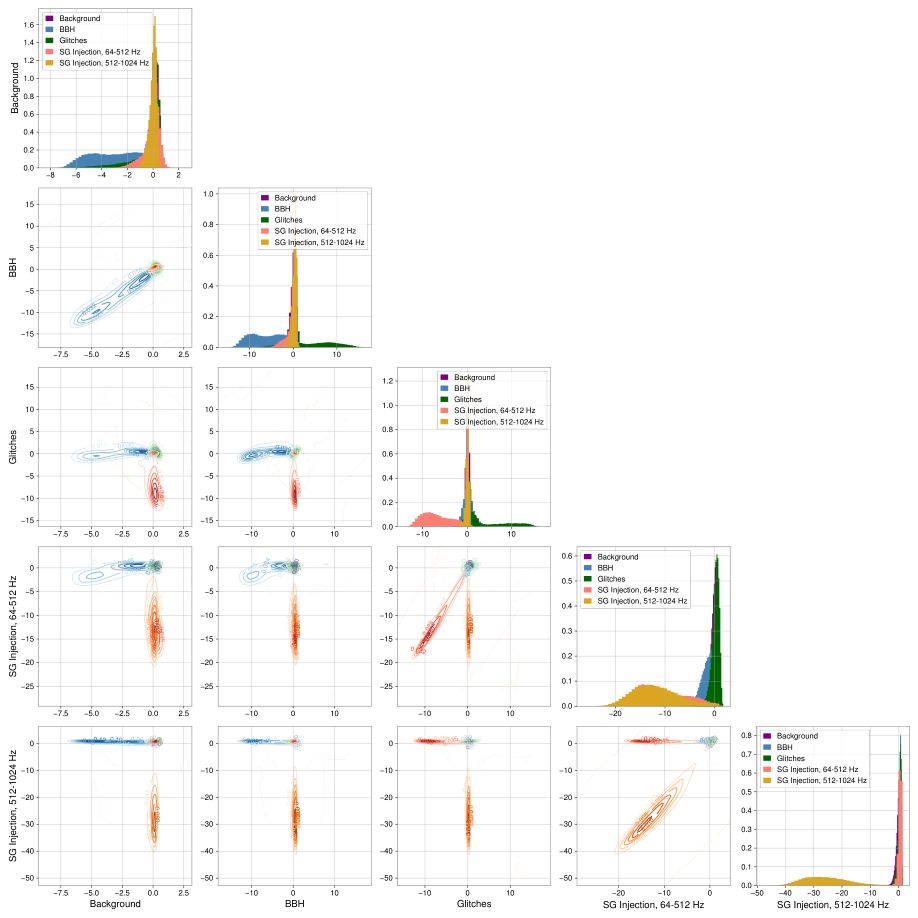
Each autoencoder produces a reconstruction error score for any incoming data. A signal resembling a CBC will have low loss on the CBC autoencoder and high loss on the others. These scores assemble into a single low-dimensional embedded space (the GWAK space), a map where each axis represents one signal class and data points with similar properties cluster together. Real signals separate from noise not by any single score, but by where they land in this multi-dimensional map.
This semi-supervised strategy is what sets GWAK apart. Rather than labeling data as “signal” or “noise” and training a classifier directly, GWAK lets the geometry of the embedded space do the work. A previously unknown signal type should still cluster somewhere distinct, because it will preferentially resemble some priors more than others and appear coherently across multiple detectors simultaneously.
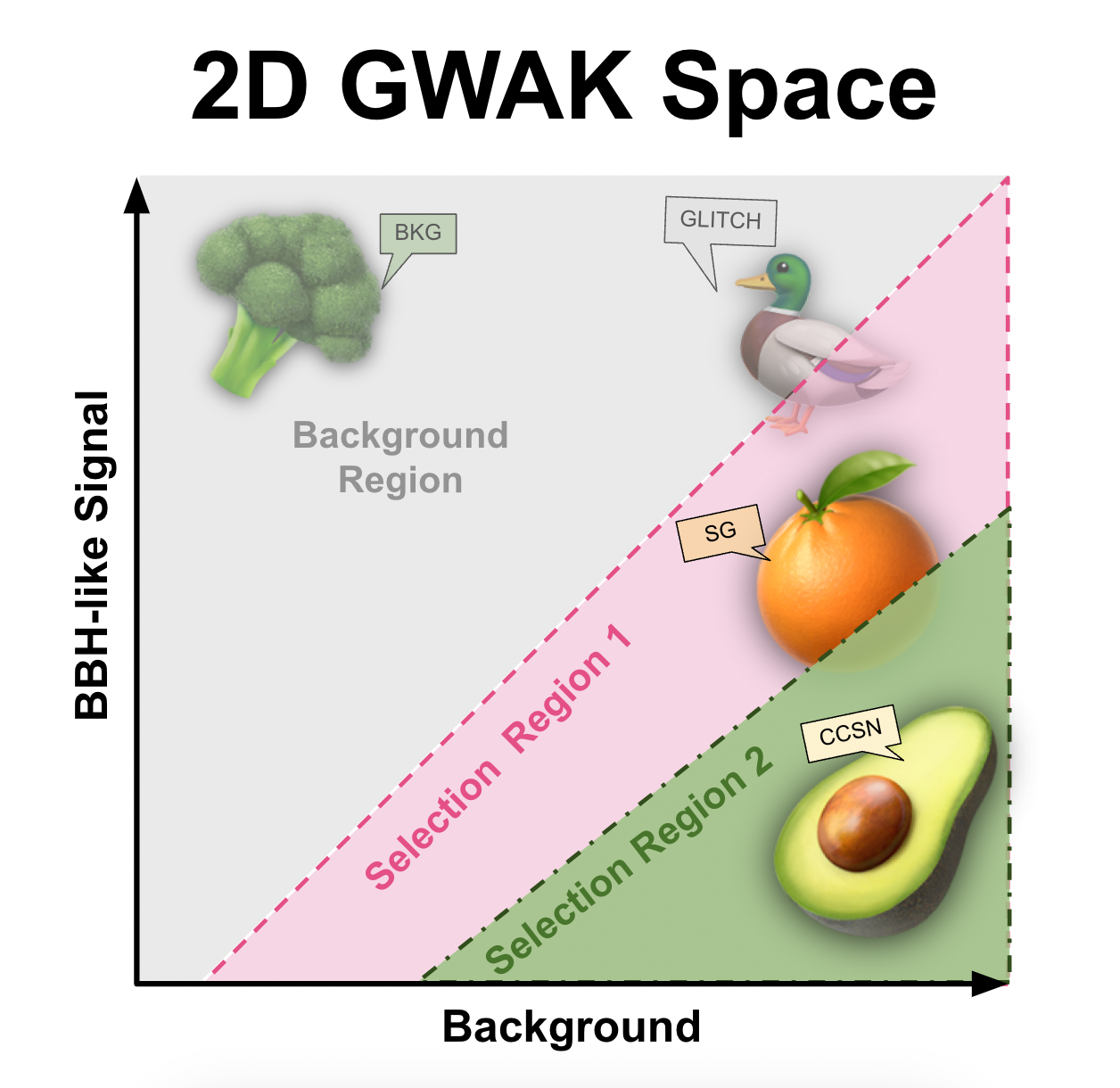
Cross-detector coherence acts as a hard constraint. A real gravitational wave must appear consistently at both LIGO Hanford and LIGO Livingston, with the appropriate light-travel-time delay. Detector glitches, by contrast, appear in only one instrument. This single requirement suppresses false alarms by a large factor without requiring any signal model at all.
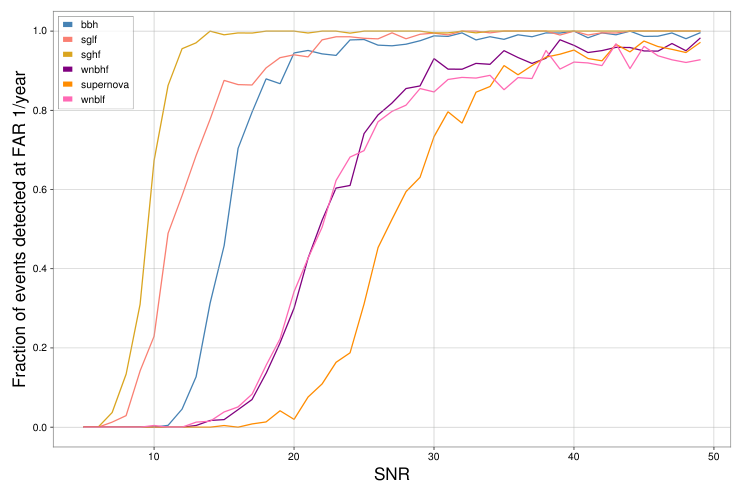
When tested on real LIGO data, GWAK carved out distinct regions of its embedded space for CBCs, for glitches, and for simulated core-collapse supernovae never used in training. The system recovered sensitivity to unmodeled sources because those sources share qualitative features (coherence, oscillatory content) with the known priors.
Why It Matters
Every gravitational-wave detection to date has confirmed something theorists already expected. Black holes merge. Neutron stars merge. The matches between observation and template are spectacular, and also slightly circular. We find what we know to look for.
GWAK expands that sensitivity to the unknown. Core-collapse supernovae are among the most energetic events in the universe, and detecting their gravitational-wave signatures would give astrophysicists a direct view into the collapsing stellar core, a region permanently hidden from light. Cosmic strings, if they exist, would be direct relics of phase transitions in the early universe. These aren’t marginal science cases. They’re some of the biggest open questions in fundamental physics.
The idea reaches well beyond gravitational waves. Semi-supervised anomaly detection, where you learn rich structure from both labeled and unlabeled data and use it to flag new phenomena, matters anywhere theoretical priors are incomplete. Particle physics, cosmology, medical imaging: supervised methods excel at finding what you expect. GWAK-style approaches handle the surprises.
Future work could expand the prior library, incorporate data from Virgo and KAGRA, or adapt the architecture for real-time low-latency alerts. The team frames GWAK as complementary to matched filtering, not a replacement. It’s a tool for the part of the sky that templates don’t reach.
Bottom Line: A carefully structured semi-supervised autoencoder can locate real astrophysical signals in gravitational-wave data without knowing what those signals look like in advance, opening the detector network to a much wider universe.
IAIFI Research Highlights

This work connects deep learning methodology from high-energy physics anomaly detection with gravitational-wave observational astronomy, using recurrent neural networks to tackle a fundamental signal-discovery problem in the LIGO/Virgo network.

GWAK uses an architecture in which multiple specialized autoencoders jointly construct a geometrically meaningful embedding space, a transferable design pattern for anomaly detection in any domain with incomplete signal priors.

By extending gravitational-wave searches beyond matched-filter templates, GWAK opens experimental sensitivity to core-collapse supernovae, cosmic strings, and exotic sources whose discovery could reveal new physics inaccessible through any other observational channel.
Future extensions include real-time deployment and integration with additional IGWN detectors; the full method is described in [arXiv:2309.11537](https://arxiv.org/abs/2309.11537) and code is publicly available at github.com/ML4GW/gwak.
Original Paper Details
GWAK: Gravitational-Wave Anomalous Knowledge with Recurrent Autoencoders
2309.11537
["Ryan Raikman", "Eric A. Moreno", "Ekaterina Govorkova", "Ethan J Marx", "Alec Gunny", "William Benoit", "Deep Chatterjee", "Rafia Omer", "Muhammed Saleem", "Dylan S Rankin", "Michael W Coughlin", "Philip C Harris", "Erik Katsavounidis"]
Matched-filtering detection techniques for gravitational-wave (GW) signals in ground-based interferometers rely on having well-modeled templates of the GW emission. Such techniques have been traditionally used in searches for compact binary coalescences (CBCs), and have been employed in all known GW detections so far. However, interesting science cases aside from compact mergers do not yet have accurate enough modeling to make matched filtering possible, including core-collapse supernovae and sources where stochasticity may be involved. Therefore the development of techniques to identify sources of these types is of significant interest. In this paper, we present a method of anomaly detection based on deep recurrent autoencoders to enhance the search region to unmodeled transients. We use a semi-supervised strategy that we name Gravitational Wave Anomalous Knowledge (GWAK). While the semi-supervised nature of the problem comes with a cost in terms of accuracy as compared to supervised techniques, there is a qualitative advantage in generalizing experimental sensitivity beyond pre-computed signal templates. We construct a low-dimensional embedded space using the GWAK method, capturing the physical signatures of distinct signals on each axis of the space. By introducing signal priors that capture some of the salient features of GW signals, we allow for the recovery of sensitivity even when an unmodeled anomaly is encountered. We show that regions of the GWAK space can identify CBCs, detector glitches and also a variety of unmodeled astrophysical sources.