

Harmonic $1$-forms on real loci of Calabi-Yau manifolds
Authors
Michael R. Douglas, Daniel Platt, Yidi Qi, Rodrigo Barbosa
Abstract
We numerically study whether there exist nowhere vanishing harmonic $1$-forms on the real locus of some carefully constructed examples of Calabi-Yau manifolds, which would then give rise to potentially new examples of $G_2$-manifolds and an explicit description of their metrics. We do this in two steps: first, we use a neural network to compute an approximate Calabi-Yau metric on each manifold. Second, we use another neural network to compute an approximately harmonic $1$-form with respect to the approximate metric, and then inspect the found solution. On two manifolds existence of a nowhere vanishing harmonic $1$-form can be ruled out using differential geometry. The real locus of a third manifold is diffeomorphic to $S^1 \times S^2$, and our numerics suggest that when the Calabi-Yau metric is close to a singular limit, then it admits a nowhere vanishing harmonic $1$-form. We explain how such an approximate solution could potentially be used in a numerically verified proof for the fact that our example manifold must admit a nowhere vanishing harmonic $1$-form.
Concepts
The Big Picture
Mapping territory so complex that no formula could describe it sounds like a contradiction. The terrain exists, mathematicians proved that decades ago, but every attempt to write down its coordinates fails. This is the situation physicists face with Calabi-Yau manifolds: curled-up geometric spaces central to string theory, whose defining shape is provably real yet impossible to express analytically. Probing one slice of such territory might unlock a new class of even stranger spaces that matter deeply to string theory. A team from Harvard, Northeastern, and Imperial College London decided to attack the problem with neural networks.
At stake is a rare object called a G₂-manifold: a seven-dimensional curved space with a special geometric structure. M-theory, the most ambitious framework for unifying all fundamental forces, requires the universe to have extra dimensions too small to observe. Those hidden dimensions must curl into a specific shape, and G₂-manifolds are prime candidates. They are so scarce that mathematicians can count known construction methods on one hand.
A 2021 blueprint by Joyce and Karigiannis showed how to build new G₂-manifolds from Calabi-Yau manifolds, but only if the Calabi-Yau’s real locus admits a special mathematical object. The real locus is the three-dimensional “shadow” cast by the six-dimensional manifold when restricted to real coordinates. The required object is a nowhere-vanishing harmonic 1-form: a smooth vector field pointing in some direction at every point, satisfying a natural equilibrium condition, with no zeros anywhere. Checking whether this can exist requires knowing the Calabi-Yau’s geometry precisely, the very thing no one can write down.
This paper uses two neural networks to do what analytic methods cannot: numerically approximate both the geometry and the desired vector field, then use those approximations to detect whether the real thing can exist.
Key Insight: By training neural networks to approximate elusive Calabi-Yau metrics and harmonic 1-forms simultaneously, the authors find numerical evidence for a new conjectural G₂-manifold, only the second such candidate in the literature.
How It Works
The pipeline has two stages, each powered by a neural network, applied to four carefully chosen example manifolds.
Stage one: approximating the Calabi-Yau metric. The team builds on the bihomogeneous neural network approach, an architecture designed to respect the symmetries of spaces defined by polynomial equations. A correction to the Fubini-Study metric (a natural baseline on projective space) is parametrized and trained to satisfy the complex Monge-Ampère equation, whose solution is the true Calabi-Yau metric. This produces a Ricci-flat geometry, no intrinsic curvature of its own, like a soap film settling into minimal-energy shape. For complete intersection manifolds (spaces carved out by multiple polynomial equations in a higher-dimensional ambient space), the authors extend this approach to handle the more constrained higher-codimension setting.
Stage two: finding the harmonic 1-form. A separate network targets the real locus L ⊂ M. Harmonicity on L means the form is both closed (zero variation around any loop, no “curl”) and co-closed (zero divergence), both measured with respect to the pulled-back approximate metric. The network represents the 1-form using a polynomial basis restricted to L and minimizes a combined loss using Monte Carlo integration, sampling points randomly across the manifold.
The four test cases span a range of topologies:
- Fermat quintic: real locus has first Betti number b₁ = 0, so no non-trivial 1-forms exist. A control.
- Quintic: b₁ = 1, so a harmonic 1-form exists in principle, but classical 3-manifold geometry guarantees it must vanish somewhere. Another control.
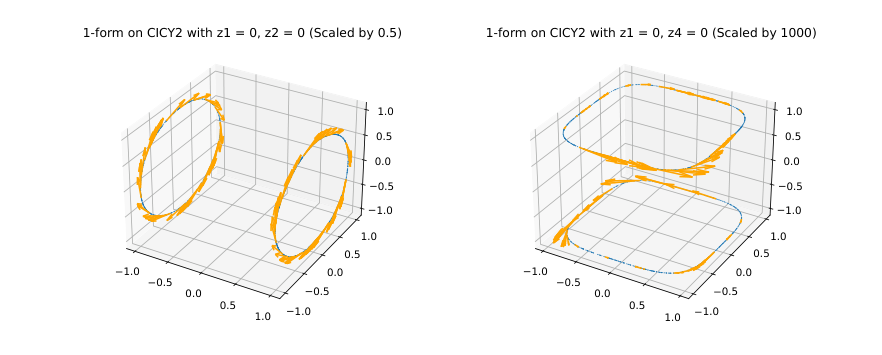
- CICY1 and CICY2: complete intersections of a quadric and a quartic in ℙ⁵. Real loci are topologically S¹ × S², with b₁ = 1 and no topological obstruction to a nowhere-vanishing 1-form.
The paper’s Corollary 3.8 provides the mathematical backbone: if a nowhere-vanishing 1-form exists for an approximate metric sufficiently close to solving Monge-Ampère, then a genuine nowhere-vanishing harmonic 1-form for the true metric must exist nearby. This transforms a numerical finding into a potential pathway toward a computer-assisted proof.
Why It Matters
The results validate the approach on both controls. On the Fermat quintic and Quintic, the approximate 1-forms are either identically near-zero or clearly develop zeros, confirming the network isn’t inventing structure that isn’t there.
CICY2 is where it gets interesting. The approximate harmonic 1-form turns out to be roughly constant along the S¹ direction and roughly zero along S². That is exactly the pattern you’d expect for a true nowhere-vanishing 1-form on S¹ × S², where the natural candidate is simply the differential of the S¹ coordinate.
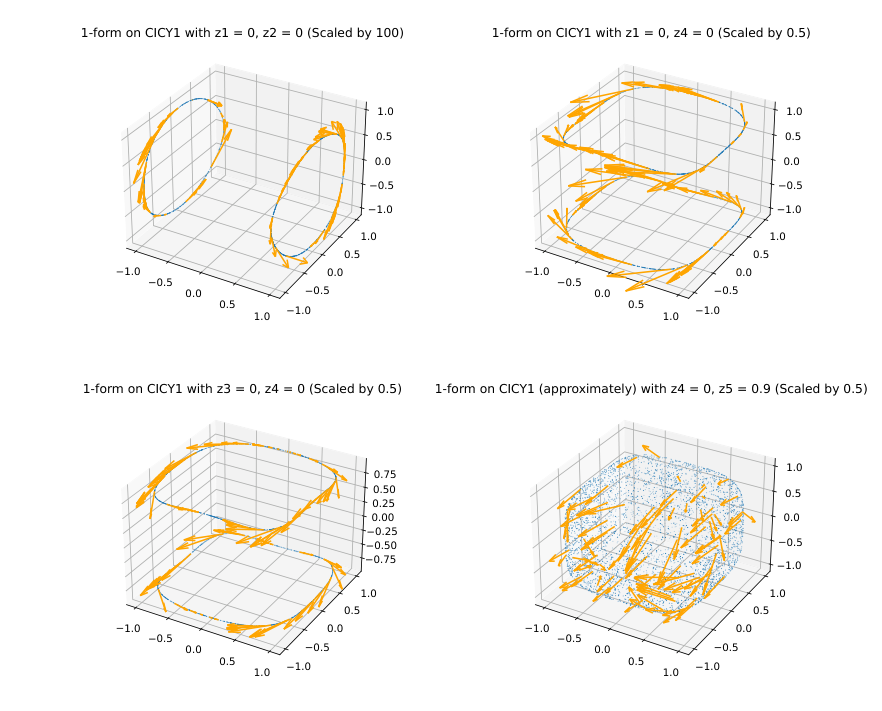
The authors also observe that the Calabi-Yau metric develops long necks near singular limits, regions where the geometry stretches thin as parameters vary. This behavior is analytically guaranteed for hypersurfaces by a 2019 theorem, but was previously unknown for higher-codimension manifolds like CICYs. The neural network simulations provide the first evidence it occurs there too.
What makes this work unusual is its relationship to proof. The authors are explicit that their approximations are not yet accurate enough to complete a formal proof. But Corollary 3.8 already shows how to get there: push the approximation accuracy high enough and a rigorous computer-assisted proof follows.
As training improves (more compute, better architectures, higher-order polynomial bases) the gap between “numerically suggestive” and “rigorously certified” could close. The result would be the first verified new G₂-manifold construction in years, with direct implications for M-theory compactifications and the landscape of possible extra-dimensional geometries.
Bottom Line: Neural networks can probe Calabi-Yau geometry well enough to find new conjectural G₂-manifolds that classical methods cannot reach, and a rigorous mathematical theorem already shows that sufficiently accurate approximations could become genuine proofs.
IAIFI Research Highlights

This work brings together differential geometry, algebraic topology, and deep learning in a single computational framework, using neural networks trained on physical constraints to answer open questions in pure mathematics about G₂-manifolds.

The paper extends neural network approximation of Calabi-Yau metrics from hypersurfaces to complete intersections of higher codimension, and introduces a polynomial-basis network for computing harmonic differential forms on curved manifolds.

The results provide the second conjectural example in the literature of a Calabi-Yau manifold whose real locus supports a nowhere-vanishing harmonic 1-form, a key ingredient for constructing new seven-dimensional G₂-manifolds relevant to M-theory compactifications.
Higher-accuracy approximations could turn this numerical evidence into a computer-assisted proof via Corollary 3.8; see [arXiv:2405.19402](https://arxiv.org/abs/2405.19402) and the accompanying code at [github.com/yidiq7/MLHarmonic-1-form](https://github.com/yidiq7/MLHarmonic-1-form).
Original Paper Details
Harmonic $1$-forms on real loci of Calabi-Yau manifolds
[2405.19402](https://arxiv.org/abs/2405.19402)
["Michael R. Douglas", "Daniel Platt", "Yidi Qi", "Rodrigo Barbosa"]
We numerically study whether there exist nowhere vanishing harmonic $1$-forms on the real locus of some carefully constructed examples of Calabi-Yau manifolds, which would then give rise to potentially new examples of $G_2$-manifolds and an explicit description of their metrics. We do this in two steps: first, we use a neural network to compute an approximate Calabi-Yau metric on each manifold. Second, we use another neural network to compute an approximately harmonic $1$-form with respect to the approximate metric, and then inspect the found solution. On two manifolds existence of a nowhere vanishing harmonic $1$-form can be ruled out using differential geometry. The real locus of a third manifold is diffeomorphic to $S^1 \times S^2$, and our numerics suggest that when the Calabi-Yau metric is close to a singular limit, then it admits a nowhere vanishing harmonic $1$-form. We explain how such an approximate solution could potentially be used in a numerically verified proof for the fact that our example manifold must admit a nowhere vanishing harmonic $1$-form.