

Hydrogen-Poor Superluminous Supernovae in the Nebular Phase: Spectral Diversity Due to Ejecta Ionization as a Probe of the Power Source
Authors
Peter K. Blanchard, Edo Berger, Sebastian Gomez, Matt Nicholl, Ryan Chornock, Harsh Kumar, Raffaella Margutti, Daichi Hiramatsu, Huei Sears
Abstract
We present a large sample of 39 nebular-phase optical spectra of 25 hydrogen-poor superluminous supernovae (SLSNe-I) and jointly analyze them with previously published spectra of 12 events. We measure the properties of key emission features, namely those at 6300, 7300, and 7774 angstroms (associated with [O I], [Ca II]/[O II], and O I, respectively), and find that SLSNe exhibit much wider spectral diversity than normal SNe Ic, primarily in the line ratio $L_{7300}/L_{6300}$, which is highly sensitive to ejecta ionization. Some events exhibit weak [O I] and a clear [O II] contribution to the 7300 angstrom feature, enhancing the ratio, along with [O III] lines at 4363 and 5007 angstroms. Other SLSNe show weak or no lines of ionized oxygen. Moreover, we find that the population exhibits decreasing $L_{7300}/L_{6300}$ over time, while a few outliers instead display sustained high or increasing ratios for extended periods. The ratio $L_{7300}/L_{6300}$ is also correlated with the rise and decline times of the light curves, with slower events exhibiting higher ionization, the first robust connection between early light curve and late-time spectral properties, likely due to the magnetar's impact: slower-evolving SLSNe are generally powered by engines with longer spin-down timescales, which deposit more energy at later phases. Among the events with decreasing $L_{7300}/L_{6300}$, SLSNe with high ionization are on average powered by magnetars with higher thermalized spin-down power, a correlation that is most significant for events with $M_{\rm ej}\lesssim12$ M$_{\odot}$. The ionization in the outliers with increasing $L_{7300}/L_{6300}$ may be due to late CSM interaction. $L_{7300}/L_{6300}$ and its evolution are therefore key diagnostics of SLSN engines and progenitor mass loss.
Concepts
The Big Picture
Somewhere in the distant universe, a star explodes with the brilliance of an entire galaxy. For weeks or months, this single detonation outshines every star in its host system combined, sometimes by a factor of ten or more. These blasts are called superluminous supernovae, and for over a decade, astronomers have argued about what fuels them.
The leading suspect: a magnetar, an ultra-dense stellar remnant left behind after the explosion. Picture a ball not much bigger than a city, spinning hundreds of times per second, with a magnetic field a trillion times stronger than Earth’s. As the magnetar gradually slows its spin, it releases enormous energy into the surrounding debris cloud, inflating it to extreme luminosity.
But proving this scenario requires catching these explosions at the right moment and reading their light with unusual precision.
That moment is the nebular phase. Typically a year or more after the initial explosion, the expanding debris cloud has thinned enough to become transparent. Astronomers can look straight through to the core, like peering into the heart of the blast once the smoke has cleared. A team led by Peter Blanchard at the Center for Astrophysics | Harvard & Smithsonian has assembled the largest collection of these late-time observations ever studied, and found a surprisingly clean fingerprint of the magnetar hiding in a simple measurement of light.
Key Insight: The ratio of two spectral emission lines (specific colors of light emitted by oxygen atoms at 7300 and 6300 Ångströms) acts as a thermometer for how energized the debris is, and that thermometer directly tracks the power output of the central magnetar engine.
How It Works
The team spent five years gathering 39 new nebular-phase optical spectra of 25 SLSNe-I, combining them with 12 previously published events for a total of 37 supernovae. Observations came from Keck, Gemini, and MMT, some of the most powerful ground-based telescopes available.
At these late times (often 200 to 500+ days after peak brightness) the expanding ejecta, the debris hurled outward by the explosion, has thinned enough that spectroscopy probes the inner regions directly. Three spectral features dominate the analysis:
- [O I] at 6300 Å: neutral oxygen, a “forbidden” emission line produced only under extremely low-density conditions, from low-ionization gas
- [Ca II]/[O II] at 7300 Å: a blend that includes ionized oxygen ([O II]) when ionization is high
- O I at 7774 Å: a “permitted” oxygen line used to cross-check the analysis
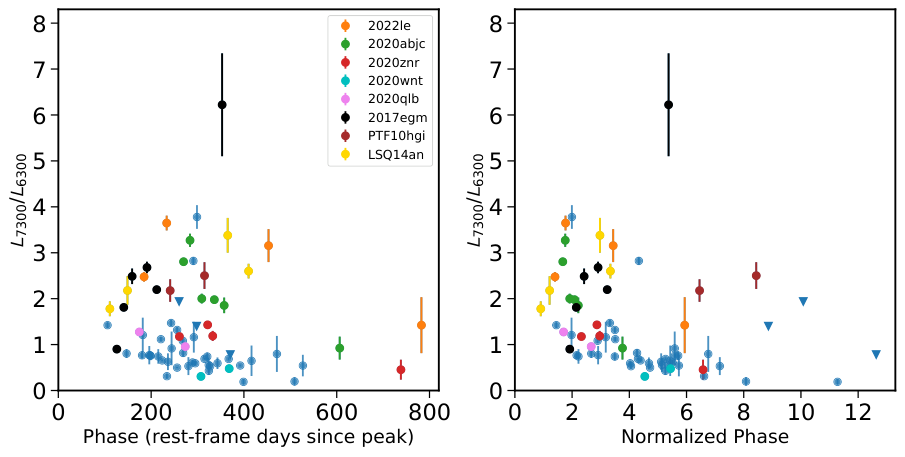
The diagnostic at the center of this work is the line ratio L₇₃₀₀/L₆₃₀₀. When ionization is high, more ionized oxygen contributes to the 7300 Å feature, driving the ratio upward. Some supernovae also show [O III] emission, oxygen doubly ionized, requiring even more energetic conditions. Others show no ionized oxygen at all.
Normal stripped-envelope supernovae (SNe Ic, the closest structural analogs to SLSNe) cluster in a narrow range of nebular line ratios. SLSNe-I scatter across a much wider range, with some showing L₇₃₀₀/L₆₃₀₀ more than three times larger than normal SNe Ic. That spread carries physical information.
Here’s where it gets interesting. The line ratio correlates with the light curve, how the supernova brightened and faded in the weeks before the nebular spectra were taken. Supernovae that rise and fall more slowly show higher ionization at late times. This is the first confirmed link between an SLSN’s early light curve behavior and its late-time spectral properties.
The magnetar scenario explains this cleanly. Slower light curves indicate magnetars with longer spin-down timescales, meaning the magnetar continues injecting energy into the ejecta long after the explosion, keeping it ionized. Among events where the ionization ratio is decreasing over time, those with higher values are powered by magnetars with higher thermalized spin-down power: more rotational energy converted to heat and deposited into the surrounding gas. This trend is strongest for supernovae with ejected masses below about 12 solar masses.
A handful of outliers complicate the picture. Several events show increasing L₇₃₀₀/L₆₃₀₀ over time, or sustained high ratios for unusually long periods. The team argues these may reflect circumstellar medium (CSM) interaction, where the expanding debris plows into material the progenitor star shed before it died. That collision injects fresh energy that mimics, but does not replicate, the magnetar signature.
Why It Matters
Superluminous supernovae sit at the intersection of stellar physics, compact object formation, and cosmology. Understanding what powers them matters for tracing the deaths of massive stars in the early universe, evaluating them as potential distance indicators, and connecting them to other engine-driven transients like long gamma-ray bursts.
The magnetar hypothesis has been compelling for years but hard to prove. Observational evidence was scattered and indirect, until now.
By measuring a single spectral diagnostic across 37 events spanning a wide range of timescales, luminosities, and host environments, the team shows that the magnetar’s fingerprint is encoded in the oxygen ionization state of the nebular ejecta. The line ratio L₇₃₀₀/L₆₃₀₀ and its time evolution now provide a direct probe of engine properties: spin-down timescale, thermalized power output, and ejecta mass.
Future spectroscopic surveys can apply this diagnostic to hundreds of events. Combined with spectral classification techniques, it could enable automated characterization of SLSN engines at cosmological distances, turning a spectroscopic insight into a statistical tool.
Bottom Line: A simple ratio of two oxygen emission lines reveals what’s powering the brightest supernovae in the universe, and a five-year spectroscopic campaign has validated it as a reliable engine diagnostic across the largest SLSN nebular sample ever assembled.
IAIFI Research Highlights

This work connects observational spectroscopy, magnetar microphysics, and stellar evolution theory. Late-time optical data constrain the properties of a compact object formed milliseconds after core collapse, linking observations spanning years to physics occurring on scales of kilometers.

The large, systematically collected spectral dataset lays groundwork for future machine learning classifiers of supernova engine types, illustrating how data-intensive observational campaigns can feed AI-driven characterization of transient populations at scale.

The study delivers the first observational link between an SLSN's early light curve and its late-time ionization state, directly confirming magnetar spin-down as the dominant power source and providing quantitative constraints on spin-down timescale and thermalized power output.
Future surveys with next-generation telescopes will expand nebular SLSN samples by an order of magnitude, making L₇₃₀₀/L₆₃₀₀ a statistical tool for mapping the magnetar population across cosmic time; this work is available at [arXiv:2511.10747](https://arxiv.org/abs/2511.10747).