

Improving neutrino energy estimation of charged-current interaction events with recurrent neural networks in MicroBooNE
Authors
MicroBooNE collaboration, P. Abratenko, O. Alterkait, D. Andrade Aldana, L. Arellano, J. Asaadi, A. Ashkenazi, S. Balasubramanian, B. Baller, A. Barnard, G. Barr, D. Barrow, J. Barrow, V. Basque, J. Bateman, O. Benevides Rodrigues, S. Berkman, A. Bhanderi, A. Bhat, M. Bhattacharya, M. Bishai, A. Blake, B. Bogart, T. Bolton, J. Y. Book, M. B. Brunetti, L. Camilleri, Y. Cao, D. Caratelli, F. Cavanna, G. Cerati, A. Chappell, Y. Chen, J. M. Conrad, M. Convery, L. Cooper-Troendle, J. I. Crespo-Anadon, R. Cross, M. Del Tutto, S. R. Dennis, P. Detje, R. Diurba, Z. Djurcic, R. Dorrill, K. Duffy, S. Dytman, B. Eberly, P. Englezos, A. Ereditato, J. J. Evans, R. Fine, B. T. Fleming, W. Foreman, D. Franco, A. P. Furmanski, F. Gao, D. Garcia-Gamez, S. Gardiner, G. Ge, S. Gollapinni, E. Gramellini, P. Green, H. Greenlee, L. Gu, W. Gu, R. Guenette, P. Guzowski, L. Hagaman, O. Hen, C. Hilgenberg, G. A. Horton-Smith, Z. Imani, B. Irwin, M. S. Ismail, C. James, X. Ji, J. H. Jo, R. A. Johnson, Y. J. Jwa, D. Kalra, N. Kamp, G. Karagiorgi, W. Ketchum, M. Kirby, T. Kobilarcik, I. Kreslo, N. Lane, I. Lepetic, J. -Y. Li, Y. Li, K. Lin, B. R. Littlejohn, H. Liu, W. C. Louis, X. Luo, C. Mariani, D. Marsden, J. Marshall, N. Martinez, D. A. Martinez Caicedo, S. Martynenko, A. Mastbaum, I. Mawby, N. McConkey, V. Meddage, J. Mendez, J. Micallef, K. Miller, K. Mistry, T. Mohayai, A. Mogan, M. Mooney, A. F. Moor, C. D. Moore, L. Mora Lepin, M. M. Moudgalya, S. Mulleria Babu, D. Naples, A. Navrer-Agasson, N. Nayak, M. Nebot-Guinot, J. Nowak, N. Oza, O. Palamara, N. Pallat, V. Paolone, A. Papadopoulou, V. Papavassiliou, H. Parkinson, S. F. Pate, N. Patel, Z. Pavlovic, E. Piasetzky, K. Pletcher, I. Pophale, X. Qian, J. L. Raaf, V. Radeka, A. Rafique, M. Reggiani-Guzzo, L. Ren, L. Rochester, J. Rodriguez Rondon, M. Rosenberg, M. Ross-Lonergan, I. Safa, G. Scanavini, D. W. Schmitz, A. Schukraft, W. Seligman, M. H. Shaevitz, R. Sharankova, J. Shi, E. L. Snider, M. Soderberg, S. Soldner-Rembold, J. Spitz, M. Stancari, J. St. John, T. Strauss, A. M. Szelc, W. Tang, N. Taniuchi, K. Terao, C. Thorpe, D. Torbunov, D. Totani, M. Toups, A. Trettin, Y. -T. Tsai, J. Tyler, M. A. Uchida, T. Usher, B. Viren, M. Weber, H. Wei, A. J. White, S. Wolbers, T. Wongjirad, M. Wospakrik, K. Wresilo, W. Wu, E. Yandel, T. Yang, L. E. Yates, H. W. Yu, G. P. Zeller, J. Zennamo, C. Zhang
Abstract
We present a deep learning-based method for estimating the neutrino energy of charged-current neutrino-argon interactions. We employ a recurrent neural network (RNN) architecture for neutrino energy estimation in the MicroBooNE experiment, utilizing liquid argon time projection chamber (LArTPC) detector technology. Traditional energy estimation approaches in LArTPCs, which largely rely on reconstructing and summing visible energies, often experience sizable biases and resolution smearing because of the complex nature of neutrino interactions and the detector response. The estimation of neutrino energy can be improved after considering the kinematics information of reconstructed final-state particles. Utilizing kinematic information of reconstructed particles, the deep learning-based approach shows improved resolution and reduced bias for the muon neutrino Monte Carlo simulation sample compared to the traditional approach. In order to address the common concern about the effectiveness of this method on experimental data, the RNN-based energy estimator is further examined and validated with dedicated data-simulation consistency tests using MicroBooNE data. We also assess its potential impact on a neutrino oscillation study after accounting for all statistical and systematic uncertainties and show that it enhances physics sensitivity. This method has good potential to improve the performance of other physics analyses.
Concepts
The Big Picture
Imagine reconstructing a car crash from only the skid marks, broken glass, and displaced bumpers, never having witnessed the collision itself. That’s roughly the challenge neutrino physicists face daily. Neutrinos are nearly massless, electrically neutral particles that zip through matter at close to the speed of light, interacting so rarely that detecting even one requires massive, exquisitely sensitive detectors. When they do interact, physicists must work backward from the debris to determine the original neutrino energy.
This matters enormously. Neutrino energy governs how particles oscillate, morphing between different flavors (electron, muon, tau) as they travel. Neutrino oscillations are one of the clearest windows into physics beyond the Standard Model, proving neutrinos have mass and potentially explaining why the universe contains matter rather than antimatter. To exploit oscillations, you need to know the neutrino’s energy. Precisely.
Now the MicroBooNE collaboration, over 200 physicists across more than 40 institutions, has demonstrated that a recurrent neural network (RNN) outperforms conventional methods, with improvements validated on real experimental data from their detector in Illinois.
Key Insight: By feeding particle kinematic information into an RNN, MicroBooNE achieves reduced bias and improved energy resolution compared to the traditional approach of summing detected energy deposits, and the network holds up when tested against real data.
How It Works
The MicroBooNE detector is a liquid argon time projection chamber (LArTPC): a 170-ton tank of ultra-pure liquid argon that doubles as both neutrino target and detector medium. When a neutrino strikes an argon nucleus, it produces a cascade of final-state particles, primarily a muon plus a spray of hadrons (protons, pions, and their kin). These particles ionize the argon, and the resulting electron clouds drift toward wire planes, producing 2D projections that get reconstructed into 3D particle tracks.
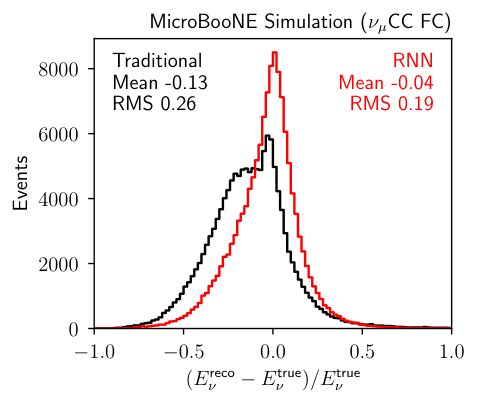
The traditional approach sounds simple enough: sum all the visible energy deposited in the detector. In practice, it runs into serious problems. Neutrons escape without leaving ionization trails. Nuclear binding energy gets absorbed by the argon nucleus. Detector gaps and inefficiencies pile on top. The result is systematic bias, with reconstructed energy consistently undershooting the true value, and poor resolution, where even events at identical true energies scatter widely.
The RNN takes a different approach entirely. Instead of integrating raw energy deposits, the network ingests the kinematic properties of individual reconstructed particles. The RNN architecture handles variable-length sequences naturally, which matters because the number of final-state particles differs from event to event. One interaction might produce a muon and a single proton; another might produce a muon, three protons, and several pions.
The input features include:
- Momentum magnitude and direction (polar and azimuthal angles) for each reconstructed particle
- Particle type (muon vs. hadron), identified using existing reconstruction tools
- A flag marking the primary muon candidate
The network processes each particle in turn, updating an internal hidden state that acts as a running summary of everything it has seen so far, then outputs an energy estimate for the whole event. Training uses Monte Carlo (MC) simulated events that generate realistic neutrino interactions, teaching the network a mapping from reconstructed kinematics to true neutrino energy. After training, it runs inference on both held-out MC samples and real MicroBooNE data collected from 2016 to 2018.
Why It Matters
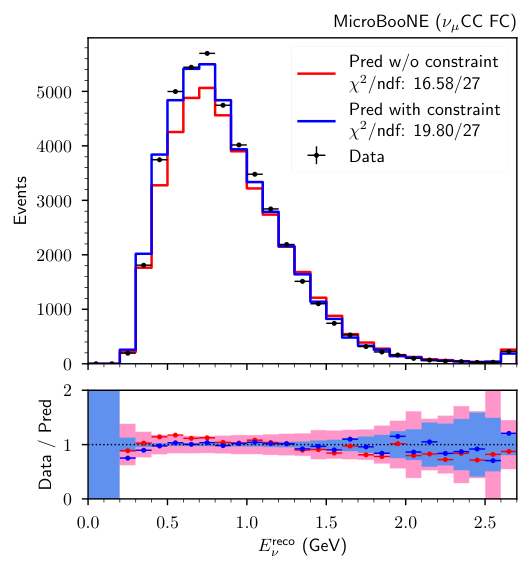
The validation is what sets this apart. Machine learning methods can latch onto features of simulated data that don’t exist in real detectors. A network that looks great in simulation might fall apart on actual data. To guard against this, the team ran data-MC consistency tests comparing RNN output distributions between real data and simulation across multiple kinematic regimes. The agreement held up, confirming the network isn’t memorizing simulation artifacts.
The payoff shows up directly in physics reach. When tested against a neutrino oscillation analysis searching for sterile neutrino signatures (hypothetical particle types that would not interact via any known force), the RNN-based estimator improves sensitivity over the traditional approach. That improvement survives a full treatment of statistical and systematic uncertainties, which in neutrino physics are notoriously large, covering everything from interaction cross-sections to detector response modeling. Getting through that gauntlet intact is a meaningful result.
The RNN framework handles any set of reconstructed particles without assuming a fixed event topology, making it adaptable to other interaction channels, other LArTPC experiments, or different detector technologies. Upcoming experiments SBND and ICARUS (which share the same Fermilab neutrino beamline) and the next-generation DUNE detector are natural candidates to pick this up.
One open question: how to handle systematic uncertainties directly within network training. Currently they are assessed after the fact. Future iterations that incorporate uncertainty-aware training could squeeze out further sensitivity gains.
Bottom Line: MicroBooNE’s RNN-based energy estimator outperforms the conventional visible-energy method in both bias and resolution, survives real-data validation, and improves sensitivity for neutrino oscillation searches, establishing a blueprint for deep learning in next-generation neutrino detectors.
IAIFI Research Highlights

This work applies sequence models originally developed for natural language processing to particle physics, showing they handle the variable-multiplicity structure of neutrino interaction events naturally and effectively.

The RNN framework provides a practical methodology for deploying learned energy regressors on real experimental data, including data-MC consistency validation, a step often missing from ML-in-physics demonstrations.

Improved neutrino energy resolution directly sharpens oscillation measurements, narrowing uncertainty on CP violation in the lepton sector and the potential existence of sterile neutrinos beyond the Standard Model.
The method is immediately applicable to SBND, ICARUS, and future DUNE analyses; the full paper and results are available at [arXiv:2406.10123](https://arxiv.org/abs/2406.10123).
Original Paper Details
Improving neutrino energy estimation of charged-current interaction events with recurrent neural networks in MicroBooNE
2406.10123
["MicroBooNE collaboration", "P. Abratenko", "O. Alterkait", "D. Andrade Aldana", "L. Arellano", "J. Asaadi", "A. Ashkenazi", "S. Balasubramanian", "B. Baller", "A. Barnard", "G. Barr", "D. Barrow", "J. Barrow", "V. Basque", "J. Bateman", "O. Benevides Rodrigues", "S. Berkman", "A. Bhanderi", "A. Bhat", "M. Bhattacharya", "M. Bishai", "A. Blake", "B. Bogart", "T. Bolton", "J. Y. Book", "M. B. Brunetti", "L. Camilleri", "Y. Cao", "D. Caratelli", "F. Cavanna", "G. Cerati", "A. Chappell", "Y. Chen", "J. M. Conrad", "M. Convery", "L. Cooper-Troendle", "J. I. Crespo-Anadon", "R. Cross", "M. Del Tutto", "S. R. Dennis", "P. Detje", "R. Diurba", "Z. Djurcic", "R. Dorrill", "K. Duffy", "S. Dytman", "B. Eberly", "P. Englezos", "A. Ereditato", "J. J. Evans", "R. Fine", "B. T. Fleming", "W. Foreman", "D. Franco", "A. P. Furmanski", "F. Gao", "D. Garcia-Gamez", "S. Gardiner", "G. Ge", "S. Gollapinni", "E. Gramellini", "P. Green", "H. Greenlee", "L. Gu", "W. Gu", "R. Guenette", "P. Guzowski", "L. Hagaman", "O. Hen", "C. Hilgenberg", "G. A. Horton-Smith", "Z. Imani", "B. Irwin", "M. S. Ismail", "C. James", "X. Ji", "J. H. Jo", "R. A. Johnson", "Y. J. Jwa", "D. Kalra", "N. Kamp", "G. Karagiorgi", "W. Ketchum", "M. Kirby", "T. Kobilarcik", "I. Kreslo", "N. Lane", "I. Lepetic", "J. -Y. Li", "Y. Li", "K. Lin", "B. R. Littlejohn", "H. Liu", "W. C. Louis", "X. Luo", "C. Mariani", "D. Marsden", "J. Marshall", "N. Martinez", "D. A. Martinez Caicedo", "S. Martynenko", "A. Mastbaum", "I. Mawby", "N. McConkey", "V. Meddage", "J. Mendez", "J. Micallef", "K. Miller", "K. Mistry", "T. Mohayai", "A. Mogan", "M. Mooney", "A. F. Moor", "C. D. Moore", "L. Mora Lepin", "M. M. Moudgalya", "S. Mulleria Babu", "D. Naples", "A. Navrer-Agasson", "N. Nayak", "M. Nebot-Guinot", "J. Nowak", "N. Oza", "O. Palamara", "N. Pallat", "V. Paolone", "A. Papadopoulou", "V. Papavassiliou", "H. Parkinson", "S. F. Pate", "N. Patel", "Z. Pavlovic", "E. Piasetzky", "K. Pletcher", "I. Pophale", "X. Qian", "J. L. Raaf", "V. Radeka", "A. Rafique", "M. Reggiani-Guzzo", "L. Ren", "L. Rochester", "J. Rodriguez Rondon", "M. Rosenberg", "M. Ross-Lonergan", "I. Safa", "G. Scanavini", "D. W. Schmitz", "A. Schukraft", "W. Seligman", "M. H. Shaevitz", "R. Sharankova", "J. Shi", "E. L. Snider", "M. Soderberg", "S. Soldner-Rembold", "J. Spitz", "M. Stancari", "J. St. John", "T. Strauss", "A. M. Szelc", "W. Tang", "N. Taniuchi", "K. Terao", "C. Thorpe", "D. Torbunov", "D. Totani", "M. Toups", "A. Trettin", "Y. -T. Tsai", "J. Tyler", "M. A. Uchida", "T. Usher", "B. Viren", "M. Weber", "H. Wei", "A. J. White", "S. Wolbers", "T. Wongjirad", "M. Wospakrik", "K. Wresilo", "W. Wu", "E. Yandel", "T. Yang", "L. E. Yates", "H. W. Yu", "G. P. Zeller", "J. Zennamo", "C. Zhang"]
We present a deep learning-based method for estimating the neutrino energy of charged-current neutrino-argon interactions. We employ a recurrent neural network (RNN) architecture for neutrino energy estimation in the MicroBooNE experiment, utilizing liquid argon time projection chamber (LArTPC) detector technology. Traditional energy estimation approaches in LArTPCs, which largely rely on reconstructing and summing visible energies, often experience sizable biases and resolution smearing because of the complex nature of neutrino interactions and the detector response. The estimation of neutrino energy can be improved after considering the kinematics information of reconstructed final-state particles. Utilizing kinematic information of reconstructed particles, the deep learning-based approach shows improved resolution and reduced bias for the muon neutrino Monte Carlo simulation sample compared to the traditional approach. In order to address the common concern about the effectiveness of this method on experimental data, the RNN-based energy estimator is further examined and validated with dedicated data-simulation consistency tests using MicroBooNE data. We also assess its potential impact on a neutrino oscillation study after accounting for all statistical and systematic uncertainties and show that it enhances physics sensitivity. This method has good potential to improve the performance of other physics analyses.