

Learning Force Control for Legged Manipulation
Authors
Tifanny Portela, Gabriel B. Margolis, Yandong Ji, Pulkit Agrawal
Abstract
Controlling contact forces during interactions is critical for locomotion and manipulation tasks. While sim-to-real reinforcement learning (RL) has succeeded in many contact-rich problems, current RL methods achieve forceful interactions implicitly without explicitly regulating forces. We propose a method for training RL policies for direct force control without requiring access to force sensing. We showcase our method on a whole-body control platform of a quadruped robot with an arm. Such force control enables us to perform gravity compensation and impedance control, unlocking compliant whole-body manipulation. The learned whole-body controller with variable compliance makes it intuitive for humans to teleoperate the robot by only commanding the manipulator, and the robot's body adjusts automatically to achieve the desired position and force. Consequently, a human teleoperator can easily demonstrate a wide variety of loco-manipulation tasks. To the best of our knowledge, we provide the first deployment of learned whole-body force control in legged manipulators, paving the way for more versatile and adaptable legged robots.
Concepts
The Big Picture
Imagine trying to thread a needle while wearing oven mitts. That’s roughly the challenge facing most robot arms when they interact with the physical world: they know where to move, but they have no intuitive sense of how hard to push. Too little force and the task fails. Too much, and something breaks.
For four-legged robots like quadrupeds, this problem compounds. Every step the legs take ripples through the entire body and changes the forces at the arm’s tip.
Researchers at MIT’s Improbable AI Lab took a different approach. Most robot controllers today achieve forceful interactions only as a side effect of position commands. They keep moving the arm until it reaches a target location, and force is whatever happens to result from that motion. What this team built instead is a controller that can be directly told how hard to push, coordinating all four legs and the arm together to hit that target precisely.
The result: a four-legged robot with an arm that has calibrated, controllable touch.
Key Insight: By training a reinforcement learning policy to track explicit force commands, without any dedicated force sensors, the researchers achieved compliant, whole-body manipulation on a quadruped robot. This makes it far more intuitive for humans to teleoperate and opens a path toward safer, more versatile robotic assistants.
How It Works
The team reframed the learning problem. Standard sim-to-real reinforcement learning (RL) trains a robot policy in a physics simulation, then deploys it in the real world. This has become the dominant paradigm for legged locomotion, but those policies typically learn to achieve positions, not forces. The MIT team added a force-tracking objective directly into the training loop.
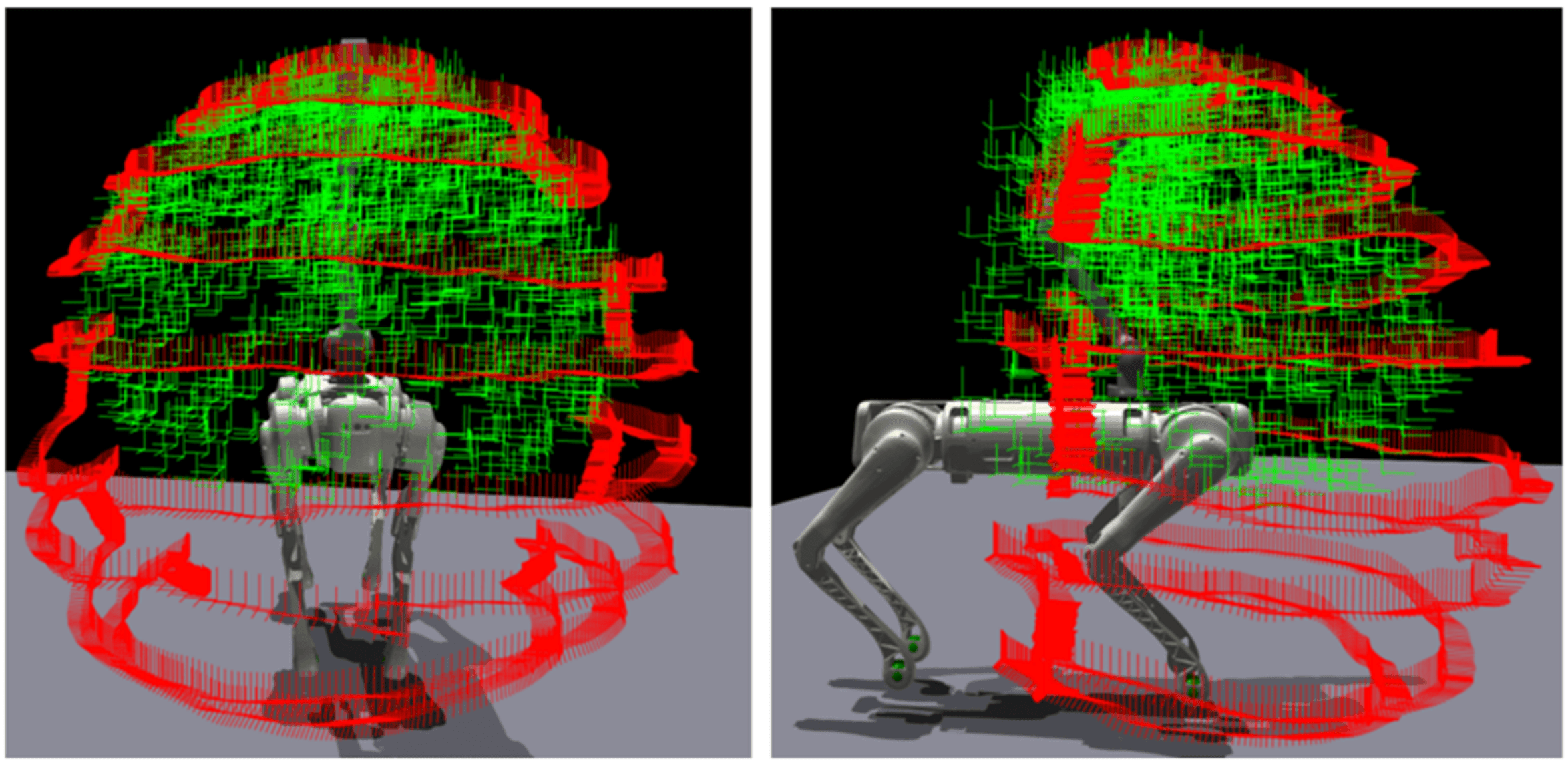
Here’s the clever part: rather than equipping the robot with expensive wrist force-torque sensors, the policy learns to estimate contact forces entirely from proprioception, the robot’s internal sense of its own joint positions, velocities, and motor torques. No additional hardware. The policy infers how hard the gripper is pushing from the same signals a human feels as muscle tension and joint resistance.
Training happens in a carefully designed simulation environment. The researchers place the robot in a virtual “potential field,” a simulated spring pulling the gripper toward a randomized target point. This forces the policy to push against varying resistances and learn what different force magnitudes feel like proprioceptively. The policy receives three types of commands simultaneously:
- A base velocity command telling the body where to walk
- An end-effector position command telling the arm where to place the gripper (the end-effector is the tool at the tip of the arm)
- A force command specifying how hard to press at the gripper
A single neural network, the whole-body controller, coordinates all four legs and the arm at once to execute these commands. When the arm needs to push harder, the legs automatically shift weight and reposition the torso to provide a stable foundation. The human teleoperator doesn’t manage any of this. They simply command “push with 10 Newtons” and the robot handles the rest.
This architecture produces two classical control behaviors that roboticists have prized for decades. Gravity compensation makes the arm feel weightless when a human physically guides it; the robot cancels out its own arm’s mass so a person can move it through tasks by hand. Impedance control lets the operator set the gripper’s effective stiffness: dial it up for precise positioning, dial it down for compliant contact with fragile or irregular surfaces. Both behaviors emerge from the same learned force controller, simply by changing the commanded force profile.
Why It Matters
Legged robots have become good at locomotion: running, jumping, navigating rubble, recovering from falls. Manipulation robots have mastered dexterous grasping and assembly. But combining both, with enough finesse to interact safely with humans and fragile environments, has remained stubbornly difficult.
Force control is what’s missing for a wide class of real-world tasks. Think of a robot that needs to wipe a surface without scratching it, tighten a bolt to a specific torque, or help an elderly person stand without jerking. All of these require knowing not just where to move, but how hard to push at every instant.
That the MIT team pulled this off without force sensors matters a lot for deployment. Sensors add cost, fragility, and failure modes. A robot that infers forces from its own proprioception is cheaper and more durable.
The teleoperation angle deserves attention too. By making force a first-class commanded quantity, the researchers made it easy for a single human operator to demonstrate complex manipulation tasks: pulling open drawers, handling objects with varying weights, applying sustained pressure. That demonstration data becomes fuel for the next generation of imitation learning systems, potentially speeding up the path toward robots that learn manipulation from human demonstrations at scale.
Bottom Line: MIT researchers trained a quadruped robot to directly control the forces it applies, without force sensors, by learning from simulation alone. This is the first legged robot to deploy learned whole-body force control in the real world, enabling compliant, intuitive manipulation that could change how robots work alongside humans in unstructured environments.
IAIFI Research Highlights

This work connects reinforcement learning theory with classical robotics concepts like impedance control and gravity compensation. Learned neural policies can recover principled force-regulation behaviors without explicit physics-based programming.

The research extends sim-to-real RL by introducing explicit force-tracking objectives and proprioceptive force estimation, expanding what learned policies can do beyond position control into compliant physical interaction.

By modeling contact mechanics through a potential-field training environment and proprioceptive feedback, the work sharpens our picture of how physical interaction forces can be represented and regulated in learned dynamical systems.
Future work may extend this framework to tasks requiring precise force profiles, such as surgical assistance or material testing. Integration with tactile sensing could yield even richer contact feedback. See the full paper by Portela, Margolis, Ji, and Agrawal at [arXiv:2405.01402](https://arxiv.org/abs/2405.01402).