

Learning Galaxy Intrinsic Alignment Correlations
Authors
Sneh Pandya, Yuanyuan Yang, Nicholas Van Alfen, Jonathan Blazek, Robin Walters
Abstract
The intrinsic alignments (IA) of galaxies, regarded as a contaminant in weak lensing analyses, represents the correlation of galaxy shapes due to gravitational tidal interactions and galaxy formation processes. As such, understanding IA is paramount for accurate cosmological inferences from weak lensing surveys; however, one limitation to our understanding and mitigation of IA is expensive simulation-based modeling. In this work, we present a deep learning approach to emulate galaxy position-position ($ξ$), position-orientation ($ω$), and orientation-orientation ($η$) correlation function measurements and uncertainties from halo occupation distribution-based mock galaxy catalogs. We find strong Pearson correlation values with the model across all three correlation functions and further predict aleatoric uncertainties through a mean-variance estimation training procedure. $ξ(r)$ predictions are generally accurate to $\leq10\%$. Our model also successfully captures the underlying signal of the noisier correlations $ω(r)$ and $η(r)$, although with a lower average accuracy. We find that the model performance is inhibited by the stochasticity of the data, and will benefit from correlations averaged over multiple data realizations. Our code will be made open source upon journal publication.
Concepts
The Big Picture
Imagine measuring the curvature of a glass lens while someone keeps smearing fingerprints on it. That’s roughly the challenge cosmologists face when mapping the universe’s invisible scaffolding, dark matter, using the subtle distortion of light from distant galaxies. The technique is called weak gravitational lensing: massive objects warp space, bending background light, and by measuring those tiny distortions in galaxy shapes, astronomers can chart where dark matter lurks.
But there’s a persistent smudge. Galaxies don’t point in random directions. Gravity tugs them into alignments with each other and with the vast filamentary web of matter filling the universe, creating a fake lensing signal that bleeds into the real one.
This contamination is called intrinsic alignment (IA), the tendency of galaxies to orient themselves based on gravitational tugs from surrounding matter rather than from light being bent along our line of sight. Ignore IA and your cosmological measurements go badly wrong. Modeling it properly requires enormous computer simulations with no cheap analytical shortcut.
A team from Northeastern University and the NSF AI Institute for Artificial Intelligence and Fundamental Interactions (IAIFI) trained a neural network to stand in for those simulations, predicting IA statistics in milliseconds rather than hours.
Key Insight: A deep learning emulator can predict galaxy intrinsic alignment correlation functions from seven physical parameters with roughly 10% accuracy, potentially replacing costly simulation runs in cosmological analyses.
How It Works
The training data came from a multi-step pipeline. First, N-body simulations: numerical experiments tracking how gravity moves billions of dark matter particles through a simulated universe. From these, the team extracted catalogs of dark matter halos (the gravitational knots where galaxies form) and then populated those halos with galaxies using a Halo Occupation Distribution (HOD) model, a statistical recipe governing how many galaxies live in a halo of a given mass and where they sit.
On top of the standard HOD framework, the team added an IA model. Central galaxies, the massive ones at a halo’s core, were aligned with their host halo’s major axis (its longest physical dimension). Satellite galaxies orbiting within were aligned radially toward the center. Both models include random scatter reflecting the messiness of real galaxy formation. Seven parameters control the whole system: five HOD occupation parameters governing galaxy counts, plus two IA strength parameters, one for centrals and one for satellites.
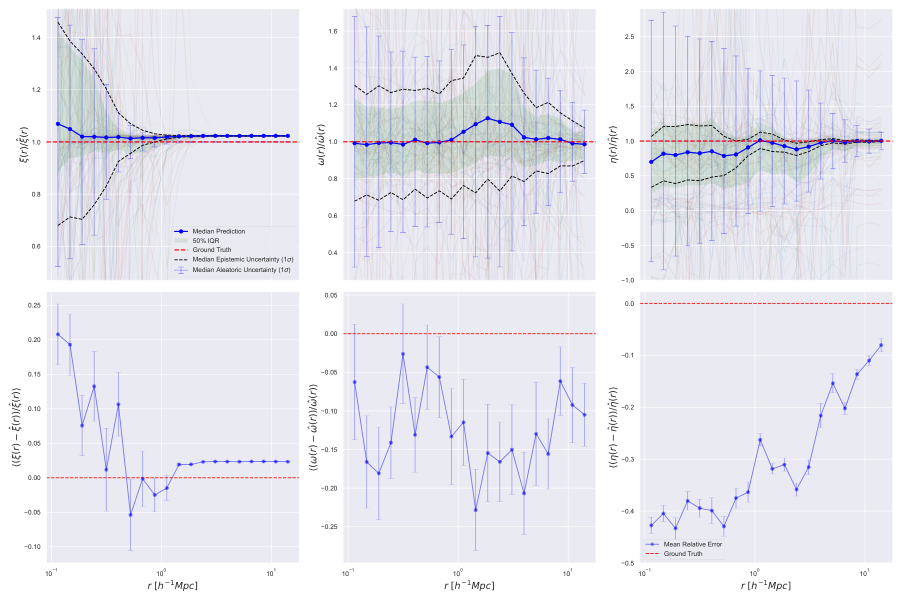
From each mock catalog, the team measured three correlation functions across 20 radial bins:
- ξ(r): position-position, how galaxies cluster in space
- ω(r): position-orientation, whether a galaxy’s orientation correlates with its neighbors’ positions
- η(r): orientation-orientation, whether two galaxies tend to point toward each other
Together these three functions give a complete statistical picture of how galaxy shapes and positions are linked. Computing them from simulations is the expensive part. The neural network’s job is to skip that computation entirely.
The architecture is an encoder-decoder network. The encoder compresses the seven HOD+IA input parameters into a compact internal summary; the decoder expands that summary into the full set of correlation values across all radial bins. The model also predicts aleatoric uncertainties, the irreducible noise from galaxy formation’s stochasticity, using a mean-variance estimation procedure. In practice, the network outputs both its best guess and a calibrated error bar, which any downstream statistical analysis needs.
Why It Matters
The position-position correlation ξ(r) comes out cleanest, with predictions accurate to ≤10% and strong Pearson correlation values. Clustering statistics are relatively smooth and well-behaved, so the emulator handles them without much trouble.
The orientation correlations ω(r) and η(r) are harder. Galaxy orientations are more sensitive to the stochastic scatter in the alignment models, and the emulator’s accuracy drops accordingly. It captures the underlying signal, but individual predictions carry larger errors. The root cause is the training data itself: when each simulation realization is somewhat random, the network has to learn average behavior from noisy examples. Averaging measurements over multiple simulation runs would sharpen the training signal.
Weak lensing surveys are entering a golden age. Experiments like the Rubin Observatory’s LSST, the Euclid satellite, and the Nancy Grace Roman Space Telescope are collecting galaxy shapes for billions of objects. Extracting cosmological constraints (how fast the universe is expanding, how clumpy dark matter is) requires modeling IA with high precision. Getting it wrong biases everything downstream.
The traditional solution is to run many expensive N-body simulations across a wide parameter range, compute statistics from each, and build an interpolating model. This work short-circuits that chain. Once trained, the neural network generates predictions in milliseconds on a GPU, enabling the rapid Monte Carlo parameter inference needed to explore high-dimensional parameter spaces. That’s a qualitative change in what’s computationally feasible.
Bottom Line: This neural network emulator predicts all three galaxy intrinsic alignment correlation functions from seven physical parameters in milliseconds, achieving ~10% accuracy on clustering statistics and opening the door to fast, simulation-free IA modeling in next-generation lensing surveys.
IAIFI Research Highlights

This work combines neural network emulation with physical cosmological simulations, using HOD-based galaxy catalogs to train a model predicting statistics central to weak lensing cosmology. It is a concrete example of AI accelerating inference in fundamental physics.

The mean-variance estimation framework produces calibrated aleatoric uncertainty predictions alongside correlation function estimates. Building uncertainty quantification directly into scientific emulators, rather than bolting it on after the fact, makes the outputs usable in real statistical analyses.

By making intrinsic alignment modeling orders of magnitude faster, this emulator tackles one of the main systematic uncertainties limiting cosmological constraints from weak gravitational lensing, a measurement sensitive to dark matter distribution across cosmic scales.
Future work will focus on training with averaged realizations to reduce stochasticity-driven errors and extending to hydrodynamic simulations. The paper appeared in the Journal of Data-centric Machine Learning Research (2024), and code will be released open source upon publication.
Original Paper Details
Learning Galaxy Intrinsic Alignment Correlations
[arXiv:2404.13702](https://arxiv.org/abs/2404.13702)
Sneh Pandya, Yuanyuan Yang, Nicholas Van Alfen, Jonathan Blazek, Robin Walters
The intrinsic alignments (IA) of galaxies, regarded as a contaminant in weak lensing analyses, represents the correlation of galaxy shapes due to gravitational tidal interactions and galaxy formation processes. As such, understanding IA is paramount for accurate cosmological inferences from weak lensing surveys; however, one limitation to our understanding and mitigation of IA is expensive simulation-based modeling. In this work, we present a deep learning approach to emulate galaxy position-position ($ξ$), position-orientation ($ω$), and orientation-orientation ($η$) correlation function measurements and uncertainties from halo occupation distribution-based mock galaxy catalogs. We find strong Pearson correlation values with the model across all three correlation functions and further predict aleatoric uncertainties through a mean-variance estimation training procedure. $ξ(r)$ predictions are generally accurate to $\leq10\%$. Our model also successfully captures the underlying signal of the noisier correlations $ω(r)$ and $η(r)$, although with a lower average accuracy. We find that the model performance is inhibited by the stochasticity of the data, and will benefit from correlations averaged over multiple data realizations. Our code will be made open source upon journal publication.