

Learning Integrable Dynamics with Action-Angle Networks
Authors
Ameya Daigavane, Arthur Kosmala, Miles Cranmer, Tess Smidt, Shirley Ho
Abstract
Machine learning has become increasingly popular for efficiently modelling the dynamics of complex physical systems, demonstrating a capability to learn effective models for dynamics which ignore redundant degrees of freedom. Learned simulators typically predict the evolution of the system in a step-by-step manner with numerical integration techniques. However, such models often suffer from instability over long roll-outs due to the accumulation of both estimation and integration error at each prediction step. Here, we propose an alternative construction for learned physical simulators that are inspired by the concept of action-angle coordinates from classical mechanics for describing integrable systems. We propose Action-Angle Networks, which learn a nonlinear transformation from input coordinates to the action-angle space, where evolution of the system is linear. Unlike traditional learned simulators, Action-Angle Networks do not employ any higher-order numerical integration methods, making them extremely efficient at modelling the dynamics of integrable physical systems.
Concepts
The Big Picture
Imagine predicting where a pendulum will be in an hour by simulating every tiny tick of time between now and then. Each step introduces a small error, a rounding here, an approximation there, and those errors stack up like interest on a debt. By the end, your prediction might be wildly wrong. Most machine learning simulators for physical systems suffer from exactly this: step-by-step mistakes compounding into catastrophic drift.
Physics has known a secret for over a century. Certain physical systems, called integrable systems, possess so much hidden symmetry that their behavior can be described with surprising simplicity. Describe them in the right coordinates, and predicting the future requires nothing more than multiplication and addition. A spinning top, an orbiting planet, a vibrating crystal: wildly complicated in everyday terms, but change your perspective and they’re just clocks ticking at steady rates.
A team of researchers from MIT, Princeton, LMU Munich, and the Flatiron Institute has built a neural network that learns to find those magical coordinates automatically, then uses them to simulate physical systems without ever accumulating step-by-step error.
Key Insight: Action-Angle Networks transform complex physical dynamics into a space where evolution is perfectly linear, eliminating the error accumulation that plagues traditional learned simulators and making long-range predictions orders of magnitude more stable.
How It Works
The mathematical engine behind this idea comes from classical mechanics: action-angle coordinates. These special coordinates exist for physical systems with enough hidden symmetry, technically called Hamiltonian systems, a framework describing motion through positions and momenta. The right coordinate transformation splits the description into two parts.
The actions (think of them as the energy content or “shape” of the motion) stay constant forever. The angles (the phase or position along the motion’s cycle) increase at a perfectly steady rate. In these coordinates, predicting the future is trivially easy: multiply angular velocity by time elapsed and add. No integration. No error accumulation.
The catch? Finding these coordinates has historically required deep mathematical insight. The Action-Angle Network learns them from data. The architecture breaks into three clean stages:
-
Encode: A stack of symplectic normalizing flows, transformations specially designed to preserve the conservation laws baked into the physics, maps ordinary positions and momenta into an intermediate representation. A polar coordinate transformation then converts this into proper action-angle coordinates (I, θ). The symplectic constraint ensures the transformation can never violate conservation of energy or momentum.
-
Evolve: A small multi-layer perceptron (MLP) takes the actions I and predicts the angular velocities θ̇. Because the actions are constant along any trajectory, this only needs to be computed once. The angles then advance as: θ(t + Δt) = θ(t) + θ̇ · Δt (mod 2π). Just arithmetic.
-
Decode: The inverse transformation maps the updated action-angle state back to physical coordinates, positions and momenta, using the inverse of the learned symplectic map.
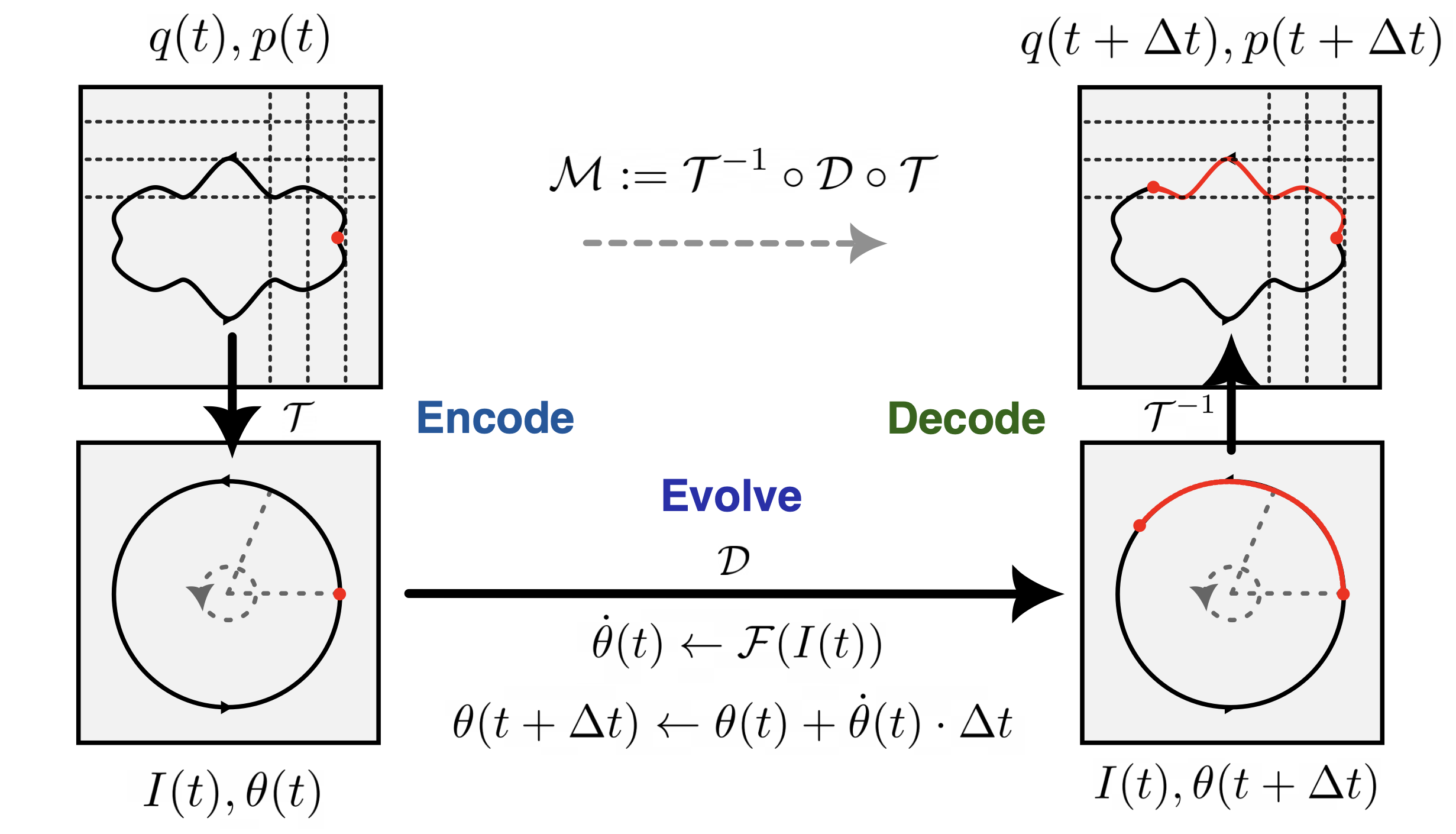
There’s a nice engineering detail worth mentioning: the network doesn’t map directly onto a torus (the donut-shaped surface that is the natural geometry for looping angle coordinates), which would create numerical breakdowns at the edges. Instead, it outputs Cartesian components converted to polar form. A small trick, but it makes training dramatically more stable.
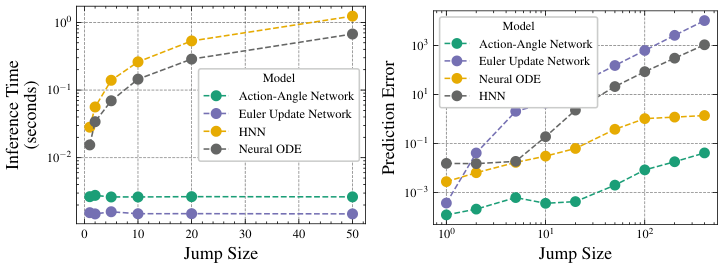
The payoff is a simulator whose inference time doesn’t depend on the time horizon at all. Want to predict a system’s state one second in the future, or one million seconds? Same computation. Same cost. Traditional integrators work proportionally harder for larger time jumps. Action-Angle Networks don’t.
Why It Matters
On the AI side, this work joins a growing movement to embed physical structure directly into neural networks rather than hoping the network discovers that structure from data alone. Constraining the encoder to only learn symplectic transformations isn’t just mathematical aesthetics; it’s what makes the whole approach trustworthy over long rollouts. The network cannot violate conservation laws even if it wanted to.
On the physics side, the ability to automatically discover action-angle coordinates for complex systems opens real doors. Integrable systems appear throughout fundamental physics, from particles in electromagnetic traps to quantum spin chains to planetary orbital mechanics. If a researcher suspects a system might be integrable but can’t write down its action-angle coordinates analytically, this framework offers a data-driven path to finding them.
The learned coordinates themselves become scientific artifacts worth examining. Future extensions might tackle nearly integrable systems, where weak perturbations break exact integrability. That direction connects to the rich physics of chaos and the KAM theorem, the mathematical result describing how ordered motion gradually breaks down under perturbation.
Bottom Line: By teaching a neural network to find the coordinates where physics becomes linear, Action-Angle Networks sidestep error accumulation entirely, delivering fast, stable, parameter-efficient simulations that improve with the elegance of the physics, not despite it.
IAIFI Research Highlights

This work transplants a century-old concept from classical mechanics into a modern neural network architecture, showing that deep physical symmetry principles can be encoded as inductive biases to produce qualitatively better learned simulators.

Action-Angle Networks achieve competitive trajectory prediction with significantly fewer parameters than standard learned simulators, and uniquely offer inference time independent of the prediction horizon, a fundamental efficiency gain over all step-by-step integration approaches.

The framework provides a data-driven method to automatically discover hidden integrable structure in physical systems, which could speed up the identification of conserved quantities and symmetries across domains from celestial mechanics to condensed matter physics.
Future work could extend the framework to approximately integrable and chaotic systems, explore connections to quantum integrability, and scale to higher-dimensional field theories. The paper appeared at the Machine Learning and the Physical Sciences workshop at NeurIPS 2022 ([arXiv:2211.15338](https://arxiv.org/abs/2211.15338)).