

Mathematical Data Science
Authors
Michael R. Douglas, Kyu-Hwan Lee
Abstract
Can machine learning help discover new mathematical structures? In this article we discuss an approach to doing this which one can call "mathematical data science". In this paradigm, one studies mathematical objects collectively rather than individually, by creating datasets and doing machine learning experiments and interpretations. After an overview, we present two case studies: murmurations in number theory and loadings of partitions related to Kronecker coefficients in representation theory and combinatorics.
Concepts
The Big Picture
Imagine handing a master chef thousands of recipes and asking them not to cook a single dish, but to discover a new cuisine. That’s roughly what a growing group of mathematicians are doing with machine learning. They’re not solving individual problems; they’re feeding entire families of mathematical objects into neural networks and watching for patterns no human has noticed before. This is mathematical data science, and it’s starting to change how mathematicians discover new truths.
For centuries, math has been a discipline of lone geniuses wrestling with specific objects: this particular curve, that knot, a specific polynomial. Patterns occasionally emerged when someone computed enough examples by hand. But computation has exploded. Databases of millions of mathematical objects now exist, and the tools to search for hidden structure in them (tools perfected by the tech industry to recommend movies and translate languages) are available to anyone with a laptop and a curiosity about abstract structures.
Physicist Michael R. Douglas and mathematician Kyu-Hwan Lee have written a manifesto for this emerging paradigm, demonstrating through two case studies that the approach isn’t just plausible. It already works.
Key Insight: Treating mathematical objects as data and applying machine learning lets researchers detect statistical patterns invisible to traditional analysis, generating precise new conjectures that humans can then rigorously prove.
How It Works
The mathematical data science (MDS) paradigm breaks into four steps that are simple to state but hard to execute well:
- Generate a dataset of mathematical objects, not one object but thousands or millions, computed systematically.
- Apply ML tools to find structure in that dataset, treating invariants (measurable properties) as features.
- Interpret the results to understand what the patterns actually mean mathematically.
- Formulate conjectures and theorems from the evidence.
Every step still requires human mathematicians. Choices about what to measure, how to sample, which patterns are interesting: none of this is automated. The computer is a powerful telescope, not an autonomous explorer.
One of the paper’s conceptual contributions is the “platonic dataset.” Most ML datasets are fuzzy: web-scraped text, photographs with inconsistent labels. A platonic dataset is mathematically precise. It consists of a well-defined set of objects, a function mapping each to measurable invariants, and a principled rule for choosing finite subsets to analyze. Because of this precision, any conjecture the ML suggests can be stated in exact mathematical language, which is a prerequisite for eventually proving it.
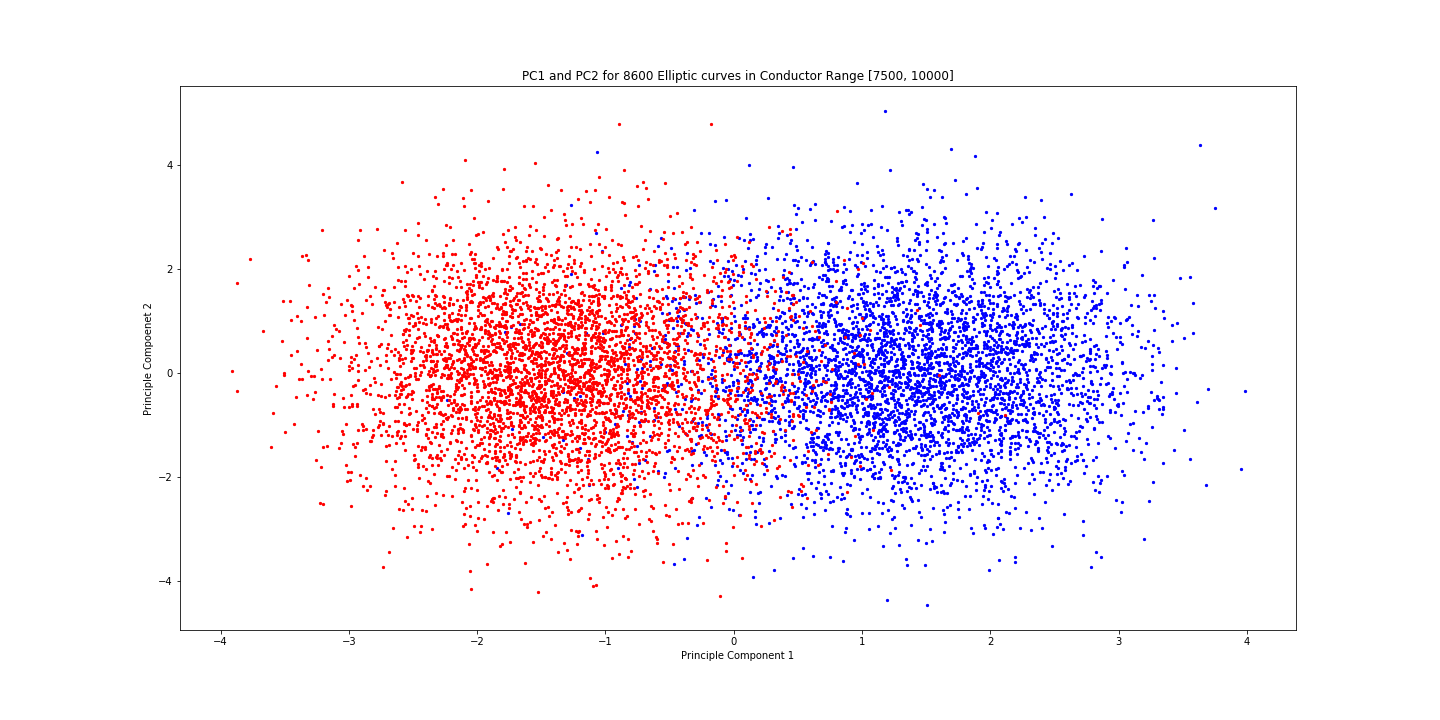
The first case study involves murmurations, a phenomenon recently discovered in the statistics of elliptic curve L-functions. An L-function is a formula encoding deep arithmetic information about a mathematical object; here, an elliptic curve, a smooth curve defined by a cubic equation with rich number-theoretic properties. Researchers had studied these functions one at a time for decades.
When Lee and collaborators looked at large collections of elliptic curves, sorting them by rank (the number of independent rational solutions) and plotting average values of the L-functions, they found an unexpected oscillatory correlation. They called it a murmuration pattern, after the collective undulation of starling flocks. This structure is invisible when you study one curve at a time. It only shows up statistically, from the crowd.
The second case study tackles Kronecker coefficients, numbers that appear throughout the mathematics of symmetry and have applications in quantum information theory. These coefficients are notoriously hard to compute, and harder still to understand conceptually.
The authors define a dataset of integer partitions (ways to write a number as an ordered sum; for example, 4 can be expressed as 3+1, or 2+2, or 2+1+1) and compute associated loadings, numerical summaries capturing how Kronecker coefficients are distributed across the dataset. Machine learning experiments reveal clustering patterns in these loadings, pointing toward combinatorial structure that pure theory had not predicted.
Why It Matters
There is a strong historical precedent for this kind of work. The Birch and Swinnerton-Dyer conjecture, one of the Millennium Prize Problems (with a $1 million reward for its proof), originated from exactly this kind of computer experiment in the 1960s. Bryan Birch and Peter Swinnerton-Dyer generated elliptic curves by computer and performed linear regression on the results. They were doing mathematical data science before the term existed.
The authors are clear-eyed about what distinguishes math from other data sciences: interpretability. In biology or medicine, a neural network that predicts outcomes accurately is already useful even if you can’t explain why. In mathematics, a black-box prediction is nearly worthless without understanding. A pattern only becomes mathematically meaningful when it can be turned into a precise statement and, ultimately, a proof.
The tension between the power of modern ML and the rigorous demands of mathematics is where the field must develop. Techniques like attribution analysis, which identify which input features drove a model’s prediction, are one way to turn a statistical pattern into a mathematical insight.
The timing is right. Mathematical databases like the LMFDB (L-functions and Modular Forms Database) and KnotInfo have matured. Computing power makes datasets of millions of objects routine. Perhaps most importantly, the culture is shifting: mathematicians and ML researchers are increasingly working together. The 2021 Nature paper by DeepMind, collaborating with mathematicians Geordie Williamson and Marc Lackenby, produced new theorems in knot theory and representation theory. Douglas and Lee’s paper is an invitation to more such collaborations.
Bottom Line: Murmurations in number theory and structure in Kronecker coefficients show that collective analysis of mathematical objects can reveal patterns no individual study could find. Mathematical data science is changing how new conjectures get discovered, and the most productive phase is probably still ahead.
IAIFI Research Highlights

This work connects AI methodology with pure mathematics, applying supervised and unsupervised machine learning to abstract mathematical datasets to discover new structures in number theory and representation theory.

The paper introduces the "platonic dataset" framework, a principled standard for ML experiments where data has exact definitions rather than empirical noise. This offers a template for rigorous ML-driven scientific discovery.

The murmuration phenomenon in *L*-functions of elliptic curves is a new statistical regularity in arithmetic objects, with potential implications for the Langlands program and related areas of mathematical physics.
Future directions include automating more of the conjecture-generation pipeline and extending MDS to geometric and topological objects; the paper is available at [arXiv:2502.08620](https://arxiv.org/abs/2502.08620).
Original Paper Details
Mathematical Data Science
2502.08620
["Michael R. Douglas", "Kyu-Hwan Lee"]
Can machine learning help discover new mathematical structures? In this article we discuss an approach to doing this which one can call "mathematical data science". In this paradigm, one studies mathematical objects collectively rather than individually, by creating datasets and doing machine learning experiments and interpretations. After an overview, we present two case studies: murmurations in number theory and loadings of partitions related to Kronecker coefficients in representation theory and combinatorics.