

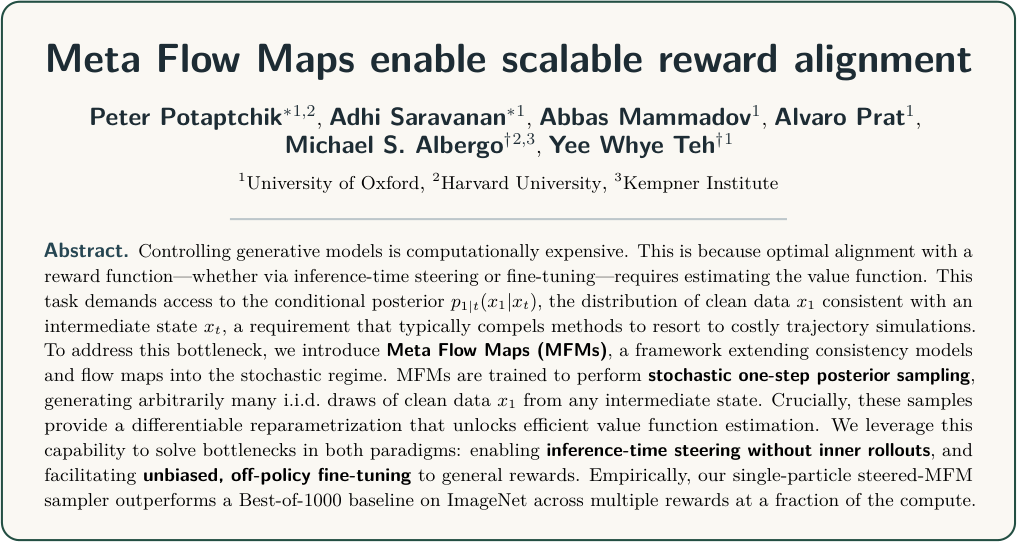
Meta Flow Maps enable scalable reward alignment
Authors
Peter Potaptchik, Adhi Saravanan, Abbas Mammadov, Alvaro Prat, Michael S. Albergo, Yee Whye Teh
Abstract
Controlling generative models is computationally expensive. This is because optimal alignment with a reward function--whether via inference-time steering or fine-tuning--requires estimating the value function. This task demands access to the conditional posterior $p_{1|t}(x_1|x_t)$, the distribution of clean data $x_1$ consistent with an intermediate state $x_t$, a requirement that typically compels methods to resort to costly trajectory simulations. To address this bottleneck, we introduce Meta Flow Maps (MFMs), a framework extending consistency models and flow maps into the stochastic regime. MFMs are trained to perform stochastic one-step posterior sampling, generating arbitrarily many i.i.d. draws of clean data $x_1$ from any intermediate state. Crucially, these samples provide a differentiable reparametrization that unlocks efficient value function estimation. We leverage this capability to solve bottlenecks in both paradigms: enabling inference-time steering without inner rollouts, and facilitating unbiased, off-policy fine-tuning to general rewards. Empirically, our single-particle steered-MFM sampler outperforms a Best-of-1000 baseline on ImageNet across multiple rewards at a fraction of the compute.
Concepts
The Big Picture
Imagine you’re a sculptor who has spent years mastering the art of forming clay into beautiful figures. Now someone asks you to create sculptures that are not just beautiful but specifically dramatic, capturing tension, movement, urgency. You have the skill, but redirecting every nuance of your technique for this new constraint requires rethinking each step from scratch. This is essentially the dilemma facing modern AI image generators.
These systems have gotten very good at producing high-quality images. But making them consistently produce exactly what you want, images that score highly on a specific quality like aesthetic appeal or fidelity to a text description, turns out to be expensive.
The core issue is mathematical. Today’s best image generators work by gradually transforming random noise into a coherent picture through a long sequence of small steps. To steer this process toward a goal (say, “make images that look more like a majestic volcano”), you need to know, at every intermediate step, what the final image is likely to look like: the full range of plausible finished images that could emerge from the current half-formed, noisy state.
Getting that information accurately typically means running the full generation process many times over. It’s like needing to fast-forward a movie to its ending thousands of times just to decide what happens next.
A team of researchers from Oxford, NYU, and Google DeepMind found a way to compress all that expensive future-peeking into a single learned operation, one that can be reused across any reward at a fraction of the cost.
Key Insight: Meta Flow Maps learn to generate arbitrarily many samples from the full range of plausible finished images in a single step, turning an expensive computational bottleneck into an efficient, reusable operation that works for both real-time steering and permanent model fine-tuning.
How It Works
The central innovation is a new class of model the authors call Meta Flow Maps (MFMs), a framework that makes this expensive computation cheap and reusable.
To understand why they’re needed, consider the two main strategies for reward-aligned generation. Inference-time steering adjusts the generation process on the fly without changing the model itself, keeping the pretrained model frozen and nudging the sampling trajectory toward high-reward outputs. Fine-tuning permanently updates the model’s internal parameters to internalize a new reward.
Both strategies rely on the same mathematical quantity: the value function, defined as the expected future reward given the current noisy state. Computing its gradient tells you which direction to push the generation process. The problem is that doing so accurately requires many samples from the range of plausible finished images, and historically those samples have required expensive trajectory simulations.
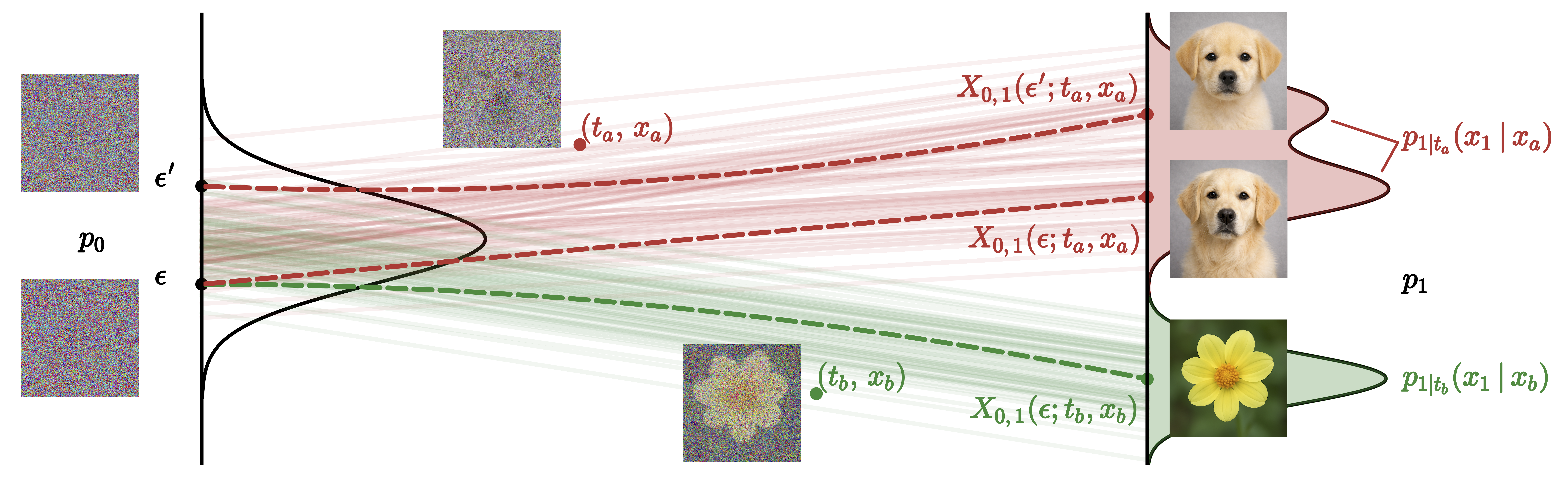
MFMs attack this by training a single amortized model, one trained once to handle many different situations so the upfront cost is spread across all future uses. For any intermediate noisy state, there exists an ODE (ordinary differential equation) that transports noise to the correct distribution of finished images. Standard flow maps (fast, few-step approximations to these ODEs) already exist, but they’re deterministic: feed them a state and they produce a single predicted endpoint. They cannot represent the diversity of possible clean images consistent with that noisy state.
MFMs fix this by conditioning on an additional random noise input. Vary that noise, and you get different samples, all valid draws from the same distribution. One model, many samples, one step each.
Training an MFM proceeds as follows:
- Sample an intermediate noisy state along a standard generative trajectory.
- Construct the conditional ODE targeting the posterior for that state.
- Train the MFM to reproduce the endpoint of that ODE given a noise seed, using a flow matching objective applied to this conditional ODE.
- Amortize this across all possible intermediate states simultaneously, so the MFM learns to handle any state it encounters during generation.
The payoff is a differentiable reparametrization of the posterior. MFM samples depend on their input noise in a smooth, mathematically tractable way. You can plug them directly into value function estimates and differentiate through them, enabling both steering and fine-tuning with asymptotically exact, unbiased gradient estimates.
Why It Matters
The empirical results speak for themselves. For inference-time steering on ImageNet, the authors’ single-particle steered-MFM sampler outperforms a Best-of-1000 baseline, producing better results than picking the best image out of a thousand random generations, across multiple reward functions and at a fraction of the compute. That’s not a modest improvement. It’s a qualitative leap in efficiency.
The model is trained using only class labels, yet steering with a human preference reward (HPSv2) produces images that match detailed text prompts, a capability the base model never had.
The applications extend well beyond image generation. Scientific domains like protein design, drug discovery, and materials science all involve maximizing some property function over a complex generative model. The computational cost of alignment has been a real barrier to deploying these methods at scale. MFMs offer a path toward making reward-aligned generation practical across these fields, since the expensive posterior sampling happens once at training time rather than being repeated for every new task.
Bottom Line: Meta Flow Maps eliminate the core computational bottleneck in reward-aligned generative modeling, enabling a single trained model to steer any reward efficiently and outperform exhaustive search methods at a fraction of the cost.
IAIFI Research Highlights

This work formalizes a mathematical connection between stochastic optimal control theory (value functions and Doob's h-transform) and practical generative modeling, linking the theoretical physics of dynamical systems with scalable machine learning.

MFMs provide the first scalable, unbiased framework for both inference-time steering and off-policy fine-tuning of flow-based generative models, outperforming Best-of-1000 search with a single-particle sampler.

The framework's ability to efficiently sample conditional posteriors has direct applications to inverse problems and scientific discovery tasks where generative models must align with physical measurement constraints.
Future directions include applying MFMs to protein structure prediction, molecular design, and other scientific generative modeling tasks; the paper is available at [arXiv:2601.14430](https://arxiv.org/abs/2601.14430).