

Multiscale Normalizing Flows for Gauge Theories
Authors
Ryan Abbott, Michael S. Albergo, Denis Boyda, Daniel C. Hackett, Gurtej Kanwar, Fernando Romero-López, Phiala E. Shanahan, Julian M. Urban
Abstract
Scale separation is an important physical principle that has previously enabled algorithmic advances such as multigrid solvers. Previous work on normalizing flows has been able to utilize scale separation in the context of scalar field theories, but the principle has been largely unexploited in the context of gauge theories. This work gives an overview of a new method for generating gauge fields using hierarchical normalizing flow models. This method builds gauge fields from the outside in, allowing different parts of the model to focus on different scales of the problem. Numerical results are presented for $U(1)$ and $SU(3)$ gauge theories in 2, 3, and 4 spacetime dimensions.
Concepts
The Big Picture
Imagine trying to paint a detailed landscape by starting with every individual brushstroke simultaneously. You’d miss the forest for the trees. Skilled painters rough in large shapes first, then add progressively finer detail. That same intuition turns out to apply to one of the most computationally demanding problems in modern physics: simulating the quantum vacuum of the universe.
Particle physicists studying the strong nuclear force need to simulate a gauge field, a mathematical object encoding how particles exert forces across space and time. These simulations run on discrete grids called lattices, and they suffer from a notorious computational pathology. As physicists push to finer lattice spacings, the simulations slow to a crawl, getting trapped in one configuration for millions of steps and barely exploring the range of states the theory actually predicts.
Machine learning promised a cure, but an important physical principle was left on the table: the idea that physics at different length scales can be separated and handled independently. A new paper from researchers at MIT, NYU, Fermilab, and partner institutions changes that. By building gauge fields coarse-to-fine in a principled hierarchy, their multiscale normalizing flow framework brings scale separation to non-Abelian gauge theories for the first time. These are the mathematically richer class of theories governing the actual strong force. Results span 2D toy models and four-dimensional SU(3), the specific mathematical group describing the strong force in nature.
Key Insight: Building gauge field configurations hierarchically, from large-scale structure down to fine details, lets different parts of the neural network focus on different physical scales. The sampler becomes more expressive without sacrificing physical structure.
How It Works
Normalizing flows are a machine-learning technique for generating samples from complicated probability distributions. You train a neural network to transform a simple, easy-to-sample distribution into the complex target. In this case, that target is the distribution telling you how likely each field configuration is, given the theory’s physical rules. Once trained, you can generate thousands of independent samples almost instantly, potentially bypassing the slow random walk of traditional Monte Carlo methods.
Previous normalizing flow approaches for gauge theories treated the lattice uniformly: every site, every scale, all at once. But a lattice gauge theory has structure at many scales simultaneously. Long-wavelength modes (the “infrared”) describe large-scale correlations, while short-wavelength modes (the “ultraviolet”) capture fine local fluctuations. The physics at each scale is different, and so are the modeling challenges.
The multiscale approach solves this with a two-part construction:
-
Start with a coarse prior. Rather than beginning from random noise on the full fine lattice, the model first samples values on a much coarser lattice, possibly as coarse as a single site. This coarse configuration captures the large-scale, infrared structure of the field.
-
Apply successive doubling layers. A doubling layer is a learned neural network transformation that takes a coarse lattice and refines it, doubling the number of sites in one spacetime direction. It splits each link (the mathematical value living on each edge of the lattice grid) into two components, then samples new “perpendicular” links from a learned distribution conditioned on the surrounding geometry.
How do perpendicular links get generated? The researchers use a small normalizing flow conditioned on the local geometric environment, specifically on the staples: the U-shaped paths of neighboring links that close around the new link to form the smallest possible closed loop on the lattice. The model learns to fill in fine-scale structure consistent with the coarse backbone already in place, much as a painter fills in details that fit the broad composition.
Stacking these doubling layers and alternating between spacetime directions builds the full fine lattice from scratch, scale by scale. Each layer adds a new octave of detail, and each layer’s network can specialize in the physics at that scale.
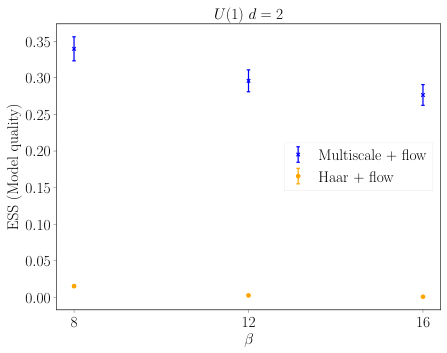
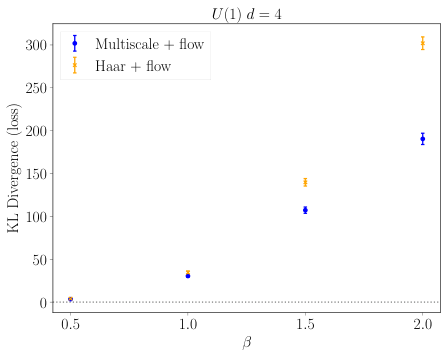
The team tested this framework across U(1) gauge theory (the Abelian case, essentially a lattice version of electromagnetism) in 2, 3, and 4 dimensions, and SU(3) in 4 dimensions. They measured effective sample size (ESS), a number between 0 and 1 quantifying how many independent samples the model delivers per generated configuration. An ESS near 1 means nearly every sample is independent; near 0 means the model is badly miscalibrated.
Multiscale models showed competitive or improved ESS compared to flat normalizing flow baselines. The hierarchical structure enabled more stable training and better expressiveness across varying coupling strengths, the parameter controlling how strongly particles interact.
Why It Matters
The ultimate goal of lattice QCD, simulating the strong force from first principles, demands both fine lattices (to approach the continuum limit) and large lattices (to capture long-range physics). Traditional Monte Carlo simulations suffer from critical slowing down and topological freezing as lattice spacing decreases: the simulation gets stuck and computational cost explodes. Normalizing flows offer a route around this bottleneck, but only if they can scale to physically relevant volumes with high sample quality.
Multiscale architectures are a natural fit. Multigrid solvers, which accelerate differential equation solving by operating on coarse and fine representations simultaneously, transformed numerical linear algebra decades ago. Multiscale flows could do the same for lattice QCD sampling. The underlying logic is the same: don’t fight the scale structure of the problem, use it.
These results show that the principle works in the non-Abelian setting where the gauge group is non-commutative, which is the case that matters for the real strong force. Open questions remain around scaling to larger lattices, incorporating fermions, and optimizing per-scale flow architectures, but the groundwork is in place.
Bottom Line: Multiscale normalizing flows bring scale separation to machine-learning-based sampling of gauge theories, producing more expressive models that work for both Abelian and non-Abelian gauge groups in up to four spacetime dimensions.
IAIFI Research Highlights

This work translates a classical physics principle, scale separation as used in multigrid algorithms, directly into a machine learning architecture for quantum field theory. Physical insight improves the AI, and the AI enables new physics calculations.

The hierarchical normalizing flow construction, building samples coarse-to-fine via learned doubling layers, is a general technique applicable beyond physics. It advances structured generative modeling for high-dimensional, geometrically constrained distributions.

By demonstrating multiscale sampling for SU(3) gauge theory in four dimensions, this work adds to the toolkit for lattice QCD calculations that inform our understanding of the strong nuclear force and hadron structure.
Future work will focus on scaling to larger lattices and integrating fermions to approach realistic QCD simulations. The full method and results appear in [arXiv:2404.10819](https://arxiv.org/abs/2404.10819).