

Observable Optimization for Precision Theory: Machine Learning Energy Correlators
Authors
Arindam Bhattacharya, Katherine Fraser, Matthew D. Schwartz
Abstract
The practice of collider physics typically involves the marginalization of multi-dimensional collider data to uni-dimensional observables relevant for some physics task. In any cases, such as classification or anomaly detection, the observable can be arbitrarily complicated, such as the output of a neural network. However, for precision measurements, the observable must correspond to something computable systematically beyond the level of current simulation tools. In this work, we demonstrate that precision-theory-compatible observable space exploration can be systematized by using neural simulation-based inference techniques from machine learning. We illustrate this approach by exploring the space of marginalizations of the energy 3-point correlator to optimize sensitivity to the the top quark mass. We first learn the energy-weighted probability density from simulation, then search in the space of marginalizations for an optimal triangle shape. Although simulations and machine learning are used in the process of observable optimization, the output is an observable definition which can be then computed to high precision and compared directly to data without any memory of the computations which produced it. We find that the optimal marginalization is isosceles triangles on the sphere with a side ratio approximately $1:1:\sqrt{2}$ (i.e. right triangles) within the set of marginalizations we consider.
Concepts
The Big Picture
Imagine measuring the exact weight of a specific ingredient in a complex dish by analyzing just the smell. You can’t sample everything at once; you have to choose which scent to focus on. Pick the wrong one and you’ll get a muddy signal buried in noise. Pick the right one and you might nail it precisely. Physicists at particle colliders face exactly this problem, except instead of smells, they’re choosing which mathematical “shape” of particle data to examine.
Every time protons smash together at the Large Hadron Collider, they spray out hundreds of particles in a chaotic cascade. The raw data is staggeringly complex. Tracking the energy and direction of every particle in every collision produces millions of numbers per event. To extract physics from this flood, scientists must compress that information into a single number called an observable.
For simple sorting tasks, you can hand the job to a neural network and let it do whatever it wants. But for precision measurements, the kind that pin down fundamental constants to many decimal places, your observable must be something you can calculate from first principles. Neural networks are not that. They’re black boxes, and theoretical physicists can’t derive predictions for what a black box will output.
This sets up a real tension: the most powerful tools for finding useful signals are exactly the tools you can’t use for the most important measurements. A team of researchers, with support from IAIFI, has found a way to thread this needle. They use machine learning to find the best observable, then step away, leaving behind only a clean, calculable quantity ready for precision comparison with data.
Key Insight: Machine learning can scout the space of possible precision observables and identify the best one, then exit the picture entirely, leaving a human-interpretable, theoretically computable result.
How It Works
The researchers focused on a specific class of observables called energy correlators, quantities that measure how particle energies are distributed across different angular separations. The energy 3-point correlator (E3C) captures the pattern of energy flow by measuring the angles between three particles simultaneously.
The problem is that this three-particle triangle has many possible shapes, forming a two-parameter family. Scientists typically collapse it to a single number by “marginalizing,” summing over all triangle shapes satisfying some constraint. The question is: which constraint? Which triangle shape carries the most information about the top quark mass?
The team’s approach unfolds in two stages:
-
Learn the distribution. Using Monte Carlo simulations (computer programs that generate realistic collision data by randomly sampling from known physics rules), they produced large datasets of E3C data at different top quark mass values. They trained two types of density estimators: a dense neural network (DNN) trained with a weighting scheme that emphasizes physics-relevant features, and a normalizing flow, a type of neural network that explicitly models the probability of any given data point.
-
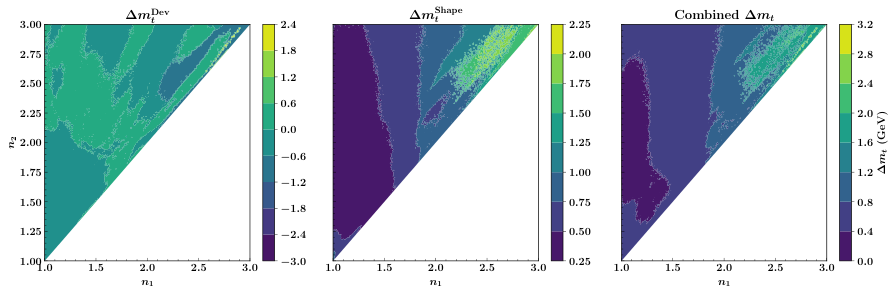
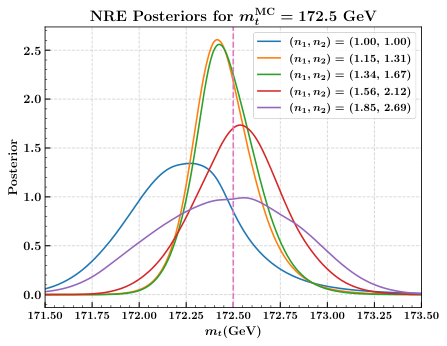
Search for the optimal observable. With a learned surrogate model in hand, they deployed neural ratio estimation (NRE), a simulation-based inference technique. NRE trains a classifier to distinguish samples generated at the true parameter value from samples with mismatched values; the ratio of likelihoods it learns directly measures the statistical power of any proposed observable. By sweeping through different triangle shape constraints, parameterized by the side ratios of isosceles triangles, they quantified how sharply each shape constrains the top quark mass.
The search is efficient because the neural surrogate is fast to evaluate, making it practical to scan a wide space of candidates without running expensive new simulations for each one.
Here’s the payoff. After scanning the full space of isosceles triangle marginalizations, the researchers found that right triangles, with side ratios of 1:1:√2, give the sharpest sensitivity to the top quark mass. That’s a clean, geometric result. A right triangle on the angular sphere is a precise definition that any theorist can write down and any experimentalist can implement.
Once this shape is identified, the machine learning infrastructure becomes irrelevant. Future measurements can simply report the E3C marginalized over right triangles, compute theoretical predictions using perturbative QCD (the standard mathematical toolkit for calculating particle interactions), and compare directly to data. No neural networks in the final analysis chain.
The team validated their results by checking that marginals computed from the learned distributions matched those computed directly from simulation. Both the DNN and normalizing flow approaches gave consistent results, providing a cross-check on reliability.
Why It Matters
Precision particle physics has a bottleneck. The field has adopted machine learning for tasks where interpretability isn’t required: jet tagging, anomaly detection, fast simulation. But precision measurements of Standard Model parameters demand a different standard. Theoretical predictions must be computed order-by-order in perturbation theory, and that only works for well-defined mathematical quantities, not neural network outputs.
By framing observable optimization as a machine learning problem that terminates in a classical result, the authors crack open a new approach. The same methodology could optimize observables for measuring the strong coupling constant, probing new physics signals, or extracting other fundamental parameters from LHC data. Every precision measurement that currently settles for a “good enough” observable could be revisited with this search strategy.
The work also reflects how far simulation-based inference has come in physics. Rather than approximating likelihood functions analytically (often impossible for complex collider processes), these methods extract statistical power directly from simulated data, sidestepping years of difficult theoretical approximation.
Bottom Line: By using ML to navigate the space of theoretically calculable observables and identify right-triangle energy correlators as optimal for top quark mass measurements, this work shows that machine learning and precision physics aren’t opposites. They’re collaborators, with ML doing the scouting and theory doing the measurement.
IAIFI Research Highlights

This work combines machine learning density estimation and simulation-based inference to solve a core problem in precision particle physics: finding the best observable for a measurement without sacrificing theoretical calculability.

The paper applies neural simulation-based inference to observable *design* rather than parameter inference, showing that NRE can function as a search tool over continuous spaces of experimental quantities.

By identifying isosceles right triangles as the optimal marginalization of the energy 3-point correlator, the work provides a concrete, theoretically computable observable with enhanced sensitivity to the top quark mass at the LHC.
Future work could extend this framework to strong coupling extractions, beyond-Standard-Model parameter searches, and other precision measurements. The paper is available at [arXiv:2508.10988](https://arxiv.org/abs/2508.10988).