

Precise Cosmological Constraints from BOSS Galaxy Clustering with a Simulation-Based Emulator of the Wavelet Scattering Transform
Authors
Georgios Valogiannis, Sihan Yuan, Cora Dvorkin
Abstract
We perform a reanalysis of the BOSS CMASS DR12 galaxy dataset using a simulation-based emulator for the Wavelet Scattering Transform (WST) coefficients. Moving beyond our previous works, which laid the foundation for the first galaxy clustering application of this estimator, we construct a neural net-based emulator for the cosmological dependence of the WST coefficients and the 2-point correlation function multipoles, trained from the state-of-the-art suite of \textsc{AbacusSummit} simulations combined with a flexible Halo Occupation Distribution (HOD) galaxy model. In order to confirm the accuracy of our pipeline, we subject it to a series of thorough internal and external mock parameter recovery tests, before applying it to reanalyze the CMASS observations in the redshift range $0.46<z<0.57$. We find that a joint WST + 2-point correlation function likelihood analysis allows us to obtain marginalized 1$σ$ errors on the $Λ$CDM parameters that are tighter by a factor of $2.5-6$, compared to the 2-point correlation function, and by a factor of $1.4-2.5$ compared to the WST-only results. This corresponds to a competitive $0.9\%$, $2.3\%$ and $1\%$ level of determination for parameters $ω_c$, $σ_8$ $\&$ $n_s$, respectively, and also to a $0.7\%$ $\&$ $2.5 \%$ constraint on derived parameters h and $f(z)σ_8(z)$, in agreement with the \textit{Planck} 2018 results. Our results reaffirm the constraining power of the WST and highlight the exciting prospect of employing higher-order statistics in order to fully exploit the power of upcoming Stage-IV spectroscopic observations.
Concepts
The Big Picture
Imagine trying to recognize a face using only the average brightness of a photograph. You’d get something, a rough sense of how light or dark the image is, but you’d miss the wrinkles, the curve of a smile, the specific arrangement of features that makes a face unique.
For decades, cosmologists have relied on the 2-point correlation function, a statistical tool that measures how likely you are to find two galaxies at any given distance apart. It works. But it throws away a staggering amount of information.
The universe isn’t a smooth, uniform distribution of matter. Gravity has spent 13 billion years sculpting gas and dark matter into a cosmic web of filaments (thread-like bridges between galaxy clusters), sheets (flat walls of galaxies), voids (enormous empty bubbles), and halos (dense knots where galaxies take root). This three-dimensional architecture encodes fundamental cosmological parameters: how fast the universe is expanding, how clumpy matter became over time. The 2-point function captures only the skeleton of this picture. To read the full portrait, you need tools that detect specific textures, shapes, and multi-point arrangements that pairwise statistics miss entirely.
A team from Harvard and Stanford has now shown that one such tool, the Wavelet Scattering Transform (WST), borrowed from computer vision, can be deployed on real galaxy survey data with a neural network emulator. The payoff: constraints on cosmological parameters up to six times tighter than the standard approach.
Key Insight: By combining the Wavelet Scattering Transform with the traditional 2-point correlation function and a neural net emulator trained on thousands of simulations, researchers extracted significantly more cosmological information from the same galaxy data, without needing new observations.
How It Works
The WST takes inspiration from convolutional neural networks, but with one key difference: it’s interpretable. Instead of learning arbitrary filters through training, it applies a fixed bank of wavelet filters at multiple scales, measures each response, and averages the results. Wavelet filters are mathematical probes that detect patterns at specific sizes and orientations, similar to edge-detectors in computer vision. The output is a set of WST coefficients, compact numbers describing clustering patterns in a 3D galaxy map. These coefficients capture filamentarity (how much galaxies arrange into strands and sheets) and void statistics (the sizes and distribution of empty regions) that the 2-point function simply cannot see.
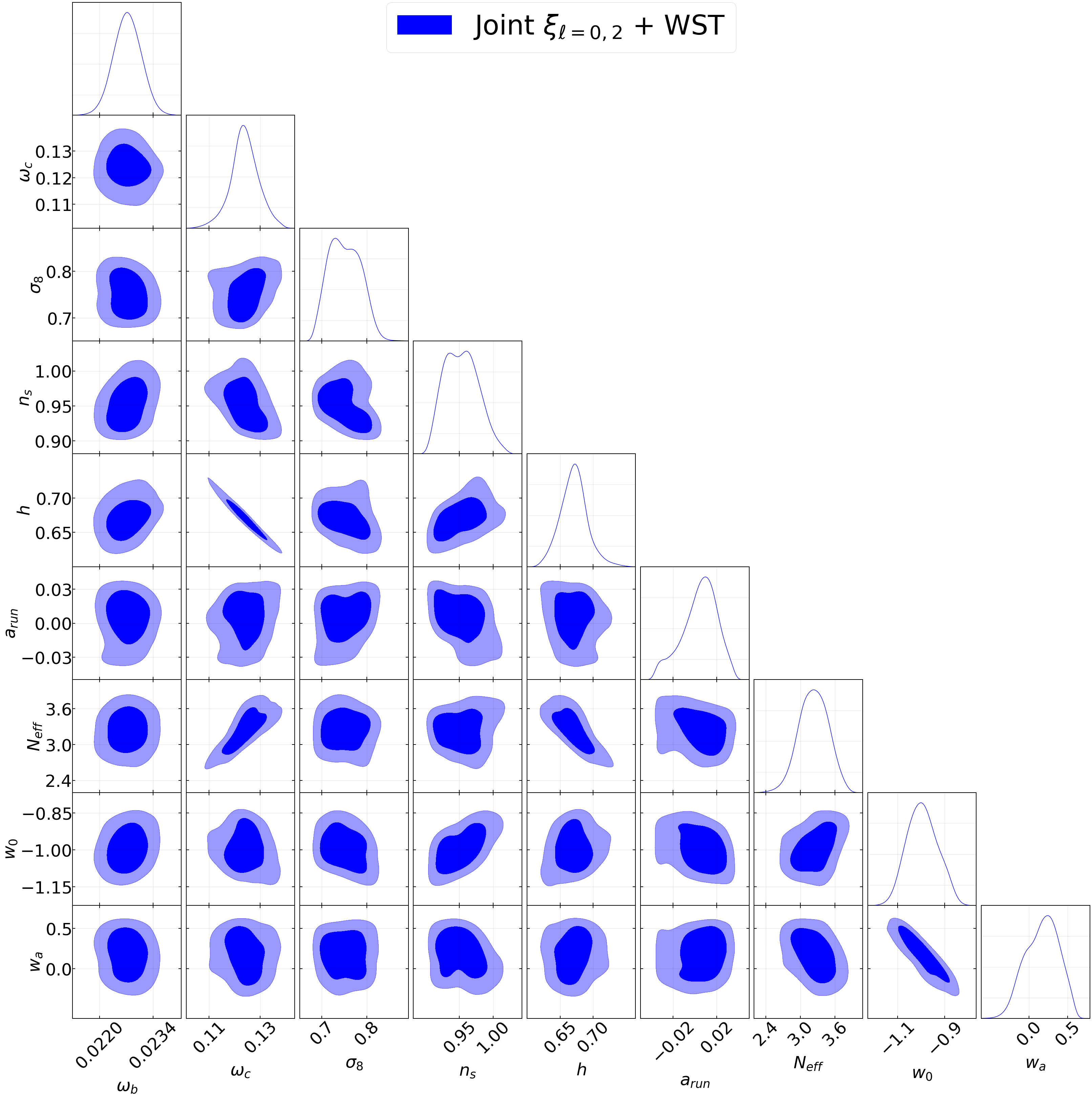
To use these coefficients for parameter inference, you need to know how they depend on cosmology. Valogiannis, Yuan, and Dvorkin solved this by building a neural network emulator, a fast surrogate model trained on the AbacusSummit simulation suite: thousands of virtual universes run with different cosmological settings. For each simulated cosmology, they modeled the galaxy population using a Halo Occupation Distribution (HOD), a flexible prescription for how many galaxies occupy dark matter halos of given masses. The emulator predicts WST coefficients and 2-point function multipoles for any point in a high-dimensional parameter space in milliseconds rather than hours.
The pipeline runs in four stages:
- Train the emulator on hundreds of AbacusSummit simulations, covering 8 cosmological parameters and flexible HOD parameters
- Validate rigorously with internal and external mock recovery tests, confirming the pipeline recovers the right answers on simulated data with known parameters
- Analyze real BOSS CMASS data, specifically the DR12 galaxy sample in the redshift window 0.46 < z < 0.57
- Run a joint likelihood analysis combining WST coefficients and 2-point correlation function multipoles
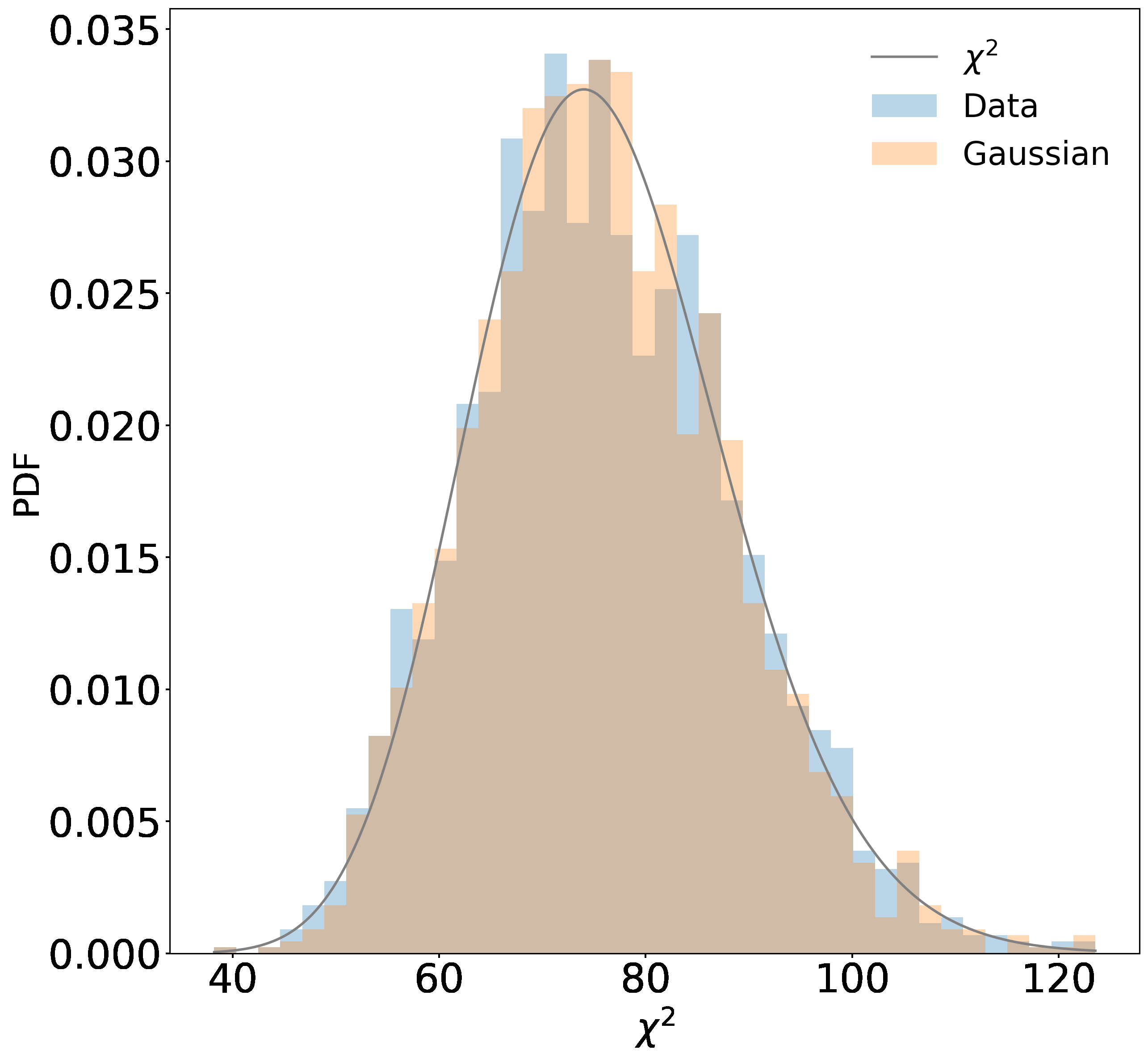
The validation step was especially thorough. Internal tests used AbacusSummit simulations; external tests used independent galaxy mocks from entirely different simulation codes. An emulator that only works on its training data isn’t trustworthy. Successful recovery in both cases confirmed the pipeline was learning genuine cosmological signal, not simulation artifacts.
Why It Matters
The numbers speak for themselves. Compared to the 2-point correlation function alone, the joint WST + 2PCF analysis shrinks error bars by a factor of 2.5 to 6 across standard ΛCDM (Lambda Cold Dark Matter, the current best model of the universe’s evolution) parameters. The joint analysis also gains an additional factor of 1.4 to 2.5 over WST alone, showing the two statistics are genuinely complementary.
In concrete terms: a 0.9% measurement of ωc (cold dark matter density), a 2.3% measurement of σ8 (the amplitude of matter fluctuations, measuring how clumpy the universe is on large scales), and a 1% measurement of ns (spectral tilt of primordial fluctuations). The Hubble parameter h is constrained to 0.7%, and the growth rate parameter f(z)σ8(z) to 2.5%. All results agree with Planck 2018 measurements, confirming the pipeline is physically sound.
These are competitive constraints from a single galaxy redshift bin, using a dataset with years of traditional analysis behind it. The WST didn’t slightly improve things; it unlocked substantially more information that was always encoded in those galaxy positions, waiting for the right tool.
Cosmology is entering a data-rich era. Surveys like DESI, the Vera C. Rubin Observatory’s LSST, and Euclid will map tens to hundreds of millions of galaxies with unprecedented precision. But precision data is only valuable if you have statistical tools powerful enough to extract the physics inside it. If the community relies solely on 2-point functions, vast amounts of hard-won observational data will go to waste.
The results here show that higher-order statistics, specifically the WST paired with a neural emulator, are ready for prime time on actual survey data, not just forecasts. The same framework can incorporate other beyond-2-point statistics, richer simulations, and more flexible galaxy models. As Stage-IV surveys come online, tools like this won’t just be nice to have. They’ll be essential.
Bottom Line: The Wavelet Scattering Transform, powered by a neural network emulator trained on thousands of simulations, squeezes up to six times more cosmological information from existing galaxy data than the standard 2-point correlation function alone. As DESI and Euclid begin collecting data, this kind of AI-enhanced statistical analysis will become the norm.
IAIFI Research Highlights

This work connects machine learning and observational cosmology, applying a computer-vision-derived transform to real galaxy survey data via a neural network emulator and validating it rigorously for fundamental physics inference.

The neural network emulator approach shows how deep learning can serve as a fast, accurate surrogate for expensive simulations, enabling Bayesian inference over high-dimensional cosmological parameter spaces that would otherwise be computationally intractable.

The analysis delivers sub-percent constraints on core ΛCDM parameters, including cold dark matter density, matter fluctuation amplitude, and the Hubble constant, from a single galaxy redshift bin, confirming the value of higher-order statistics for precision cosmology.
This pipeline is poised for application to next-generation surveys like DESI and Euclid, where information gains from WST-based analysis will be even larger; the full methodology is detailed in [arXiv:2310.16116](https://arxiv.org/abs/2310.16116) by Valogiannis, Yuan, and Dvorkin.
Original Paper Details
Precise Cosmological Constraints from BOSS Galaxy Clustering with a Simulation-Based Emulator of the Wavelet Scattering Transform
2310.16116
["Georgios Valogiannis", "Sihan Yuan", "Cora Dvorkin"]
We perform a reanalysis of the BOSS CMASS DR12 galaxy dataset using a simulation-based emulator for the Wavelet Scattering Transform (WST) coefficients. Moving beyond our previous works, which laid the foundation for the first galaxy clustering application of this estimator, we construct a neural net-based emulator for the cosmological dependence of the WST coefficients and the 2-point correlation function multipoles, trained from the state-of-the-art suite of \textsc{AbacusSummit} simulations combined with a flexible Halo Occupation Distribution (HOD) galaxy model. In order to confirm the accuracy of our pipeline, we subject it to a series of thorough internal and external mock parameter recovery tests, before applying it to reanalyze the CMASS observations in the redshift range $0.46