

Precision Machine Learning
Authors
Eric J. Michaud, Ziming Liu, Max Tegmark
Abstract
We explore unique considerations involved in fitting ML models to data with very high precision, as is often required for science applications. We empirically compare various function approximation methods and study how they scale with increasing parameters and data. We find that neural networks can often outperform classical approximation methods on high-dimensional examples, by auto-discovering and exploiting modular structures therein. However, neural networks trained with common optimizers are less powerful for low-dimensional cases, which motivates us to study the unique properties of neural network loss landscapes and the corresponding optimization challenges that arise in the high precision regime. To address the optimization issue in low dimensions, we develop training tricks which enable us to train neural networks to extremely low loss, close to the limits allowed by numerical precision.
Concepts
The Big Picture
Imagine measuring the width of a human hair with a ruler designed for buildings. That’s roughly the problem facing scientists who want to use machine learning for precision science. Standard ML tools were never built to be precise enough. A chatbot doesn’t need to know the next-word probability to seven decimal places. But a physicist trying to rediscover the laws of nature from data? They need to get things exactly right.
This is the world of Precision Machine Learning (PML), where researchers ask not whether a neural network can learn a mathematical pattern, but whether it can do so with errors smaller than one part in a trillion. In science, a tiny difference in how wrong the model is can mean the difference between finding the exact formula and missing it entirely. Standard training methods, optimized for vision and language tasks, can fail spectacularly at this level of scrutiny.
Researchers at MIT’s IAIFI set out to understand exactly why precision is hard, compare every major function-fitting method head-to-head, and develop new training techniques that push neural networks to the very edge of what computers can numerically represent.
Key Insight: Neural networks auto-discover hidden modular structure in high-dimensional scientific functions, letting them outperform classical methods. But standard optimizers fall short in low dimensions, a fixable problem that requires rethinking how we train.
How It Works
The team framed precision ML as a regression problem: given data from symbolic formulas drawn from the Feynman Lectures on Physics, how precisely can different methods recover the underlying function? These equations cover everything from ideal gas laws to relativistic energy. They make perfect test cases because they have no noise, possess genuine mathematical structure, and span a wide range of input dimensions.
The researchers decomposed total error into four components: optimization error (how far the optimizer is from its best), sampling luck (statistical fluctuations), generalization gap (train vs. test performance), and architecture error (the best a given model type can ever achieve). In the high-precision regime, architecture error and optimization error dominate. The usual concerns about overfitting become secondary.
To compare architectures fairly, they tracked how error shrinks as parameters increase. The key metric is the scaling exponent α, where loss ∝ N^(−α). A higher α means faster precision gains per parameter added:
- Piecewise polynomial methods (splines) have theoretically grounded scaling but degrade badly as dimension grows
- Chebyshev polynomials and Fourier series achieve high precision but only for smooth, low-dimensional functions
- Neural networks with standard activations (ReLU, tanh) scale better in higher dimensions by exploiting computational modularity, the property that a function is built from composable sub-parts like
sin(x + y²), so networks can learn each piece separately
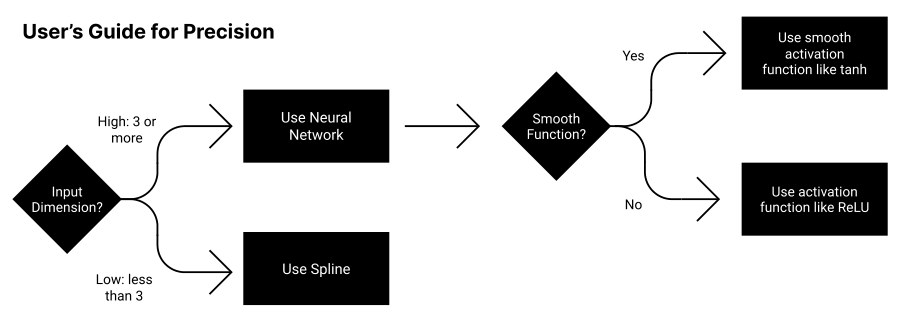
This modularity insight is central. Feynman equations are hierarchically structured with nested additions, multiplications, and simple nonlinearities. Neural networks spontaneously discover these building blocks and represent them efficiently, outperforming classical methods on 5- or 10-dimensional functions even at equal parameter counts.
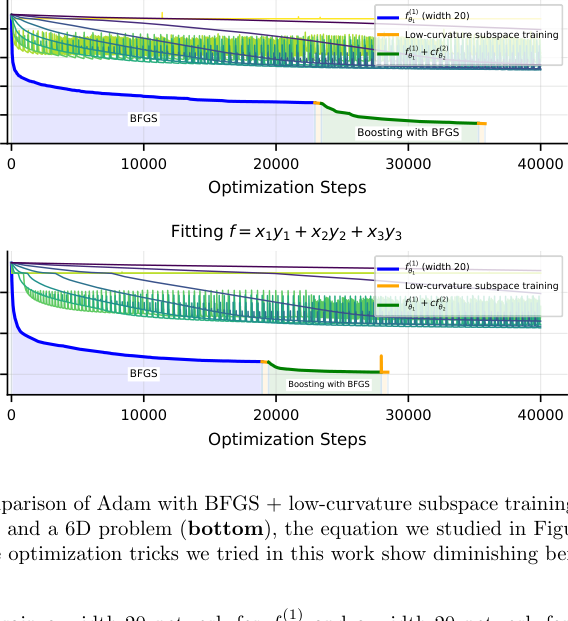
But here’s the catch. In low-dimensional cases, classical methods beat neural networks. Not because of architecture limits, but because of optimization failure. The error landscapes in the high-precision regime are littered with flat regions, saddle points, and narrow valleys that standard gradient descent cannot navigate. The optimizer stalls before reaching the global minimum, even when that minimum theoretically exists.
To fix this, the team developed targeted training techniques: aggressive learning rate scheduling (starting large and gradually shrinking), second-order optimization (using curvature information to navigate more intelligently than plain gradient descent), and precision-tuned weight initialization. Cycling between optimizers at different training stages, a kind of optimizer annealing, also helped escape local traps.
With these methods, they trained networks to relative RMSE losses of 10^(−14) and below, approaching the 10^(−16) floor imposed by 64-bit floating-point arithmetic. That’s the hard limit of how precisely modern computers store numbers.
Why It Matters
The payoff goes beyond benchmarking. Symbolic regression (discovering exact mathematical formulas from data) is one of the most promising frontiers in AI for science. Tools like PySR and Eureqa propose candidate formulas, but they depend on neural network components fitting intermediate representations with high fidelity. Imprecise function approximation breaks the symbolic discovery pipeline. Precision ML is the missing ingredient.
This work also exposes a gap in how the ML community thinks about optimization. Decades of research have been driven by tasks where error of 0.1 is acceptable and 0.01 is excellent. Adam, SGD with momentum, cosine schedules: these tools were never built for the high-precision game. The finding that standard training fails not due to architecture limits but due to optimizer limits should prompt the field to develop optimization methods designed for precision from the ground up, especially as ML moves deeper into scientific applications.
There’s also an open question worth watching: if neural networks are auto-discovering modular structure in high dimensions, can we read out that structure? Precision training might become a tool for scientific interpretability, not just fitting functions but revealing their compositional anatomy.
Bottom Line: By pushing neural networks to the limits of floating-point precision, this work shows that the bottleneck in scientific ML is often the optimizer, not the architecture. Fixing it unlocks a path toward discovering exact scientific laws from data.
IAIFI Research Highlights

This work connects AI methodology and physics practice directly, using the Feynman Lectures as a benchmark to expose and fix fundamental limitations in how neural networks handle scientific data requiring ultra-high precision.

The paper introduces a new training framework, including optimizer annealing and precision-targeted scheduling, that enables neural networks to reach losses within an order of magnitude of the 64-bit floating-point floor, far beyond what standard training achieves.

By demonstrating that neural networks auto-discover modular structure in physics equations, the work opens a path for data-driven symbolic regression capable of recovering exact physical laws from experimental observations.
Future work may extend these techniques to noisy experimental data and multi-output scientific models; the full paper is available at [arXiv:2210.13447](https://arxiv.org/abs/2210.13447).