

Progress in Normalizing Flows for 4d Gauge Theories
Authors
Ryan Abbott, Denis Boyda, Daniel C. Hackett, Gurtej Kanwar, Fernando Romero-López, Phiala E. Shanahan, Julian M. Urban
Abstract
Normalizing flows have arisen as a tool to accelerate Monte Carlo sampling for lattice field theories. This work reviews recent progress in applying normalizing flows to 4-dimensional nonabelian gauge theories, focusing on two advancements: an architectural improvement referred to as learned active loops, and the application of correlated ensemble methods to QCD with $N_f=2$ dynamical fermions.
Concepts
The Big Picture
Imagine trying to map every possible weather pattern on Earth, not just today’s forecast but every configuration the atmosphere could ever take. Now imagine your simulation gets stuck, unable to escape certain configurations no matter how long it runs. That’s the problem facing physicists who simulate quantum chromodynamics (QCD), the theory of the strong nuclear force holding protons and neutrons together.
In lattice QCD, spacetime is discretized into a computational grid and billions of possible field configurations are sampled using Monte Carlo methods. Two problems haunt these simulations. Critical slowing down: as simulations approach physically realistic conditions, the algorithm takes exponentially longer to generate independent samples. Topological freezing: the simulation locks into one structural configuration and can’t cross over to explore fundamentally different ones, like a marble stuck at the bottom of one valley, unable to reach the others. Both get dramatically worse as physicists push toward the finer lattice spacings needed for precise predictions.
Normalizing flows, deep generative models that transform simple probability distributions into complex ones, can be trained to sample directly from the lattice QCD distribution, bypassing the slowdowns entirely. Researchers at MIT’s Center for Theoretical Physics and IAIFI now report two advances that bring this approach closer to practical use for full-scale QCD.
Key Insight: By teaching the neural network to learn which geometric loops matter most, rather than hardcoding them by hand, the researchers improved flow model quality and demonstrated the first flow-accelerated computation in QCD with dynamical fermions.
How It Works
The core architecture is a coupling-based spectral flow: a pipeline of transformation stages applied sequentially to reshape the field. Each stage takes a subset of field variables on the lattice grid (the “active links,” individual directed connections between neighboring grid points) and reshapes them while leaving the rest frozen. The transformation uses Wilson loops, closed paths tracing polygons along the lattice grid that capture how the field rotates as you travel around a loop, to guide how active links get modified.
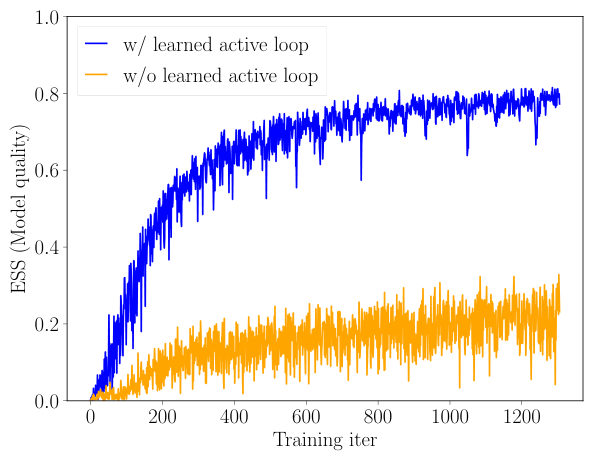
The first innovation here is learned active loops. Previous architectures used a fixed, hand-chosen loop geometry per stage, typically a small plaquette (the smallest square loop on the lattice) or a 2×1 rectangle, with loop orientations alternated across stages. Nobody revisited that design choice. The new approach replaces it with a small trainable neural network, a staple network, that computes a learned linear combination of loops for each stage.
It works in three steps:
- Frozen links are fed into the staple network, which constructs left and right “staples” by combining neighboring links and summing contributions from different loop geometries.
- The network outputs an active staple, a weighted mix of loop geometries optimized during training.
- This active staple is projected onto SU(N), the mathematical group describing valid field configurations (values must behave like rotations in an abstract space), using a polar decomposition to keep the result in the correct mathematical space.
Any fixed-loop architecture is a special case of this design, where the learned weights happen to select a single geometry. Freeing these parameters lets each stage simultaneously access local correlations and long-range structure.
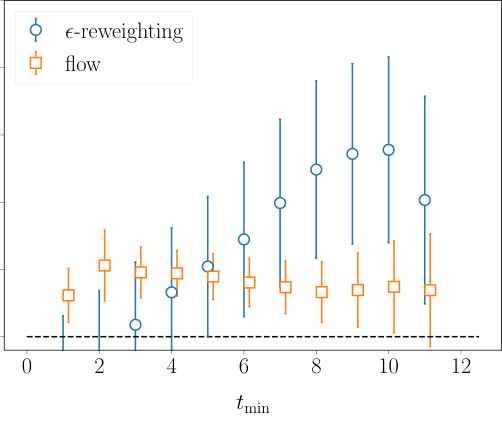
The second innovation is correlated ensemble methods, a statistical strategy for measuring small differences with high precision. Rather than using the flow model as a standalone sampler, the team generates correlated samples from two slightly different action parameters (two lattice spacings or quark masses) simultaneously. Drawing from both with correlated random numbers dramatically reduces the statistical noise in their difference, making certain ratios measurable with far fewer samples.
The team applied this to calculate the gluon momentum fraction of the pion (how much of the pion’s momentum is carried by gluons) in QCD with $N_f=2$ dynamical twisted-mass fermions at a pion mass of roughly 540 MeV. This is the first application of correlated ensemble methods to a theory with dynamical fermions.
Why It Matters
Lattice QCD is the only rigorous, first-principles method for computing hadron properties: the protons, neutrons, and pions that make up atomic nuclei. These simulations are extraordinarily expensive. The U.S. Department of Energy spends millions of dollars on supercomputer time for lattice QCD, and topological freezing acts as a hard ceiling on precision at fine lattice spacings.
A flow-based sampler that sidesteps this ceiling would change the field. What makes this work particularly convincing is the cost accounting: the authors explicitly show that the computational advantage holds even after including the cost of training the neural network. Many machine learning accelerations look good on paper until you factor in training overhead. Here, the method pays for itself.
Future work will push toward lighter pion masses, finer lattice spacings, and eventually the physical quark masses where real QCD lives and where current algorithms suffer most.
Bottom Line: Learned active loops give flow models new expressive power by letting the network discover which geometric structures matter. Correlated ensemble methods deliver real computational gains for dynamical QCD, marking the first demonstration that flow-based sampling can accelerate calculations in a physically realistic gauge theory with fermions.
IAIFI Research Highlights

This work brings modern deep generative modeling (coupling-based normalizing flows) to bear on one of the hardest computational problems in theoretical physics, advancing lattice QCD simulation with ML-accelerated sampling.

The learned active loops architecture shows how domain-specific geometric constraints (gauge equivariance, SU(N) group structure) can be woven into learned representations, providing a model for physics-informed neural networks in other structured domains.

By achieving the first flow-accelerated gluon momentum fraction calculation in dynamical QCD, the team has shown a viable route to flow-based sampling at fine lattice spacings, potentially breaking through the topological freezing barrier that limits current QCD precision.
Future directions include scaling learned active loops to physical pion masses and finer lattice spacings, and exploring alternative staple network architectures such as L-CNNs. Full details are available at [arXiv:2502.00263](https://arxiv.org/abs/2502.00263) (presented at LATTICE2024).
Original Paper Details
Progress in Normalizing Flows for 4d Gauge Theories
2502.00263
["Ryan Abbott", "Denis Boyda", "Daniel C. Hackett", "Gurtej Kanwar", "Fernando Romero-López", "Phiala E. Shanahan", "Julian M. Urban"]
Normalizing flows have arisen as a tool to accelerate Monte Carlo sampling for lattice field theories. This work reviews recent progress in applying normalizing flows to 4-dimensional nonabelian gauge theories, focusing on two advancements: an architectural improvement referred to as learned active loops, and the application of correlated ensemble methods to QCD with $N_f=2$ dynamical fermions.