

QuACK: Accelerating Gradient-Based Quantum Optimization with Koopman Operator Learning
Authors
Di Luo, Jiayu Shen, Rumen Dangovski, Marin Soljačić
Abstract
Quantum optimization, a key application of quantum computing, has traditionally been stymied by the linearly increasing complexity of gradient calculations with an increasing number of parameters. This work bridges the gap between Koopman operator theory, which has found utility in applications because it allows for a linear representation of nonlinear dynamical systems, and natural gradient methods in quantum optimization, leading to a significant acceleration of gradient-based quantum optimization. We present Quantum-circuit Alternating Controlled Koopman learning (QuACK), a novel framework that leverages an alternating algorithm for efficient prediction of gradient dynamics on quantum computers. We demonstrate QuACK's remarkable ability to accelerate gradient-based optimization across a range of applications in quantum optimization and machine learning. In fact, our empirical studies, spanning quantum chemistry, quantum condensed matter, quantum machine learning, and noisy environments, have shown accelerations of more than 200x speedup in the overparameterized regime, 10x speedup in the smooth regime, and 3x speedup in the non-smooth regime. With QuACK, we offer a robust advancement that harnesses the advantage of gradient-based quantum optimization for practical benefits.
Concepts
The Big Picture
Imagine you’re hiking through a vast mountain range, searching for the lowest valley. Each step requires consulting an expensive GPS device, and the more peaks surrounding you, the more measurements you need. Now imagine someone hands you a map predicting where the valley lies, so you only need to check the GPS occasionally. That’s what QuACK does for quantum computers optimizing complex physics problems.
Quantum computers should eventually let us simulate molecules, design materials, and solve problems beyond classical machines. But there’s a painful bottleneck: computing gradients, the measurements that tell an optimizer which direction to improve. Training a Variational Quantum Algorithm (VQA) means fine-tuning a quantum circuit’s adjustable settings until it finds the best solution, which requires calculating how the score changes with each setting. The cost scales linearly with the number of settings. Add more, pay more, every single iteration.
A team from MIT, Harvard, and the University of Illinois tackled this with QuACK (Quantum-circuit Alternating Controlled Koopman Operator Learning), a method that borrows from dynamical systems theory developed nearly a century ago. It achieves speedups of up to 200x.
Key Insight: QuACK uses Koopman operator theory to learn a linear model of the nonlinear optimization dynamics, then predicts future parameter updates without running expensive quantum gradient computations, cutting circuit evaluations by orders of magnitude.
How It Works
The core idea: reframe quantum optimization as a dynamical system, one whose state evolves step by step according to fixed rules, like a planet tracing its orbit. Rather than asking “what’s the gradient right now?”, QuACK asks “can we learn the rules governing how parameters evolve, then extrapolate forward?”
Koopman operator theory makes this possible. Developed in the 1930s, it says that even for wildly nonlinear systems, there exists a linear operator that captures all the dynamics exactly. The catch is that this operator acts on an infinite-dimensional space of measurable quantities. In practice, you approximate it with a finite set of measurements. What you get is a linear representation of nonlinear behavior, and linear systems are far easier to predict.
QuACK’s pipeline breaks into four stages:
- Quantum optimization runs — parameterized quantum circuits evaluate the loss via measurements, and a classical optimizer computes parameter updates using quantum gradients (the expensive part)
- Data acquisition — the optimization history forms a time series; each step costs resources proportional to the number of parameters
- Koopman operator learning — an alternating algorithm learns an embedding space where the dynamics become approximately linear
- Prediction — QuACK uses the learned operator to predict many future parameter updates at once, checking the actual quantum circuit only periodically to keep the model honest
The “alternating” in the name refers to the core optimization scheme: the algorithm alternates between updating the Koopman embedding and updating the linear operator, converging efficiently to a stable representation. The authors analyze spectral stability to ensure predicted dynamics don’t blow up, and extend the approach to handle nonlinear corrections via sliding windows and neural network enhancements.
The connection to quantum natural gradient is worth unpacking. The natural gradient accounts for the geometry of quantum state space, treating the optimization landscape as curved rather than flat. This curvature is captured by the quantum Fisher information metric, which measures how distinguishable nearby quantum states are. The authors show that Koopman learning in this geometric setting is theoretically well-posed. Overparameterized circuits, those with more parameters than strictly needed, are especially amenable because their loss landscapes are smoother and the dynamics more predictable.
Why It Matters
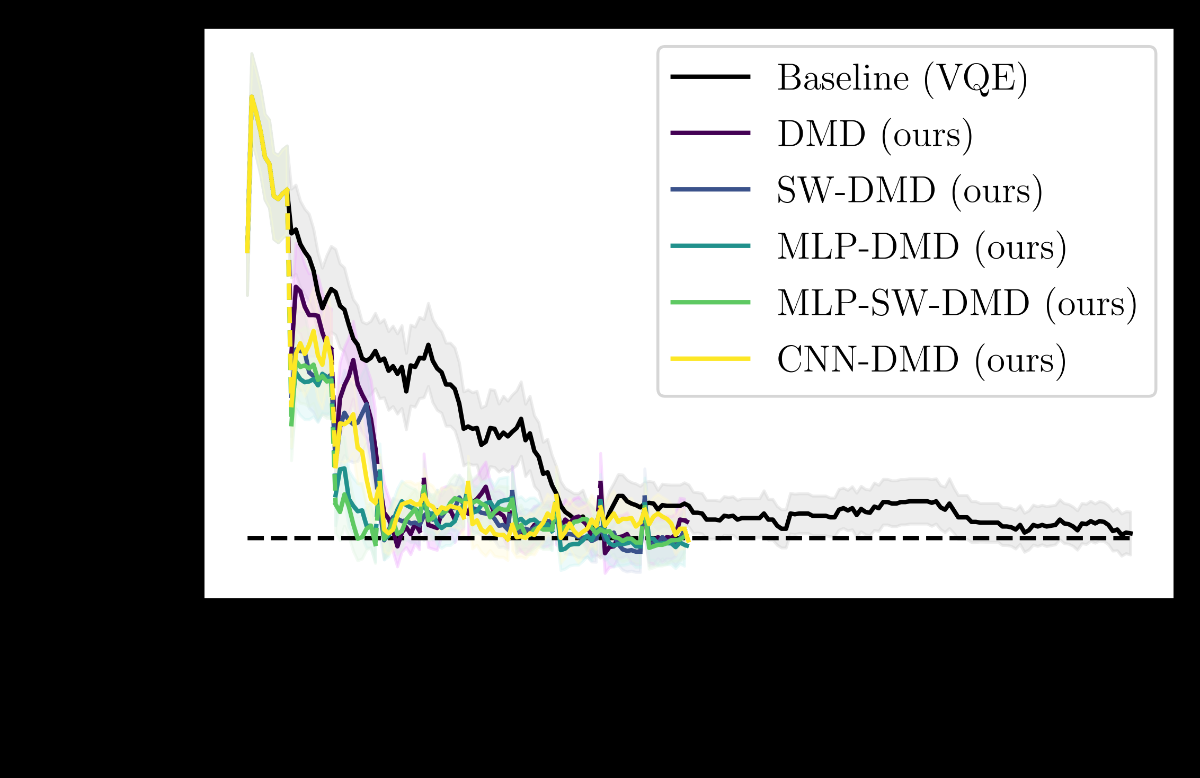
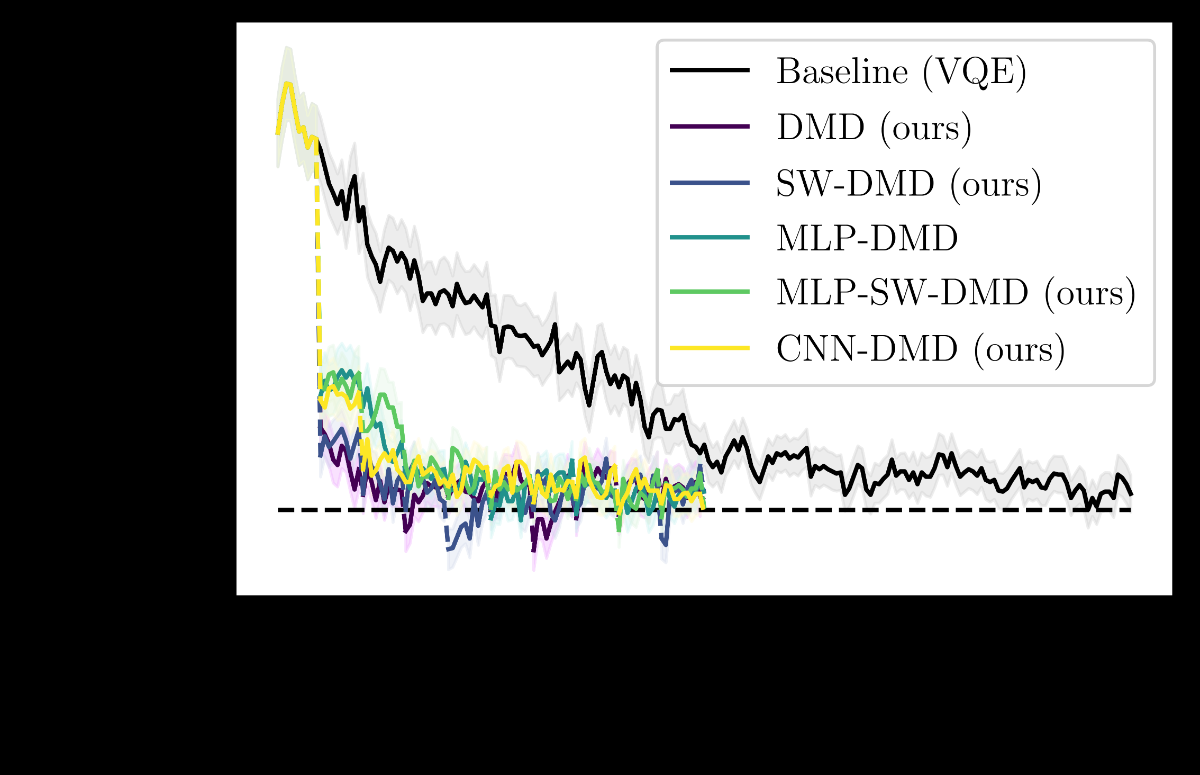
The results are striking. In the overparameterized regime, QuACK delivers over 200x speedup compared to standard gradient-based methods. In the smooth regime, it achieves 10x speedup. Even in non-smooth settings, notoriously difficult for any optimizer, QuACK still manages 3x speedup. The team validated these results across quantum chemistry, condensed matter spin systems, quantum machine learning tasks, and noisy environments mimicking real hardware.
The gradient bottleneck has been one of the most stubborn practical obstacles to deploying VQAs on near-term hardware. Quantum computers are expensive to run, noisy, and time-limited. A 200x reduction in required circuit evaluations could be the difference between a feasible experiment and an impossible one.
QuACK also complements meta-learning and other acceleration strategies; it layers on top of existing approaches rather than replacing them. The Koopman framework opens up new questions too: studying optimization landscapes theoretically, understanding not just whether gradient methods converge but why and how fast. Extensions to larger qubit systems, more complex noise models, and hybrid classical-quantum architectures are natural next steps.
Bottom Line: A century-old mathematical theory, Koopman operator learning, can cut quantum optimization costs by up to 200x. This could make gradient-based VQAs practical on real quantum hardware for the first time.
IAIFI Research Highlights

This work connects Koopman dynamical systems theory, quantum natural gradient methods, and overparameterization theory into a single algorithmic framework that spans pure mathematics, quantum physics, and machine learning.

QuACK introduces a new class of optimization accelerator for variational quantum algorithms, showing that machine-learned surrogate models of gradient dynamics can replace expensive quantum measurements in quantum ML tasks.

By making gradient-based optimization at scale practical, QuACK advances our ability to simulate quantum chemistry and many-body condensed matter systems, problems at the heart of understanding quantum-level physical interactions.
Future work may extend QuACK to larger qubit systems, more realistic noise models, and integration with meta-learning pipelines. The paper is available at [arXiv:2211.01365](https://arxiv.org/abs/2211.01365) and was presented at NeurIPS 2023.
Original Paper Details
QuACK: Accelerating Gradient-Based Quantum Optimization with Koopman Operator Learning
2211.01365
Di Luo, Jiayu Shen, Rumen Dangovski, Marin Soljačić
Quantum optimization, a key application of quantum computing, has traditionally been stymied by the linearly increasing complexity of gradient calculations with an increasing number of parameters. This work bridges the gap between Koopman operator theory, which has found utility in applications because it allows for a linear representation of nonlinear dynamical systems, and natural gradient methods in quantum optimization, leading to a significant acceleration of gradient-based quantum optimization. We present Quantum-circuit Alternating Controlled Koopman learning (QuACK), a novel framework that leverages an alternating algorithm for efficient prediction of gradient dynamics on quantum computers. We demonstrate QuACK's remarkable ability to accelerate gradient-based optimization across a range of applications in quantum optimization and machine learning. In fact, our empirical studies, spanning quantum chemistry, quantum condensed matter, quantum machine learning, and noisy environments, have shown accelerations of more than 200x speedup in the overparameterized regime, 10x speedup in the smooth regime, and 3x speedup in the non-smooth regime. With QuACK, we offer a robust advancement that harnesses the advantage of gradient-based quantum optimization for practical benefits.