

Quantum Computation and Simulation using Fermion-Pair Registers
Authors
Xiangkai Sun, Di Luo, Soonwon Choi
Abstract
We propose and analyze an approach to realize quantum computation and simulation using fermionic particles under quantum gas microscopes. Our work is inspired by a recent experimental demonstration of large-scale quantum registers, where tightly localized fermion pairs are used to encode qubits exhibiting long coherence time and robustness against laser intensity noise. We describe how to engineer the SWAP gate and high-fidelity controlled-phase gates by adjusting the fermion hopping as well as Feshbach interaction strengths. Combined with previously demonstrated single-qubit rotations, these gates establish the computational universality of the system. Furthermore, we show that 2D quantum Ising Hamiltonians with tunable transverse and longitudinal fields can be efficient simulated by modulating Feshbach interaction strengths. We present a sample-efficient protocol to characterize engineered gates and Hamiltonian dynamics based on an improved classical shadow process tomography that requires minimal experimental controls. Our work opens up new opportunities to harness existing ultracold quantum gases for quantum information sciences.
Concepts
The Big Picture
Imagine building a computer where the bits are individual atoms, each held in a fragile quantum superposition of 0 and 1 that collapses the instant anything disturbs it. That’s the central challenge of quantum computing: the very properties that make these machines powerful also make them desperately fragile. Every vibration, every stray photon, every imperfection in a laser beam threatens to destroy the delicate states that carry information.
Physicists have spent decades hunting for qubit platforms that are simultaneously controllable and long-lived. Superconducting circuits are fast but require near-absolute-zero temperatures and custom-built chips. Trapped ions are precise but hard to scale. Now, researchers at MIT propose turning an existing laboratory tool, the quantum gas microscope (a device that traps and images individual atoms), into a universal quantum computer. The qubit of choice is surprisingly sturdy: pairs of fermions, the class of quantum particles that includes electrons, protons, and certain atoms.
In a new theoretical paper, Xiangkai Sun, Di Luo, and Soonwon Choi describe how to achieve universal quantum computation and large-scale quantum simulation using fermion-pair registers, quantum memory units built from bound pairs of fermionic atoms. The idea builds on a recent experiment showing that these registers hold quantum information for exceptionally long times and resist the laser noise that limits most competing platforms.
Key Insight: By encoding qubits in the shared vibrational states of tightly bound fermion pairs, and exploiting fundamental quantum statistics for protection, the system gains built-in robustness against laser intensity fluctuations.
How It Works
The starting point is a quantum gas microscope that uses tightly focused lasers to trap ultracold atoms in a grid called an optical lattice, with single-atom resolution. Instead of one atom per site, this system places exactly two fermionic atoms at every lattice site. These pairs are the qubits.
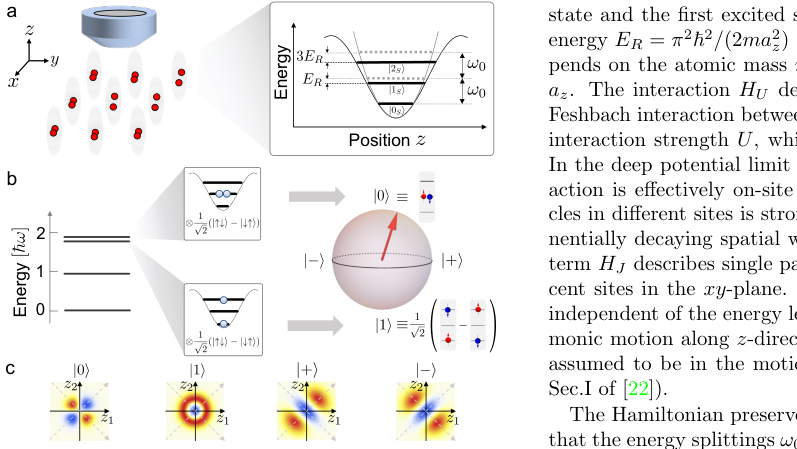
In each site, two atoms sit in a slightly anharmonic trap, like a bowl that’s not quite parabolic. The qubit states |0⟩ and |1⟩ differ in how the pair distributes its vibrational energy: in |0⟩, both atoms occupy the first excited vibrational level; in |1⟩, one atom climbs to the second. Both states carry roughly the same total energy, so stray fluctuations in laser intensity, which shift all energy levels together, can’t distinguish between them. Structure itself is what protects these qubits.
Manipulating them requires two physical controls:
- Feshbach interaction strength (U): Tuning a magnetic field near a Feshbach resonance dramatically amplifies atomic interactions. Modulating this field drives transitions between qubit states, implementing single-qubit rotations.
- Nearest-neighbor hopping amplitude (J): Atoms quantum-mechanically tunnel between adjacent lattice sites. Controlling this tunneling creates quantum entanglement, correlations between neighboring qubit pairs with no classical equivalent and the ingredient that makes quantum computation possible.
Together, these two knobs produce a complete set of universal quantum gates.
The SWAP gate is almost free. Without interaction (U = 0), atoms tunnel freely between neighboring sites. Let the system evolve for exactly t = π/(2J) and two qubits exchange their full quantum states. This isn’t magic; it’s quantum mechanics doing what it does naturally.
The harder part is the controlled-phase (CPHASE) gate, which creates the entanglement that makes quantum computers powerful. Both hopping and Feshbach interactions are activated simultaneously. Atoms briefly hop to neighboring sites and return, and this rapid sequence of virtual moves leaves a permanent mark: a quantum phase shift whose value depends on the state of both qubits. Tuning the ratio U/J and the evolution time gives access to any desired phase angle φ.
The system also directly simulates a foundational physics model: the 2D quantum Ising model, which describes quantum particles interacting like tiny magnets and captures phenomena from ordinary magnetism to abrupt quantum phase transitions. By varying the Feshbach interaction strength U(t) over time, the fermion-pair register naturally implements the Ising equations with tunable effective magnetic fields in two directions, without decomposing the simulation into individual gates. Since the optical lattice geometry can be freely reconfigured, the same hardware adapts to different physical scenarios.
Why It Matters
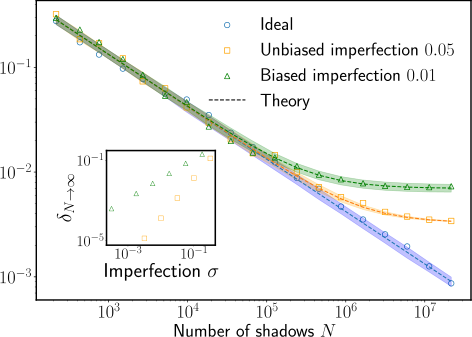
The practical challenge for any quantum computing platform isn’t just building hardware; it’s verifying that hardware works. Quantum states can’t be measured without destroying them, and full quantum process tomography, the standard method for characterizing what a quantum gate actually does, requires an exponentially large number of measurements.
The MIT team addresses this with an improved classical shadow process tomography protocol that requires minimal experimental overhead. Random measurements combined with classical post-processing reconstruct gate behavior with provably efficient sample complexity. For experimentalists working with quantum gas microscopes, this is a practical win: reliable gate characterization without redesigning experiments from scratch.
What makes this work significant is the convergence it represents. Quantum gas microscopes were originally built to study collective quantum behavior: exotic states of matter, particles freezing in place due to quantum effects, strange transport phenomena. This paper shows those same instruments, with existing capabilities, can be repurposed for universal quantum computation.
The fermion-pair platform doesn’t require the extreme isolation of trapped ions or the millikelvin temperatures of superconducting chips in specialized cryostats. It lives naturally in the ultracold physics ecosystem that already exists in laboratories worldwide. Any group with a quantum gas microscope is closer to a quantum computer than they may have realized.
Open questions remain. The paper focuses on two-qubit gates between nearest neighbors; longer-range connectivity, needed for many quantum algorithms, would require chains of SWAP operations. Decoherence from atom loss and other sources will set limits on circuit depth. Scaling to thousands of qubits will introduce new engineering challenges. But the theoretical foundation is now in place.
Bottom Line: Fermion-pair registers, already demonstrated experimentally at scale, can implement universal quantum gates and quantum many-body simulations using nothing more than tunable atomic interactions and tunneling, turning quantum gas microscopes into a viable quantum computing platform.
IAIFI Research Highlights

This work connects quantum information science and ultracold atomic physics, translating quantum gate mathematics directly into physical controls (magnetic fields and laser-tuned tunneling) available in quantum gas microscope experiments.

The classical shadow process tomography protocol provides a provably sample-efficient method for characterizing quantum processes, a technique that could accelerate benchmarking and verification across quantum computing platforms more broadly.

The fermion-pair register architecture uses fundamental fermionic exchange symmetry as a built-in error protection mechanism, showing how intrinsic quantum statistics can be harnessed for stable quantum information storage.
Future work will explore scaling to larger registers, implementing long-range entanglement, and benchmarking gate fidelities in experimental demonstrations; the full analysis appears on arXiv at [arXiv:2306.03905](https://arxiv.org/abs/2306.03905).
Original Paper Details
Quantum Computation and Simulation using Fermion-Pair Registers
2306.03905
["Xiangkai Sun", "Di Luo", "Soonwon Choi"]
We propose and analyze an approach to realize quantum computation and simulation using fermionic particles under quantum gas microscopes. Our work is inspired by a recent experimental demonstration of large-scale quantum registers, where tightly localized fermion pairs are used to encode qubits exhibiting long coherence time and robustness against laser intensity noise. We describe how to engineer the SWAP gate and high-fidelity controlled-phase gates by adjusting the fermion hopping as well as Feshbach interaction strengths. Combined with previously demonstrated single-qubit rotations, these gates establish the computational universality of the system. Furthermore, we show that 2D quantum Ising Hamiltonians with tunable transverse and longitudinal fields can be efficient simulated by modulating Feshbach interaction strengths. We present a sample-efficient protocol to characterize engineered gates and Hamiltonian dynamics based on an improved classical shadow process tomography that requires minimal experimental controls. Our work opens up new opportunities to harness existing ultracold quantum gases for quantum information sciences.