

Reconstructing $S$-matrix Phases with Machine Learning
Authors
Aurélien Dersy, Matthew D. Schwartz, Alexander Zhiboedov
Abstract
An important element of the $S$-matrix bootstrap program is the relationship between the modulus of an $S$-matrix element and its phase. Unitarity relates them by an integral equation. Even in the simplest case of elastic scattering, this integral equation cannot be solved analytically and numerical approaches are required. We apply modern machine learning techniques to studying the unitarity constraint. We find that for a given modulus, when a phase exists it can generally be reconstructed to good accuracy with machine learning. Moreover, the loss of the reconstruction algorithm provides a good proxy for whether a given modulus can be consistent with unitarity at all. In addition, we study the question of whether multiple phases can be consistent with a single modulus, finding novel phase-ambiguous solutions. In particular, we find a new phase-ambiguous solution which pushes the known limit on such solutions significantly beyond the previous bound.
Concepts
The Big Picture
Imagine listening to music through a wall. You can hear the volume of each note, how loud the bass, how strong the treble, but you’ve lost something crucial: the timing, the rhythm, the way notes relate to each other in time. That missing information is the phase.
In quantum particle physics, experimentalists face an almost identical problem. When two particles collide, detectors measure how many particles scatter in each direction, essentially the magnitude of the scattering. But the underlying quantum description is a complex number, carrying both a magnitude and a hidden rotation called the phase, invisible to detectors.
Recovering that hidden phase from measurable data is one of the oldest unsolved problems in theoretical physics. The full quantum description encodes everything about fundamental particle interactions, and without the phase, our picture remains incomplete. The problem is governed by the unitarity constraint, which enforces the requirement that all probabilities must add up to one, linking magnitude to phase through an integral equation with no known analytical solution even in the simplest two-particle case.
Now, researchers Aurélien Dersy, Matthew Schwartz, and Alexander Zhiboedov from Harvard and CERN have shown that modern machine learning can crack this problem with impressive accuracy, and do something even more surprising along the way.
Key Insight: A machine learning algorithm can reconstruct the quantum phase from a given scattering magnitude, and its failure to do so reliably signals that no valid phase exists at all, turning the optimization itself into a diagnostic for physical consistency.
How It Works
The central object of study is the S-matrix, the mathematical framework encoding all possible scattering outcomes between particles. At fixed energy, the scattering amplitude can be written as a magnitude times a complex phase factor. Unitarity imposes a strict relationship between the two through an integral equation. The question: given the magnitude, can you find the phase?
The ML approach frames this as an optimization problem with three steps:
- Represent the unknown phase using a neural network, a flexible function approximator.
- Define a loss function measuring how well the unitarity equation is satisfied.
- Minimize the loss by iteratively adjusting the network’s parameters until the equation is satisfied as well as possible.
The method works across a broad range of test cases: simple linear and quadratic magnitudes, as well as physically important extremal amplitudes that push right up against the theoretical limits of what’s allowed.
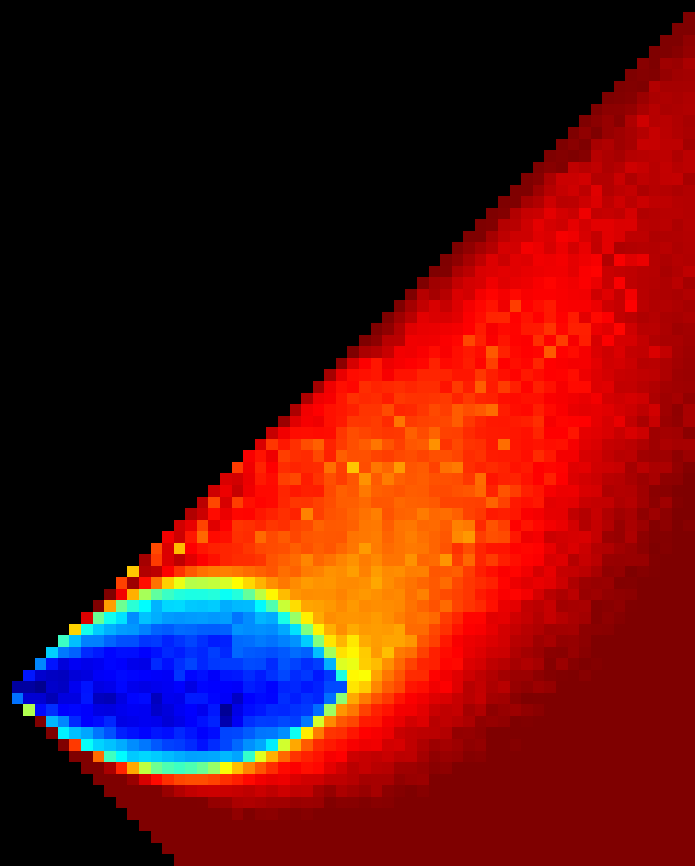
But the real payoff comes from what the loss value itself reveals. A low loss means the network successfully satisfied the constraint. A high loss strongly suggests no consistent phase exists. This makes the loss a practical unitarity feasibility probe, no new physics required, just a clever reuse of the optimization signal.
Finding phase ambiguities. Beyond reconstruction, the paper tackles a deeper question: can two completely different phases produce the same magnitude? This phase ambiguity problem has been studied since the 1970s, but progress stalled. For elastic scattering (where particles bounce without changing identity) with infinitely many partial waves, classical results showed that at most two phases could correspond to a given magnitude. Explicit examples of such pairs were rare.
To find phase-ambiguous solutions, the researchers added a repulsive loss term. Two networks run simultaneously, both trying to satisfy unitarity for the same magnitude, but penalized for converging to the same answer. This forces each network to explore different regions, hunting for distinct valid phases.
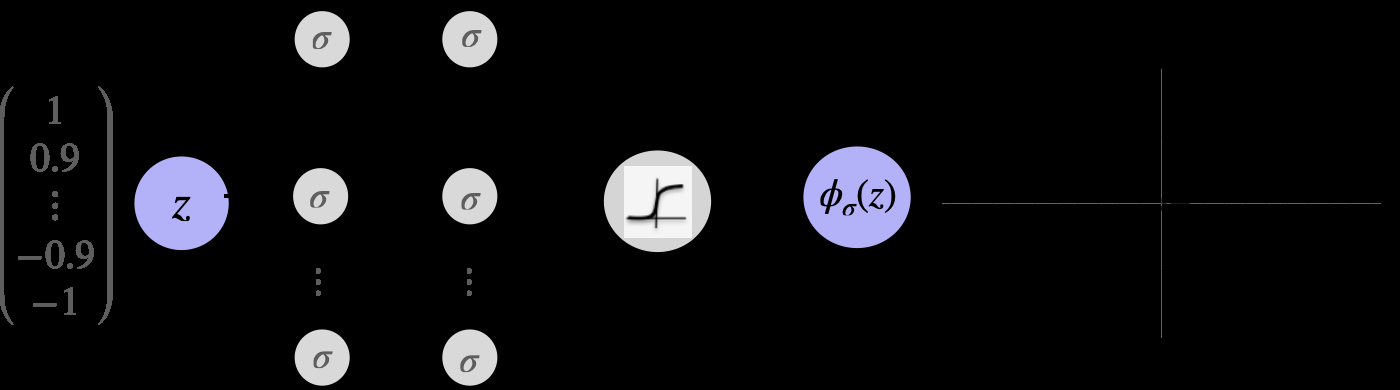
For finitely many partial waves, where at most 2^L phases can exist for L partial waves, the method finds multiple solutions systematically. For the infinite partial wave case, the team discovered new phase-ambiguous solutions that push well beyond bounds established decades ago.
The mathematical scaffolding comes from classical complex analysis: Blaschke products, which express scattering amplitudes using the locations of zeros of a complex-valued function. ML provides the numerical muscle to search through the vast space of possible solutions.
Why It Matters
This work connects two of the most active frontiers in theoretical physics. The S-matrix bootstrap program tries to constrain quantum field theories purely from consistency conditions like unitarity, analyticity, and crossing symmetry, without assuming a specific underlying model. It has seen a major revival over the past decade.
Being able to rapidly test whether a given scattering amplitude is consistent with unitarity, and to find all consistent phases, directly accelerates this program. Problems that once required laborious analytical work can now be explored at scale.
On the AI side, the paper shows that physics-informed neural networks can go beyond approximating known solutions. They can probe whether solutions exist and whether they are unique. The loss-as-feasibility-probe idea is especially clean: it turns a failed optimization into information rather than a dead end.
Future directions include extending the method to inelastic scattering, applying it to realistic collider data, and mapping the full space of physically consistent S-matrices.
Bottom Line: Machine learning doesn’t just solve the decades-old phase reconstruction problem. It uncovers new phase-ambiguous solutions that push known theoretical bounds, opening a computational path into the S-matrix bootstrap program.
IAIFI Research Highlights

This work applies modern neural network optimization to a foundational problem in theoretical particle physics, showing that machine learning can both solve and test the consistency of quantum mechanical constraints that have resisted analytical solution for over 50 years.

The repulsive loss technique, running two networks that penalize convergence to the same solution, offers a fresh strategy for finding multiple distinct solutions to nonlinear integral equations, with potential applications beyond physics.

The discovery of new phase-ambiguous S-matrix solutions extends known mathematical bounds on the unitarity phase problem, providing concrete benchmarks for the S-matrix bootstrap program and opening previously inaccessible regions of amplitude space.
Future extensions to inelastic scattering and direct application to experimental cross-section data could make phase reconstruction a practical tool for collider physics; the full paper is available at [arXiv:2308.09451](https://arxiv.org/abs/2308.09451).