

Renormalization Group flow, Optimal Transport and Diffusion-based Generative Model
Authors
Artan Sheshmani, Yi-Zhuang You, Baturalp Buyukates, Amir Ziashahabi, Salman Avestimehr
Abstract
Diffusion-based generative models represent a forefront direction in generative AI research today. Recent studies in physics have suggested that the renormalization group (RG) can be conceptualized as a diffusion process. This insight motivates us to develop a novel diffusion-based generative model by reversing the momentum-space RG flow. We establish a framework that interprets RG flow as optimal transport gradient flow, which minimizes a functional analogous to the Kullback-Leibler divergence, thereby bridging statistical physics and information theory. Our model applies forward and reverse diffusion processes in Fourier space, exploiting the sparse representation of natural images in this domain to efficiently separate signal from noise and manage image features across scales. By introducing a scale-dependent noise schedule informed by a dispersion relation, the model optimizes denoising performance and image generation in Fourier space, taking advantage of the distinct separation of macro and microscale features. Experimental validations on standard datasets demonstrate the model's capability to generate high-quality images while significantly reducing training time compared to existing image-domain diffusion models. This approach not only enhances our understanding of the generative processes in images but also opens new pathways for research in generative AI, leveraging the convergence of theoretical physics, optimal transport, and machine learning principles.
Concepts
The Big Picture
Imagine trying to describe a painting by zooming out, layer by layer, until all you see is a blur of average colors. That’s roughly what physicists do when they apply the renormalization group, a mathematical procedure that progressively simplifies a system by averaging over fine details while preserving its large-scale structure. The technique was invented to tame the runaway infinities of quantum field theory, and for decades it belonged almost exclusively to particle physics and statistical mechanics.
A team from Harvard, MIT, UC San Diego, and USC has now turned that procedure inside out and used it to build a faster, more principled image-generation AI. Their insight: the same mathematical machinery that physicists use to progressively erase small-scale variables from a physical system is mathematically equivalent to the forward diffusion process that corrupts images in modern generative AI. Run the renormalization group forward, and you destroy structure. Run it backward, and you create it.
The result is the Fourier-Domain Diffusion Model (FDDM), a generative model that works in frequency space rather than pixel space. Just as a sound can be broken into individual musical notes, FDDM decomposes images into their frequency components. It trains significantly faster than conventional diffusion models and sits on a rigorous bridge between statistical physics, information theory, and machine learning.
Key Insight: By interpreting the renormalization group as an optimal transport process in Fourier space, the researchers built a diffusion model that separates image features by scale. Broad strokes and fine details get handled at the right stages of generation, rather than treating all pixels equally.
How It Works
Getting from raw physics to a working AI model involves three conceptual steps.
Step 1: RG as Optimal Transport. The researchers first establish a formal equivalence between RG flow and optimal transport, a mathematical theory originally developed to solve logistics problems. (How do you move a pile of sand to fill a hole while minimizing total work?) The key quantity is the Wasserstein distance, which measures how much “effort” it takes to morph one probability distribution into another. The paper shows that RG flow can be described as a process that minimizes a quantity closely related to the Kullback-Leibler (KL) divergence, the standard information-theoretic measure of how different two probability distributions are. This isn’t a metaphor; it’s a precise mathematical statement.
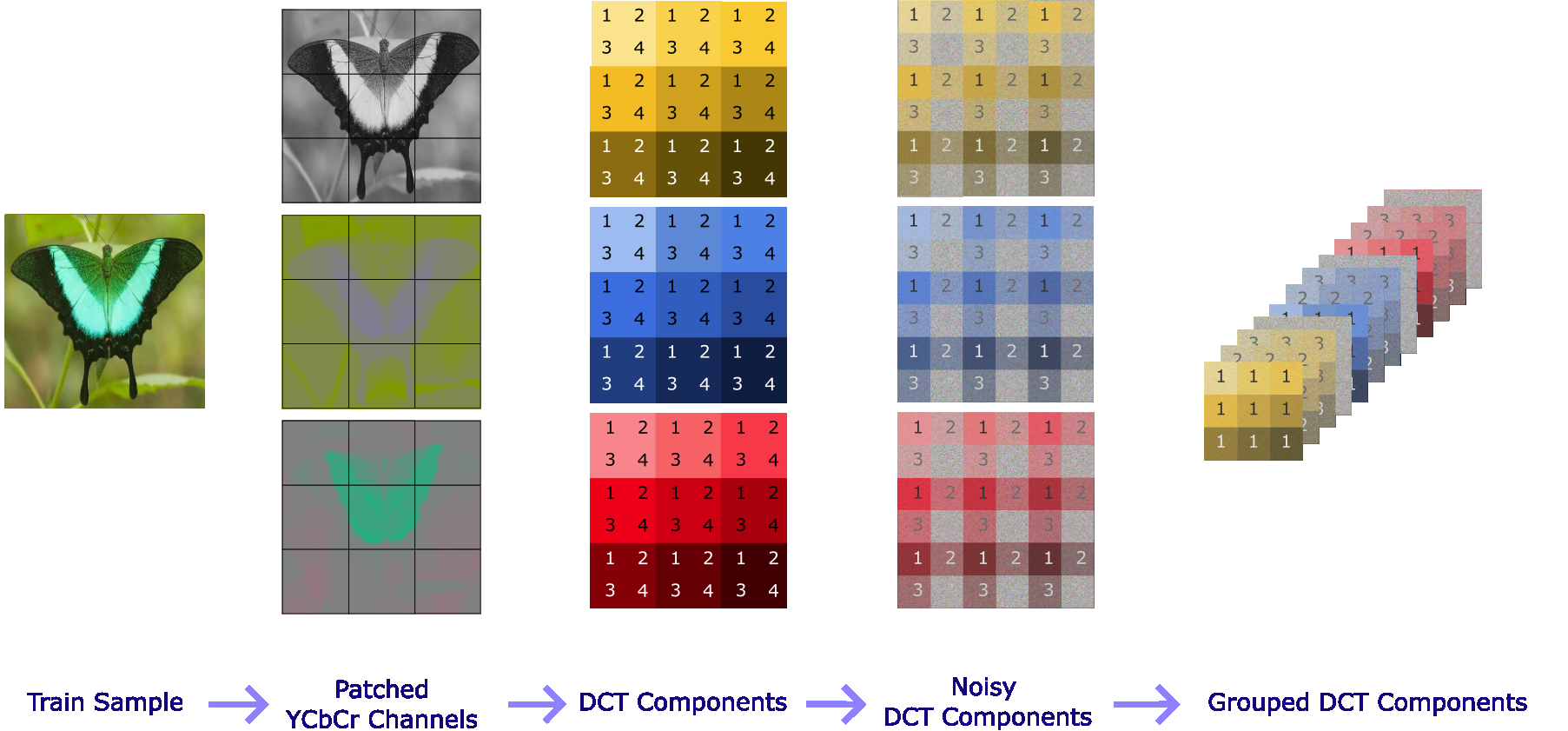
Step 2: Move everything to Fourier space. Rather than adding and removing noise pixel by pixel, FDDM operates in the Fourier domain, the space of spatial frequencies that compose an image. The motivation comes directly from physics: in quantum field theory, the renormalization group eliminates high-frequency (small-scale) components first, then progressively moves toward low-frequency (large-scale) structure. Natural images have the same property. They are sparse in Fourier space, with most image energy concentrated in relatively few frequency components. High frequencies encode sharp edges and fine textures; low frequencies encode overall composition and color.
By diffusing in Fourier space, the model selectively corrupts and recovers different scales at the right times:
- Forward diffusion (renormalization): High-frequency components are noised first. Fine details get destroyed before coarse structure, just as RG eliminates microscopic degrees of freedom before macroscopic ones.
- Reverse diffusion (generation): The model denoises low frequencies first, establishing the large-scale layout, then progressively recovers fine details. The big picture comes before the brushstrokes.
Step 3: A physics-informed noise schedule. Conventional diffusion models use a noise schedule that is largely empirical. FDDM replaces this with a dispersion relation, a concept borrowed from wave physics, that describes how different frequencies decay at different rates. Each frequency mode gets noised at a rate appropriate to its scale: high-frequency components decay rapidly, low-frequency components evolve slowly.
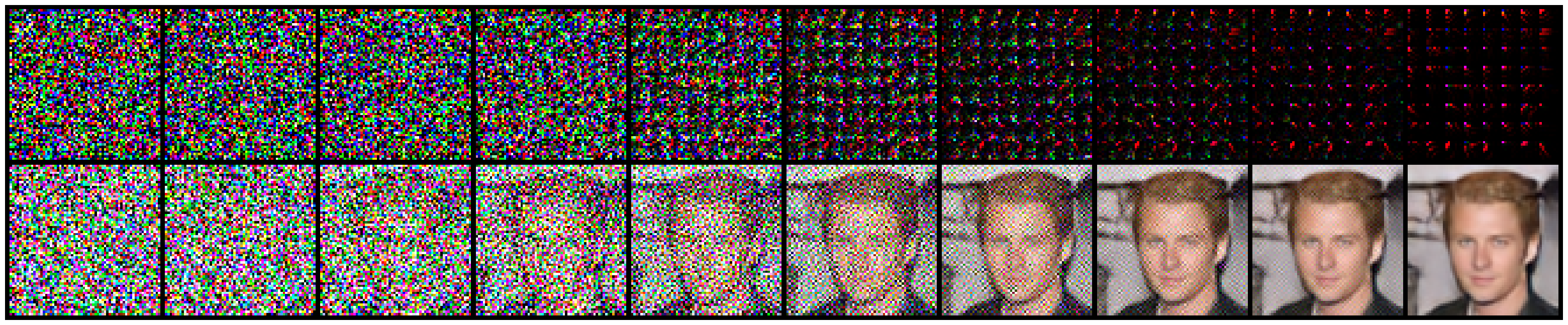
On standard image benchmarks, FDDM produced competitive image quality with substantially reduced training time compared to pixel-domain diffusion models, a direct consequence of the sparsity advantage in Fourier space.
Why It Matters
The practical payoff (faster training, good image quality) is real, but the deeper significance is conceptual. For years, researchers have noticed suggestive similarities between deep learning and physics: neural networks as statistical field theories, attention mechanisms and tensor networks, diffusion models and RG flows. Most of these analogies have stayed at the level of inspiration. This paper takes the analogy seriously enough to derive a working algorithm from it, and the algorithm performs well.
That changes the conversation. The mathematical structures physicists have refined over decades to handle the complexity of quantum fields aren’t just metaphors for machine learning. They can directly inform better algorithms. The connection to optimal transport is particularly promising because it provides a framework for understanding what diffusion models are actually optimizing, which could guide future architectural choices well beyond FDDM itself.
The authors point to several open directions: extending the framework to other data modalities (audio, molecular structures, scientific data), testing whether alternative RG schemes yield further gains, and deepening the theoretical connections to categorical and algebraic structures in both physics and machine learning.
Bottom Line: FDDM proves that the renormalization group, a tool forged in quantum field theory, can be reverse-engineered into a faster, more principled image generator. Physics didn’t just inspire the model; it built it.
IAIFI Research Highlights

This work establishes a mathematical bridge between renormalization group theory from quantum field theory, optimal transport from mathematics, and diffusion-based generative models from machine learning, turning a physics abstraction into a working AI algorithm.

The Fourier-Domain Diffusion Model matches existing image generation quality while cutting training time, by exploiting the sparse frequency-space structure of natural images and a physics-derived, scale-dependent noise schedule.

The paper formalizes RG flow as an optimal transport gradient flow minimizing a KL-divergence-like functional, offering a new information-theoretic perspective on coarse-graining in statistical and quantum physics.
Future work may extend the FDDM framework to scientific data modalities and explore alternative RG schemes for further performance gains. The paper is available as [arXiv:2402.17090](https://arxiv.org/abs/2402.17090), from researchers at Harvard, MIT, UC San Diego, and USC.
Original Paper Details
Renormalization Group flow, Optimal Transport and Diffusion-based Generative Model
2402.17090
["Artan Sheshmani", "Yi-Zhuang You", "Baturalp Buyukates", "Amir Ziashahabi", "Salman Avestimehr"]
Diffusion-based generative models represent a forefront direction in generative AI research today. Recent studies in physics have suggested that the renormalization group (RG) can be conceptualized as a diffusion process. This insight motivates us to develop a novel diffusion-based generative model by reversing the momentum-space RG flow. We establish a framework that interprets RG flow as optimal transport gradient flow, which minimizes a functional analogous to the Kullback-Leibler divergence, thereby bridging statistical physics and information theory. Our model applies forward and reverse diffusion processes in Fourier space, exploiting the sparse representation of natural images in this domain to efficiently separate signal from noise and manage image features across scales. By introducing a scale-dependent noise schedule informed by a dispersion relation, the model optimizes denoising performance and image generation in Fourier space, taking advantage of the distinct separation of macro and microscale features. Experimental validations on standard datasets demonstrate the model's capability to generate high-quality images while significantly reducing training time compared to existing image-domain diffusion models. This approach not only enhances our understanding of the generative processes in images but also opens new pathways for research in generative AI, leveraging the convergence of theoretical physics, optimal transport, and machine learning principles.