

Robust Clustering of the Local Milky Way Stellar Kinematic Substructures with Gaia eDR3
Authors
Xiaowei Ou, Lina Necib, Anna Frebel
Abstract
We apply the clustering algorithm HDBSCAN on the Gaia early third data release astrometry combined with the Gaia second data release radial velocity measurements of almost 5.5 million stars to identify the local stellar kinematic substructures in the solar neighborhood. Understanding these structures helps build a more complete picture of the formation of the Milky Way, as well as an empirical phase space distribution of dark matter that would inform detection experiments. The main goal of this study is to provide a list of the most stable clusters, by taking into account the measurement uncertainties and studying the stability of the clustering results. We apply the clustering algorithm in two spaces, in velocity space in order to study recently accreted structures, and in action-angle space to find phase-mixed structures. We find 23 (6) robust clusters in velocity space (action-angle space) that are consistently not associated with noise. They are attributed to the known structures: the Gaia Sausage-Enceladus, the Helmi Stream, and globular cluster NGC 3201 are found in both spaces, while NGC 104 and the thick disk (Sequoia) are identified in velocity space (action-angle space). We discuss the kinematic properties of these structures and study whether many of the small clusters belong to a similar larger cluster based on their chemical abundances. Although we do not identify any new structures, we find that the HDBSCAN member selection of already known structures is unstable to input kinematics of the stars when resampled within their uncertainties. We therefore present the most stable subset of local kinematic structures, which are consistently identified by the clustering algorithm, and emphasize the need to take into account error propagation during both the manual and automated identification of stellar structures, both for existing ones as well as future discoveries. (abridged)
Concepts
The Big Picture
Imagine trying to reconstruct the history of a city by studying where its residents live today, which neighborhoods they cluster in, how they move through the streets, what languages they speak. Now scale that up to hundreds of billions of stars and billions of years. That’s what researchers do when piecing together how the Milky Way formed. And like any good detective work, it requires knowing not just what you found, but how confident you are in what you found.
Our galaxy is a living record of ancient cosmic collisions. Smaller galaxies and star clusters have fallen into the Milky Way over eons. Their constituent stars, pulled apart and scattered by the Milky Way’s gravity, still carry ghostly signatures of their origins in how they move. Identifying these groups of stars with shared motion patterns tells us which smaller galaxies our Milky Way devoured, and when.
Those captured stars carry a further bonus: they may trace the dark matter that fell in alongside them, providing a rare empirical map of the invisible substance that makes up most of the universe’s mass.
Xiaowei Ou, Lina Necib, and Anna Frebel at MIT applied a machine learning clustering algorithm to the largest stellar motion dataset ever assembled. What sets their work apart is that they stress-tested their results against measurement uncertainty, something most previous studies haven’t done.
Key Insight: HDBSCAN reliably identifies major known stellar structures, but the exact membership of those structures is surprisingly fragile, shifting when you account for observational uncertainties. Knowing which stars consistently appear in a cluster is as important as finding the cluster itself.
How It Works
The team used data from Gaia, the European Space Agency’s stellar survey, combining early third data release (eDR3) positional and motion measurements with second data release (DR2) radial velocity measurements, i.e., each star’s speed toward or away from Earth. The result: 5.5 million stars in the solar neighborhood, each with full 6D phase-space information (three position coordinates, three velocity components).
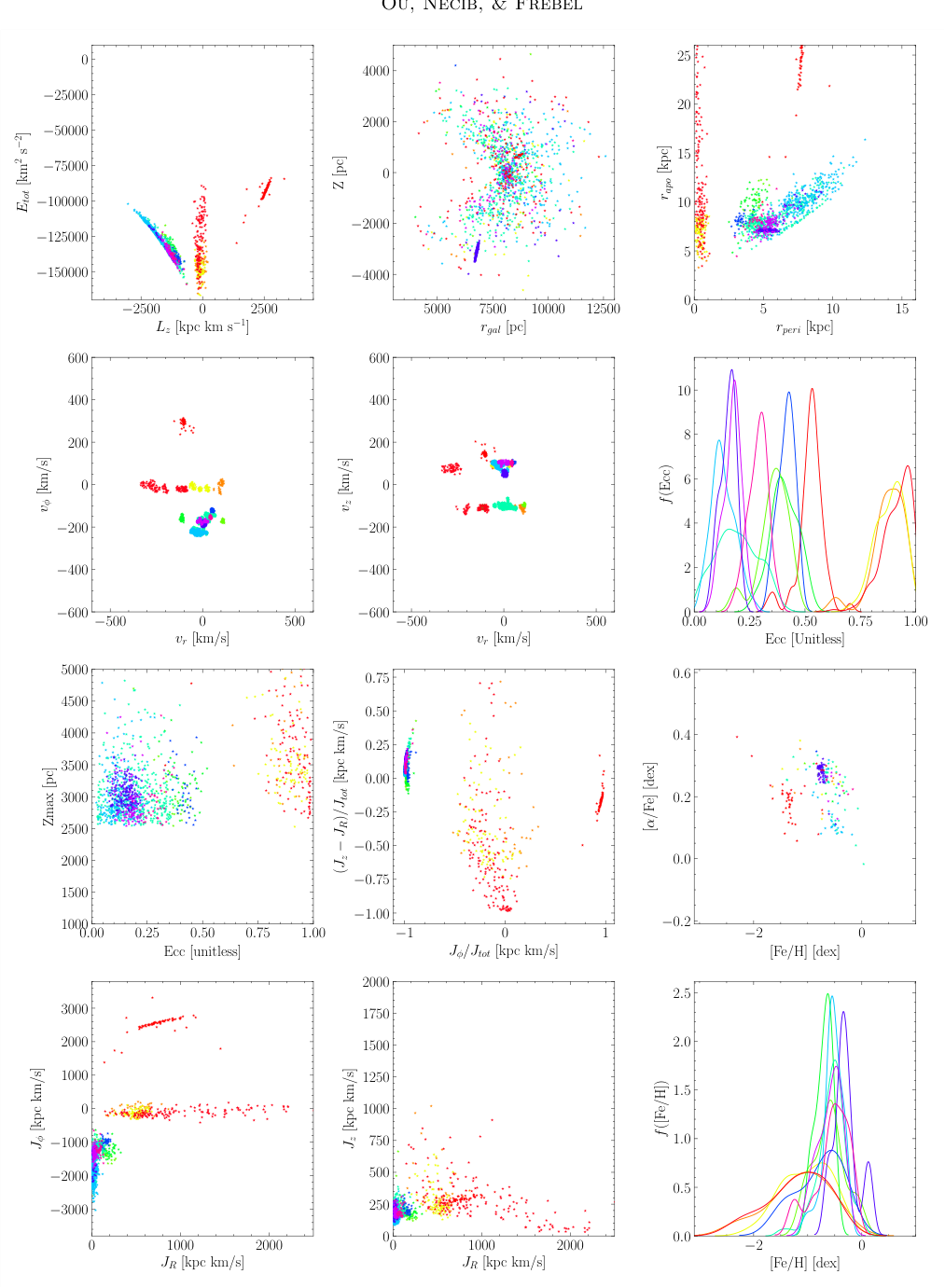
They applied HDBSCAN (Hierarchical Density-Based Spatial Clustering of Applications with Noise), an algorithm that finds clusters of arbitrary shape in high-dimensional data without requiring you to specify how many clusters exist in advance. Unlike simpler algorithms that force every data point into a group, HDBSCAN explicitly labels ambiguous points as “noise,” which matters a lot when hunting for rare stellar streams amid millions of disk stars.
The algorithm ran in two mathematical spaces:
- Velocity space (the 3D space of a star’s vx, vy, vz motion): ideal for recently accreted structures that haven’t had time to dynamically smear out.
- Action-angle space: a coordinate system derived from orbital mechanics where stars that have been gravitationally scrambled over billions of years, so-called phase-mixed structures, still cluster because they share conserved orbital properties.
The most original contribution is the treatment of error propagation. Gaia’s measurements are exquisite but not perfect, and with 5.5 million stars, small errors can meaningfully shift which clusters form. The team used a Monte Carlo bootstrap approach: running the same analysis hundreds of times with inputs resampled within each star’s measurement uncertainties, then accepting only clusters that appeared consistently across all runs.
The stability test returned a clear-eyed result: 23 stable clusters in velocity space (1,405 stars) and 6 stable clusters in action-angle space (497 stars).
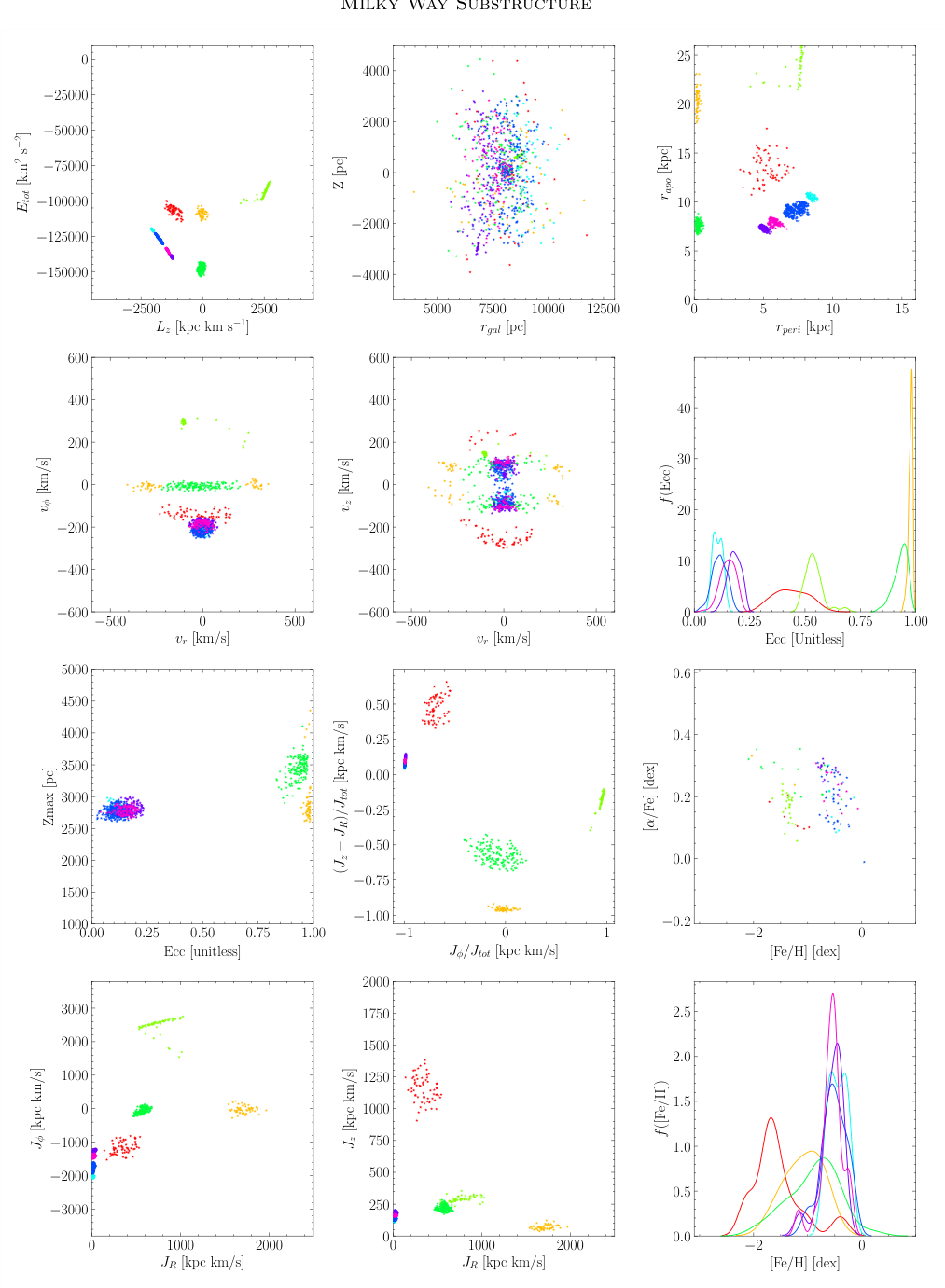
Several well-known structures emerged. The Gaia Sausage-Enceladus (GSE), remnant of the Milky Way’s most recent major merger, appeared prominently in both spaces, as did the Helmi Stream, ancient tidal debris from a disrupted dwarf galaxy. Globular cluster NGC 3201 showed up in both spaces; NGC 104 appeared only in velocity space; retrograde structure Sequoia only in action-angle space.
The researchers claimed no new discoveries. That restraint is itself scientifically significant. Previous studies using similar data but without careful uncertainty propagation have occasionally reported structures that may reflect algorithmic artifacts rather than genuine mergers. By demanding consistency across resampled datasets, Ou, Necib, and Frebel effectively publish a vetted catalog of structures you can trust.
They also cross-matched their clusters with two spectroscopic surveys, APOGEE DR17 and LAMOST DR6, checking whether stars in the same kinematic cluster share similar chemical abundances. Chemistry works like stellar DNA: stars born in the same galaxy carry similar elemental fingerprints. Where kinematic and chemical signals agreed, confidence in a cluster’s physical reality strengthened.
Why It Matters
The implications reach well into particle physics. Dark matter direct detection experiments, the underground detectors searching for the faint recoil when a dark matter particle scatters off an atomic nucleus, need accurate models of the local dark matter velocity distribution. If dark matter was accreted alongside infalling dwarf galaxies, the kinematic substructures identified here directly constrain those models. A more accurate stellar map means better predictions for where to look, and better interpretation of null results when detectors find nothing.
The approach also sets a methodological precedent. As Gaia continues releasing data, and as future surveys like the Vera Rubin Observatory and Roman Space Telescope add tens of millions more stars, automated clustering will become indispensable. But automation without uncertainty quantification is a trap. HDBSCAN’s membership lists shift when inputs are resampled. That’s a clear warning: reported structures in the literature may be real, but their boundaries carry more ambiguity than is usually acknowledged.
Bottom Line: By stress-testing their clustering algorithm against measurement uncertainties, the MIT team delivers the most carefully validated catalog of local stellar kinematic substructures to date and poses a simple challenge to the field: always propagate your errors, or risk confusing noise for cosmic history.
IAIFI Research Highlights

This work connects machine learning and astrophysics, applying the HDBSCAN clustering algorithm to 5.5 million Gaia stars to map the Milky Way's merger history and constrain the local dark matter velocity distribution relevant for particle physics experiments.

The study introduces a Monte Carlo approach to validating unsupervised clustering outputs under observational uncertainty, a methodology applicable to any domain where ML-identified clusters must be distinguished from noise.

The uncertainty-validated catalog of local stellar kinematic substructures provides the most reliable empirical input yet for modeling the dark matter phase-space distribution in the solar neighborhood, directly informing direct detection experiments.
Future Gaia data releases and next-generation spectroscopic surveys will expand the stellar sample dramatically, making careful uncertainty propagation even more important; the full analysis is available at [arXiv:2208.01056](https://arxiv.org/abs/2208.01056).