

Search for heavy neutral leptons in electron-positron and neutral-pion final states with the MicroBooNE detector
Authors
MicroBooNE collaboration, P. Abratenko, O. Alterkait, D. Andrade Aldana, L. Arellano, J. Asaadi, A. Ashkenazi, S. Balasubramanian, B. Baller, G. Barr, D. Barrow, J. Barrow, V. Basque, O. Benevides Rodrigues, S. Berkman, A. Bhanderi, A. Bhat, M. Bhattacharya, M. Bishai, A. Blake, B. Bogart, T. Bolton, J. Y. Book, M. B. Brunetti, L. Camilleri, Y. Cao, D. Caratelli, F. Cavanna, G. Cerati, A. Chappell, Y. Chen, J. M. Conrad, M. Convery, L. Cooper-Troendle, J. I. Crespo-Anadon, R. Cross, M. Del Tutto, S. R. Dennis, P. Detje, A. Devitt, R. Diurba, Z. Djurcic, R. Dorrill, K. Duffy, S. Dytman, B. Eberly, P. Englezos, A. Ereditato, J. J. Evans, R. Fine, O. G. Finnerud, B. T. Fleming, W. Foreman, D. Franco, A. P. Furmanski, F. Gao, D. Garcia-Gamez, S. Gardiner, G. Ge, S. Gollapinni, E. Gramellini, P. Green, H. Greenlee, L. Gu, W. Gu, R. Guenette, P. Guzowski, L. Hagaman, O. Hen, C. Hilgenberg, G. A. Horton-Smith, Z. Imani, B. Irwin, M. Ismail, C. James, X. Ji, J. H. Jo, R. A. Johnson, Y. J. Jwa, D. Kalra, N. Kamp, G. Karagiorgi, W. Ketchum, M. Kirby, T. Kobilarcik, I. Kreslo, M. B. Leibovitch, I. Lepetic, J. -Y. Li, K. Li, Y. Li, K. Lin, B. R. Littlejohn, H. Liu, W. C. Louis, X. Luo, C. Mariani, D. Marsden, J. Marshall, N. Martinez, D. A. Martinez Caicedo, S. Martynenko, A. Mastbaum, I. Mawby, N. McConkey, V. Meddage, J. Micallef, K. Miller, K. Mistry, T. Mohayai, A. Mogan, M. Mooney, A. F. Moor, C. D. Moore, L. Mora Lepin, M. M. Moudgalya, S. Mulleria Babu, D. Naples, A. Navrer-Agasson, N. Nayak, M. Nebot-Guinot, J. Nowak, N. Oza, O. Palamara, N. Pallat, V. Paolone, A. Papadopoulou, V. Papavassiliou, H. Parkinson, S. F. Pate, N. Patel, Z. Pavlovic, E. Piasetzky, I. Pophale, X. Qian, J. L. Raaf, V. Radeka, A. Rafique, M. Reggiani-Guzzo, L. Ren, L. Rochester, J. Rodriguez Rondon, M. Rosenberg, M. Ross-Lonergan, C. Rudolph von Rohr, I. Safa, G. Scanavini, D. W. Schmitz, A. Schukraft, W. Seligman, M. H. Shaevitz, R. Sharankova, J. Shi, E. L. Snider, M. Soderberg, S. Soldner-Rembold, J. Spitz, M. Stancari, J. St. John, T. Strauss, A. M. Szelc, W. Tang, N. Taniuchi, K. Terao, C. Thorpe, D. Torbunov, D. Totani, M. Toups, Y. -T. Tsai, J. Tyler, M. A. Uchida, T. Usher, B. Viren, M. Weber, H. Wei, A. J. White, S. Wolbers, T. Wongjirad, M. Wospakrik, K. Wresilo, W. Wu, E. Yandel, T. Yang, L. E. Yates, H. W. Yu, G. P. Zeller, J. Zennamo, C. Zhang
Abstract
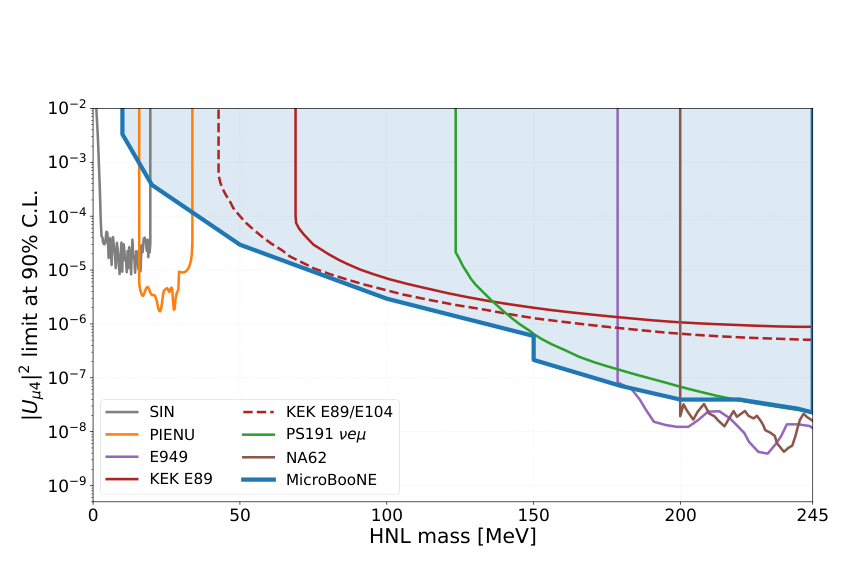
We present the first search for heavy neutral leptons (HNL) decaying into $νe^+e^-$ or $νπ^0$ final states in a liquid-argon time projection chamber using data collected with the MicroBooNE detector. The data were recorded synchronously with the NuMI neutrino beam from Fermilab's Main Injector corresponding to a total exposure of $7.01 \times 10^{20}$ protons on target. We set upper limits at the $90\%$ confidence level on the mixing parameter $\lvert U_{μ4}\rvert^2$ in the mass ranges $10\le m_{\rm HNL}\le 150$ MeV for the $νe^+e^-$ channel and $150\le m_{\rm HNL}\le 245$ MeV for the $νπ^0$ channel, assuming $\lvert U_{e 4}\rvert^2 = \lvert U_{τ4}\rvert^2 = 0$. These limits represent the most stringent constraints in the mass range $35<m_{\rm HNL}<175$ MeV and the first constraints from a direct search for $νπ^0$ decays.
Concepts
The Big Picture
Matter and antimatter should have been created in equal measure at the Big Bang, annihilating each other into a featureless sea of radiation. Instead, a tiny asymmetry survived, and that leftover sliver of matter became everything we see today. Physicists have spent decades hunting for the mechanism behind this asymmetry, and one of the leading suspects barely interacts with anything at all.
Heavy neutral leptons (HNLs) are hypothetical particles that appear in some of the simplest extensions of the Standard Model. Unlike the three known neutrino types, HNLs would be far heavier and would couple only faintly to ordinary matter. That faint coupling is what makes them appealing: HNLs could explain why neutrinos have mass at all, and could drive the matter-antimatter asymmetry through leptogenesis, a process in which particle-antiparticle imbalances in the early universe seeded today’s matter-dominated cosmos.
The catch is that HNLs interact so feebly that finding them requires enormous detectors and clever search strategies. A new analysis from the MicroBooNE collaboration at Fermilab has set the tightest constraints yet on one class of these particles in a critical mass range, and completed the first-ever direct search for a decay mode no experiment had previously targeted.
Key Insight: MicroBooNE has established the tightest limits on heavy neutral lepton mixing in the 35–175 MeV mass range and conducted the world’s first direct search for HNLs decaying into a neutrino and a neutral pion, closing a gap in the search for physics beyond the Standard Model.
How It Works
The MicroBooNE detector sits at Fermilab in Illinois and belongs to a class of instruments called liquid-argon time projection chambers (LArTPCs). Picture a 170-ton camera filled with ultra-pure liquid argon, capable of tracking charged particles with millimeter precision. When a particle passes through, it ionizes the argon atoms, and the freed electrons drift toward wire planes that reconstruct a three-dimensional image of the event.
For this search, the collaboration used data from the NuMI beam (Neutrinos at the Main Injector), a high-energy neutrino beam fired from Fermilab’s Main Injector. The choice was deliberate: NuMI’s higher beam energy produces more kaons, which are primary factories for HNL production. The dataset corresponds to 7.01 × 10²⁰ protons on target, accumulated between 2015 and 2021.
The analysis targets two distinct HNL decay channels:
- νe⁺e⁻ channel: An HNL decays into a neutrino plus an electron-positron pair. This covers HNL masses from 10 to 150 MeV.
- νπ⁰ channel: An HNL decays into a neutrino and a neutral pion, which immediately decays into two photons (π⁰ → γγ). This covers masses from 150 to 245 MeV.
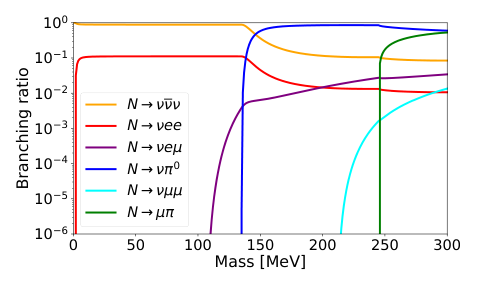
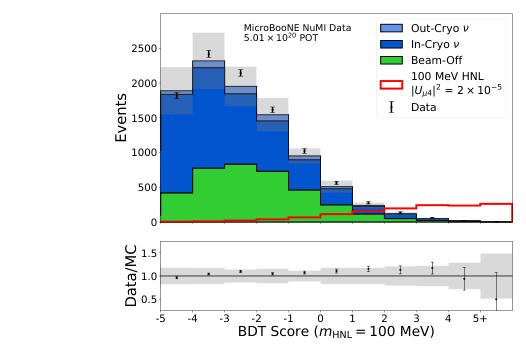
Both channels produce two electromagnetic showers, cascades of particles and light that form when high-energy electrons or photons enter the argon. This visual similarity allowed the team to build a single analysis pipeline using boosted decision trees (BDTs), an ensemble machine learning technique that combines many simple classifiers into a strong discriminant. The BDTs were trained to separate genuine HNL-like events from the far more numerous background neutrino interactions, using features like shower angles, energy deposits, and decay-point geometry.
The search assumes only the muon-flavor mixing parameter |U_μ4|² is nonzero, with |U_e4|² = |U_τ4|² = 0. HNLs would be produced through muon-neutrino interactions in the beam, travel some distance, then decay inside the detector. The analysis sets 90% confidence level upper limits on |U_μ4|² across both mass ranges. Both signal and background processes were modeled using detailed Monte Carlo simulations, computer models that simulate millions of particle interactions through statistical sampling.
Why It Matters
These results advance the experimental picture in two concrete ways. In the mass range 35 to 175 MeV, MicroBooNE now holds the tightest direct constraints on the muon-mixing parameter, surpassing every previous experiment. This mass window has historically been hard to probe because it sits between the reach of older decay experiments and the sensitivity of collider searches.
The νπ⁰ channel, meanwhile, had never been targeted by a direct search before. This analysis establishes the first experimental constraints from that decay mode.
Beyond the specific numbers, the result shows what liquid-argon technology can do for new-physics searches. The same capabilities that make LArTPCs ideal for neutrino oscillation studies (fine-grained tracking, calorimetric imaging, particle identification) also enable precision searches for rare decays. As the broader Short-Baseline Neutrino (SBN) program comes fully online with larger detectors like SBND and ICARUS, these techniques will scale to greater sensitivity. Future experiments such as DUNE, with its massive far detector, could eventually close off much of the remaining parameter space for HNLs in this mass regime.
Bottom Line: MicroBooNE has set the world’s tightest constraints on heavy neutral leptons in a critical mass window and opened a new experimental channel with the first direct search for the νπ⁰ decay mode, narrowing the possibilities for whether these particles explain the universe’s matter-antimatter imbalance.
IAIFI Research Highlights

This work combines precision detector physics with machine learning-based event classification, reflecting how modern particle physics searches increasingly rely on AI-driven analysis to separate rare signals from overwhelming backgrounds.

Deploying BDT ensembles within a unified multi-channel framework shows how gradient-boosted classifiers efficiently handle high-dimensional particle physics feature spaces where deep neural networks might be computationally prohibitive.

MicroBooNE establishes the tightest experimental constraints on HNL muon-mixing in the 35–175 MeV mass range and conducts the world's first direct search for HNL → νπ⁰ decays, directly constraining models of neutrino mass generation and leptogenesis.
The methods developed here will scale to the full Short-Baseline Neutrino program and eventually to DUNE, with the potential for orders-of-magnitude improvements in HNL sensitivity; the full results appear as [arXiv:2310.07660](https://arxiv.org/abs/2310.07660).
Original Paper Details
Search for heavy neutral leptons in electron-positron and neutral-pion final states with the MicroBooNE detector
2310.07660
["MicroBooNE collaboration", "P. Abratenko", "O. Alterkait", "D. Andrade Aldana", "L. Arellano", "J. Asaadi", "A. Ashkenazi", "S. Balasubramanian", "B. Baller", "G. Barr", "D. Barrow", "J. Barrow", "V. Basque", "O. Benevides Rodrigues", "S. Berkman", "A. Bhanderi", "A. Bhat", "M. Bhattacharya", "M. Bishai", "A. Blake", "B. Bogart", "T. Bolton", "J. Y. Book", "M. B. Brunetti", "L. Camilleri", "Y. Cao", "D. Caratelli", "F. Cavanna", "G. Cerati", "A. Chappell", "Y. Chen", "J. M. Conrad", "M. Convery", "L. Cooper-Troendle", "J. I. Crespo-Anadon", "R. Cross", "M. Del Tutto", "S. R. Dennis", "P. Detje", "A. Devitt", "R. Diurba", "Z. Djurcic", "R. Dorrill", "K. Duffy", "S. Dytman", "B. Eberly", "P. Englezos", "A. Ereditato", "J. J. Evans", "R. Fine", "O. G. Finnerud", "B. T. Fleming", "W. Foreman", "D. Franco", "A. P. Furmanski", "F. Gao", "D. Garcia-Gamez", "S. Gardiner", "G. Ge", "S. Gollapinni", "E. Gramellini", "P. Green", "H. Greenlee", "L. Gu", "W. Gu", "R. Guenette", "P. Guzowski", "L. Hagaman", "O. Hen", "C. Hilgenberg", "G. A. Horton-Smith", "Z. Imani", "B. Irwin", "M. Ismail", "C. James", "X. Ji", "J. H. Jo", "R. A. Johnson", "Y. J. Jwa", "D. Kalra", "N. Kamp", "G. Karagiorgi", "W. Ketchum", "M. Kirby", "T. Kobilarcik", "I. Kreslo", "M. B. Leibovitch", "I. Lepetic", "J. -Y. Li", "K. Li", "Y. Li", "K. Lin", "B. R. Littlejohn", "H. Liu", "W. C. Louis", "X. Luo", "C. Mariani", "D. Marsden", "J. Marshall", "N. Martinez", "D. A. Martinez Caicedo", "S. Martynenko", "A. Mastbaum", "I. Mawby", "N. McConkey", "V. Meddage", "J. Micallef", "K. Miller", "K. Mistry", "T. Mohayai", "A. Mogan", "M. Mooney", "A. F. Moor", "C. D. Moore", "L. Mora Lepin", "M. M. Moudgalya", "S. Mulleria Babu", "D. Naples", "A. Navrer-Agasson", "N. Nayak", "M. Nebot-Guinot", "J. Nowak", "N. Oza", "O. Palamara", "N. Pallat", "V. Paolone", "A. Papadopoulou", "V. Papavassiliou", "H. Parkinson", "S. F. Pate", "N. Patel", "Z. Pavlovic", "E. Piasetzky", "I. Pophale", "X. Qian", "J. L. Raaf", "V. Radeka", "A. Rafique", "M. Reggiani-Guzzo", "L. Ren", "L. Rochester", "J. Rodriguez Rondon", "M. Rosenberg", "M. Ross-Lonergan", "C. Rudolph von Rohr", "I. Safa", "G. Scanavini", "D. W. Schmitz", "A. Schukraft", "W. Seligman", "M. H. Shaevitz", "R. Sharankova", "J. Shi", "E. L. Snider", "M. Soderberg", "S. Soldner-Rembold", "J. Spitz", "M. Stancari", "J. St. John", "T. Strauss", "A. M. Szelc", "W. Tang", "N. Taniuchi", "K. Terao", "C. Thorpe", "D. Torbunov", "D. Totani", "M. Toups", "Y. -T. Tsai", "J. Tyler", "M. A. Uchida", "T. Usher", "B. Viren", "M. Weber", "H. Wei", "A. J. White", "S. Wolbers", "T. Wongjirad", "M. Wospakrik", "K. Wresilo", "W. Wu", "E. Yandel", "T. Yang", "L. E. Yates", "H. W. Yu", "G. P. Zeller", "J. Zennamo", "C. Zhang"]
We present the first search for heavy neutral leptons (HNL) decaying into $νe^+e^-$ or $νπ^0$ final states in a liquid-argon time projection chamber using data collected with the MicroBooNE detector. The data were recorded synchronously with the NuMI neutrino beam from Fermilab's Main Injector corresponding to a total exposure of $7.01 \times 10^{20}$ protons on target. We set upper limits at the $90\%$ confidence level on the mixing parameter $\lvert U_{μ4}\rvert^2$ in the mass ranges $10\le m_{\rm HNL}\le 150$ MeV for the $νe^+e^-$ channel and $150\le m_{\rm HNL}\le 245$ MeV for the $νπ^0$ channel, assuming $\lvert U_{e 4}\rvert^2 = \lvert U_{τ4}\rvert^2 = 0$. These limits represent the most stringent constraints in the mass range $35