

SHAPER: Can You Hear the Shape of a Jet?
Authors
Demba Ba, Akshunna S. Dogra, Rikab Gambhir, Abiy Tasissa, Jesse Thaler
Abstract
The identification of interesting substructures within jets is an important tool for searching for new physics and probing the Standard Model at colliders. Many of these substructure tools have previously been shown to take the form of optimal transport problems, in particular the Energy Mover's Distance (EMD). In this work, we show that the EMD is in fact the natural structure for comparing collider events, which accounts for its recent success in understanding event and jet substructure. We then present a Shape Hunting Algorithm using Parameterized Energy Reconstruction (SHAPER), which is a general framework for defining and computing shape-based observables. SHAPER generalizes N-jettiness from point clusters to any extended, parametrizable shape. This is accomplished by efficiently minimizing the EMD between events and parameterized manifolds of energy flows representing idealized shapes, implemented using the dual-potential Sinkhorn approximation of the Wasserstein metric. We show how the geometric language of observables as manifolds can be used to define novel observables with built-in infrared-and-collinear safety. We demonstrate the efficacy of the SHAPER framework by performing empirical jet substructure studies using several examples of new shape-based observables.
Concepts
The Big Picture
In 1966, mathematician Mark Kac posed a haunting question: “Can one hear the shape of a drum?” He wanted to know whether a drum’s vibrational frequencies uniquely determine its geometry. Decades later, particle physicists at the LHC are asking a strikingly similar question about the debris from proton collisions: can you “hear” the shape of a jet?
Every time two protons smash together at the Large Hadron Collider, the collision spawns hundreds of particles that fan outward in narrow, focused streams called jets. These jets carry geometric fingerprints. A top quark (one of the heaviest known elementary particles, which rapidly decays into three lighter ones) leaves a distinctly different pattern than a gluon, the carrier of the strong nuclear force, which tends to spray out softer, more diffuse energy.
Identifying those shapes is crucial for finding new physics. But the tools physicists have relied on for decades are limited to rigid, preconceived geometric templates. If you don’t know what shape to look for, you might miss it entirely.
A team from Harvard, MIT, and Tufts has built a framework called SHAPER (Shape Hunting Algorithm using Parameterized Energy Reconstruction) that can hunt for any geometric substructure within a jet: rings, ellipses, disks, or shapes physicists haven’t named yet.
Key Insight: SHAPER reframes jet substructure analysis as an optimal transport problem, proving that the “Earth Mover’s Distance” is the mathematically unique distance measure that correctly respects collider detector geometry.
How It Works
The foundation of SHAPER is the Energy Mover’s Distance (EMD). Think of each jet as a pile of dirt scattered across a detector, where height represents deposited energy. The EMD asks: what’s the minimum work needed to reshape one pile into another? This is the classical “earth mover’s distance” from computer vision, mathematically formalized as the Wasserstein metric.
The authors prove something deeper than mere usefulness. The Wasserstein metric is the unique metric on collision events satisfying two physical requirements simultaneously. It must be continuous, so tiny momentum changes don’t cause wild jumps in an observable. And it must be geometrically faithful, meaning distances between events respect the actual spatial layout of the detector. No other distance measure does both. The EMD kept showing up in collider physics not because anyone got lucky, but because it was inevitable.
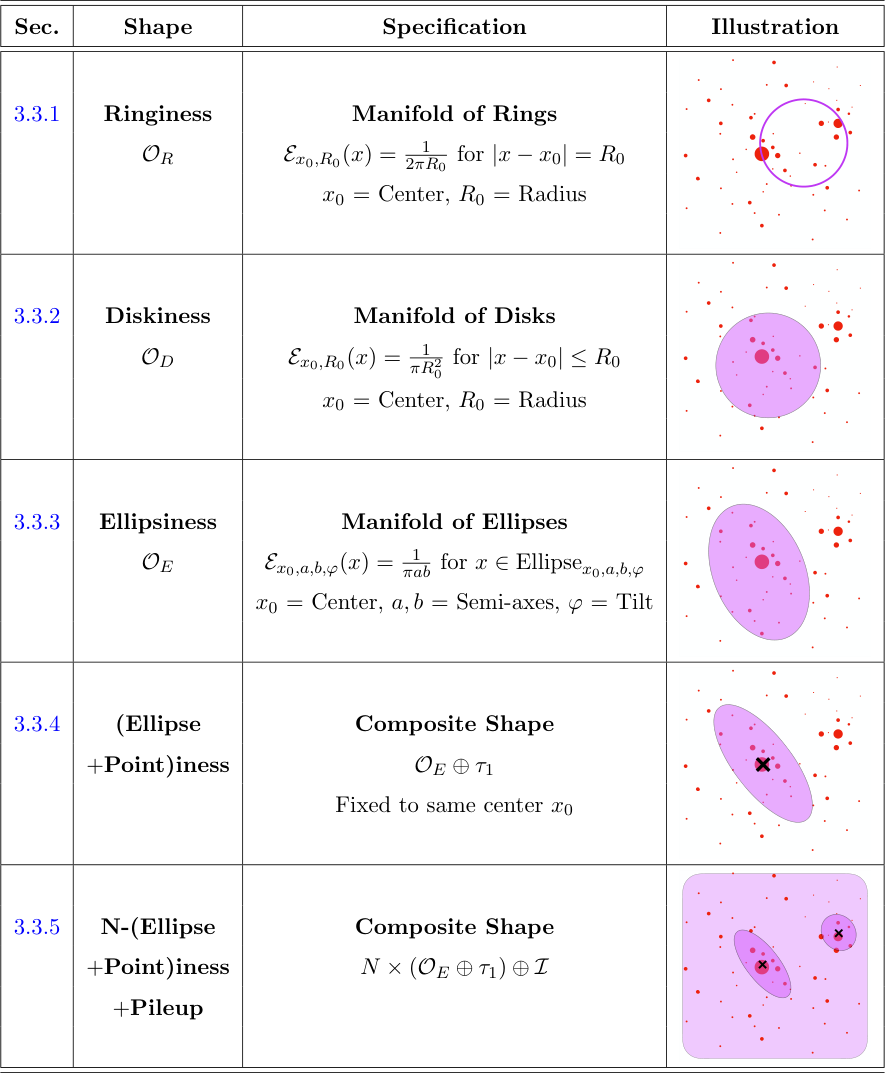
With this foundation, SHAPER defines a shape observable through a clean mathematical recipe:
- Parameterize an idealized shape — describe a ring, ellipse, or disk as a probability distribution over the detector, controlled by parameters like radius, orientation, or eccentricity.
- Compute the EMD between the actual jet and that idealized shape.
- Minimize over all parameters — find the shape configuration that best matches the jet.
- Extract two outputs: the minimum EMD value (how “shape-like” the jet is) and the optimal parameters (what the best-fit shape looks like).
The computational workhorse is the Sinkhorn divergence, a fast approximation of the Wasserstein metric that replaces the exact transport problem with a regularized version solvable by iterative matrix scaling. Because Sinkhorn is differentiable, you can take gradients through it with respect to shape parameters, which enables GPU-accelerated optimization.
SHAPER handles infrared-and-collinear (IRC) safety automatically. IRC safety is a technical requirement in QCD (Quantum Chromodynamics, the theory of quarks and gluons): observables must be insensitive to very soft particles and near-identical particle splittings, otherwise they become incalculable with standard theoretical tools. Any shape built from smooth manifolds gets IRC safety for free.
The framework unlocks observables nobody could measure before. N-Ringiness asks how well a jet decomposes into N concentric rings. N-Diskiness measures how disk-like the energy deposit is. N-Ellipsiness extracts eccentricity and orientation event-by-event. In benchmarks on top quark versus QCD jets, top jets show measurably higher 2-Ringiness than QCD jets. That makes sense: three-body decay creates ring-like energy deposits around the jet core.
One nice application adds a “pileup” term to the shape model. Instead of subtracting soft background radiation from other collisions, SHAPER just absorbs it into the fit and mitigates it automatically.
Why It Matters
SHAPER gives particle physics a new kind of instrument. Physicists previously had to commit to a specific geometric hypothesis before designing a search. Now they can let the data speak. A jet that doesn’t fit any known shape is immediately suspicious, and future collider experiments could use shape observables to flag boosted new particles, unusual color flows, or hypothetical exotic states without knowing in advance what to look for.
From a machine learning perspective, SHAPER shows that mathematical structure can outperform brute force. Rather than training a neural network on millions of jets and hoping it discovers geometric patterns, SHAPER builds that structure into the observable by construction. The result is interpretable, theoretically grounded, and computationally efficient. The connection to optimal transport also suggests applications well beyond colliders: galaxy morphology, medical imaging, protein conformations. Anywhere structured distributions need to be compared, Wasserstein geometry could define principled shape observables.
Open questions remain. The Sinkhorn regularization introduces a smoothing parameter that trades accuracy for speed. Extending SHAPER to three-dimensional shapes for full-calorimetry detectors is an active frontier. And the theoretical question the title alludes to, whether jet shapes uniquely determine the underlying physics, remains beautifully open.
Bottom Line: SHAPER proves that the Wasserstein metric is the mathematically natural language for comparing collider events, then delivers a computational framework that can measure any geometric structure within a jet, from rings to ellipses to arbitrary custom shapes, with built-in theoretical safety guarantees.
IAIFI Research Highlights

SHAPER connects optimal transport theory from mathematics and computer vision with collider jet physics, showing that abstract Wasserstein geometry provides the rigorous foundation for a wide class of particle physics observables.

By proving the Wasserstein metric's uniqueness for structured data on geometric spaces, this work justifies its use in machine learning tasks where spatial faithfulness matters, and introduces a differentiable shape-fitting framework suitable for end-to-end neural network training.

SHAPER generalizes decades-old jet shape observables into a unified framework capable of measuring novel substructures like jet eccentricity and dynamic radii, opening new experimental handles for precision Standard Model tests and new physics searches at the LHC.
Future work includes extending shape manifolds to three-dimensional detector geometries and incorporating SHAPER observables as differentiable layers in jet tagging networks; the full framework is described in [arXiv:2302.12266](https://arxiv.org/abs/2302.12266).
Original Paper Details
SHAPER: Can You Hear the Shape of a Jet?
[2302.12266](https://arxiv.org/abs/2302.12266)
Demba Ba, Akshunna S. Dogra, Rikab Gambhir, Abiy Tasissa, Jesse Thaler
The identification of interesting substructures within jets is an important tool for searching for new physics and probing the Standard Model at colliders. Many of these substructure tools have previously been shown to take the form of optimal transport problems, in particular the Energy Mover's Distance (EMD). In this work, we show that the EMD is in fact the natural structure for comparing collider events, which accounts for its recent success in understanding event and jet substructure. We then present a Shape Hunting Algorithm using Parameterized Energy Reconstruction (SHAPER), which is a general framework for defining and computing shape-based observables. SHAPER generalizes N-jettiness from point clusters to any extended, parametrizable shape. This is accomplished by efficiently minimizing the EMD between events and parameterized manifolds of energy flows representing idealized shapes, implemented using the dual-potential Sinkhorn approximation of the Wasserstein metric. We show how the geometric language of observables as manifolds can be used to define novel observables with built-in infrared-and-collinear safety. We demonstrate the efficacy of the SHAPER framework by performing empirical jet substructure studies using several examples of new shape-based observables.