

Simulating 2+1D Lattice Quantum Electrodynamics at Finite Density with Neural Flow Wavefunctions
Authors
Zhuo Chen, Di Luo, Kaiwen Hu, Bryan K. Clark
Abstract
We present a neural flow wavefunction, Gauge-Fermion FlowNet, and use it to simulate 2+1D lattice compact quantum electrodynamics with finite density dynamical fermions. The gauge field is represented by a neural network which parameterizes a discretized flow-based transformation of the amplitude while the fermionic sign structure is represented by a neural net backflow. This approach directly represents the $U(1)$ degree of freedom without any truncation, obeys Guass's law by construction, samples autoregressively avoiding any equilibration time, and variationally simulates Gauge-Fermion systems with sign problems accurately. In this model, we investigate confinement and string breaking phenomena in different fermion density and hopping regimes. We study the phase transition from the charge crystal phase to the vacuum phase at zero density, and observe the phase seperation and the net charge penetration blocking effect under magnetic interaction at finite density. In addition, we investigate a magnetic phase transition due to the competition effect between the kinetic energy of fermions and the magnetic energy of the gauge field. With our method, we further note potential differences on the order of the phase transitions between a continuous $U(1)$ system and one with finite truncation. Our state-of-the-art neural network approach opens up new possibilities to study different gauge theories coupled to dynamical matter in higher dimensions.
Concepts
The Big Picture
Imagine trying to photograph a hurricane from inside it. You can see the swirling air and water, but capturing the precise state of every particle is impossible, even for the world’s fastest computers. Now shrink that hurricane to quantum scales, add electromagnetism, pack in matter particles that repel and attract each other. That’s roughly the challenge of simulating quantum electrodynamics on a lattice.
QED, the quantum theory of light and matter, is among the most precisely tested theories in science. But simulating it from first principles, particularly with matter particles present, has remained stubbornly out of reach. The standard approach, Monte Carlo sampling, draws millions of random samples to estimate a system’s probable states. It breaks down when fermions (matter particles like electrons) enter the picture: the quantum wave function takes both positive and negative values, causing samples to catastrophically cancel. This is the sign problem.
The other main tool, tensor networks, works well in one spatial dimension but grows exponentially expensive as dimensions increase. Quantum computers may eventually help, but today’s noisy hardware can’t deliver yet.
Researchers from MIT, the University of Michigan, and UIUC have introduced Gauge-Fermion FlowNet, a neural network approach that sidesteps all three bottlenecks at once. It opens a direct computational window into quantum electrodynamics in two spatial dimensions with dynamical matter particles at varying densities.
By encoding both the electromagnetic field and fermionic quantum numbers inside a single neural network that satisfies Gauss’s law automatically, the team can simulate strongly coupled matter and light in two spatial dimensions without truncation, without sign-problem collapse, and without waiting for a simulation chain to mix and equilibrate.
How It Works
The architecture splits the problem into two coupled pieces, one for each of the hardest features of the physics.
The first handles the gauge field, the electromagnetic potential living on each bond of the lattice that governs how charged particles push and pull on each other. Standard approaches truncate this continuous field to a finite set of allowed values, introducing systematic errors. The team instead uses a discretized normalizing flow: a neural network that learns a smooth, invertible transformation from a simple random distribution into the full continuous distribution over field configurations. Because the transformation is mathematically tractable, the network gives exact probability amplitudes without any cutoff.
The flow is autoregressive, generating field variables one lattice bond at a time and conditioning each new variable on all previously generated ones. This enforces Gauss’s law (the rule that electric flux into any lattice site must equal the charge there) exactly at each step. No penalty terms, no projection. The constraint is baked into the architecture.
The second piece handles the fermionic sign structure. Swap two identical fermions and the wave function changes sign; this antisymmetry is precisely what creates the sign problem. The team addresses it with a neural net backflow: a learned function that maps each configuration to a complex phase (essentially a ± sign encoded as a mathematical angle), layered on top of the flow-based amplitude. The backflow preserves the autoregressive structure, so the system still generates independent, uncorrelated samples. No Markov chain, no equilibration time.
The resulting wave function handles continuous electromagnetic fields without any cutoff, obeys Gauss’s law by construction on every lattice site, samples exactly and independently from the learned distribution, and captures fermionic sign structure through the backflow phase.
Why It Matters
With Gauge-Fermion FlowNet, the team probed several non-trivial regimes of 2+1D compact QED.
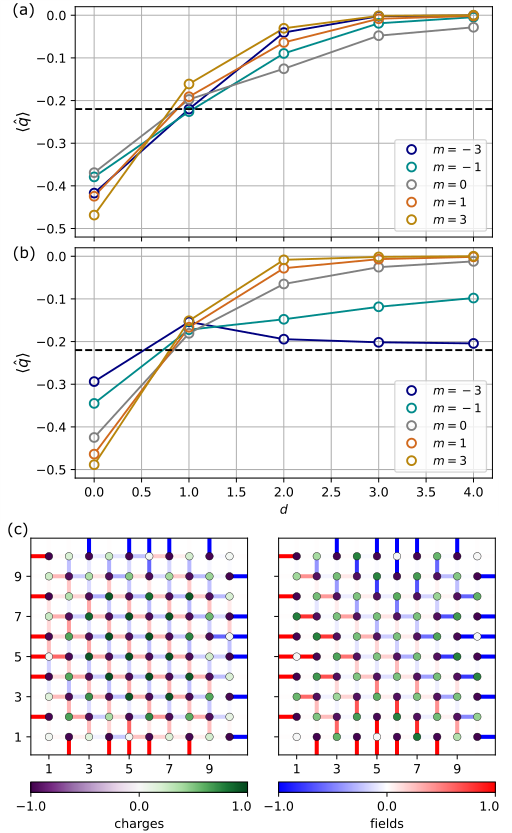
String breaking and confinement is among the most dramatic phenomena in gauge theories. At weak matter coupling, opposite charges connect via a tube of electric flux, a “string” whose energy grows with separation, confining the charges. Add enough dynamical fermions and the string breaks: popping a fermion-antifermion pair from the vacuum becomes energetically cheaper than stretching the string further. The team maps this transition as a function of fermion density and hopping amplitude, finding clear signatures in the electric field profile between static test charges.
At zero fermion density, they track a phase transition from a charge crystal phase to a vacuum phase. In the crystal phase, fermions spontaneously arrange into a regular pattern, breaking translational symmetry. As coupling strength changes, this order melts. The neural network correctly captures both phases and the transition, a nontrivial test of the method’s accuracy.
At finite density, a subtler effect shows up: net charge penetration blocking. Magnetic interactions between the gauge field and fermions create a traffic jam, preventing additional charge from entering certain lattice regions. This phase separation would be invisible to methods that can’t handle the sign problem.
The team also studies a magnetic phase transition driven by competition between fermionic kinetic energy and magnetic field energy. This is a genuine quantum phase transition, and the team finds that its order may differ between the continuous U(1) theory and truncated versions. That’s a concrete warning for the broader community relying on truncated simulations.
Compact QED in 2+1D is not a toy model. It exhibits confinement, topological effects, and phase transitions qualitatively similar to QCD, the theory of the strong nuclear force. Simulating it at finite density with dynamical fermions brings questions about dense nuclear matter, central to neutron star physics, into computational reach.
On the machine learning side, the architecture shows that neural networks can respect exact physical symmetries as hard constraints built into the generative process, not soft penalties. Extending Gauge-Fermion FlowNet to 3+1 dimensions or to non-Abelian gauge groups like QCD are the natural next steps, and the authors flag both as future directions.
Gauge-Fermion FlowNet is the first neural network architecture to directly simulate continuous-gauge lattice QED in 2+1 dimensions with dynamical fermions at finite density, bypassing the sign problem, enforcing Gauss’s law exactly, and sampling without Markov chain overhead.
IAIFI Research Highlights

Modern generative AI architectures, specifically autoregressive normalizing flows, can be redesigned to satisfy exact physical symmetry constraints, enabling ab initio simulations of quantum gauge theories that were previously intractable.

Gauge-Fermion FlowNet introduces a principled method for embedding hard physical constraints (Gauss's law, fermionic antisymmetry) directly into neural network architecture, providing a template for constraint-respecting generative models across scientific domains.

The method enables direct simulation of 2+1D compact QED with finite-density dynamical fermions, including confinement, string breaking, charge crystal phases, and magnetic phase transitions, without sign-problem limitations.
Future work will extend this framework to non-Abelian gauge theories and 3+1 dimensions, targeting dense nuclear matter and QCD. The paper comes from the IAIFI group at MIT with collaborators at the University of Michigan and UIUC.
Original Paper Details
Simulating 2+1D Lattice Quantum Electrodynamics at Finite Density with Neural Flow Wavefunctions
2212.06835
["Zhuo Chen", "Di Luo", "Kaiwen Hu", "Bryan K. Clark"]
We present a neural flow wavefunction, Gauge-Fermion FlowNet, and use it to simulate 2+1D lattice compact quantum electrodynamics with finite density dynamical fermions. The gauge field is represented by a neural network which parameterizes a discretized flow-based transformation of the amplitude while the fermionic sign structure is represented by a neural net backflow. This approach directly represents the $U(1)$ degree of freedom without any truncation, obeys Guass's law by construction, samples autoregressively avoiding any equilibration time, and variationally simulates Gauge-Fermion systems with sign problems accurately. In this model, we investigate confinement and string breaking phenomena in different fermion density and hopping regimes. We study the phase transition from the charge crystal phase to the vacuum phase at zero density, and observe the phase seperation and the net charge penetration blocking effect under magnetic interaction at finite density. In addition, we investigate a magnetic phase transition due to the competition effect between the kinetic energy of fermions and the magnetic energy of the gauge field. With our method, we further note potential differences on the order of the phase transitions between a continuous $U(1)$ system and one with finite truncation. Our state-of-the-art neural network approach opens up new possibilities to study different gauge theories coupled to dynamical matter in higher dimensions.