

Simulating moiré quantum matter with neural network
Authors
Di Luo, David D. Dai, Liang Fu
Abstract
Moiré materials provide an ideal platform for exploring quantum phases of matter. However, solving the many-electron problem in moiré systems is challenging due to strong correlation effects. We introduce a powerful variational representation of quantum states, many-body neural Bloch wavefunction, to solve many-electron problems in moiré materials accurately and efficiently. Applying our method to the semiconductor heterobilayer WSe2/WS2 , we obtain a generalized Wigner crystal at filling factor n = 1/3, a Mott insulator n = 1, and a correlated insulator with local magnetic moments and antiferromagnetic spin correlation at n = 2. Our neural network approach improves the simulation accuracy of strongly interacting moiré materials and paves the way for discovery of new quantum phases with variational learning principle in a unified framework.
Concepts
The Big Picture
Imagine stacking two sheets of graph paper on top of each other, rotating one by a tiny fraction of a degree. The result is an interference pattern, a large-scale “moiré” design that emerges from two perfectly regular grids. Now do this with atom-thin crystals, where electrons must navigate that vast interference pattern. What happens to those electrons is bizarre, and that’s the point.
Moiré materials have transformed the study of how electrons behave in real materials over the past decade. By stacking two atomically thin semiconductors, say tungsten diselenide (WSe2) atop tungsten disulfide (WS2), and letting a slight mismatch in their atomic spacings do the work, physicists can conjure exotic quantum behaviors from ordinary electrons: superconductivity, magnetism, insulating behavior, all tunable by the twist angle between layers. The catch is that electrons in these systems interact with each other fiercely, making them extraordinarily difficult to model computationally.
Researchers Di Luo, David D. Dai, and Liang Fu at MIT have introduced a machine-learning method that cuts through this complexity. It’s a neural network architecture built to respect the repeating geometric structure of moiré systems, and it can accurately predict exotic quantum phases that have defeated traditional approaches.
Key Insight: By building a neural network that respects the crystalline symmetry of moiré superlattices, the team can solve the quantum many-body problem for strongly correlated electrons, unlocking phase predictions that conventional methods simply cannot reach.
How It Works
The core obstacle: quantum mechanics requires tracking not just where each electron is, but how all electrons are correlated simultaneously. For even a modest number of electrons, the mathematical object describing this (the wavefunction, a complete quantum portrait of every electron in the system) grows exponentially in complexity. Standard techniques either ignore correlations entirely (the Hartree-Fock method) or are limited to tiny systems (exact diagonalization). Neither handles moiré systems well.
The MIT team’s solution is a construct they call the many-body neural Bloch wavefunction. It combines the classical physics of Bloch waves (the standard description of electrons in periodic crystals) with the representational power of a deep neural network. The construction has three interlocking pieces:
- Bloch basis functions: The wavefunction encodes the basic crystalline periodicity of the moiré lattice, ensuring the starting template correctly captures non-interacting physics as a baseline.
- Neural network backflow: Inspired by Feynman, backflow lets each electron’s effective position shift based on where all others are. The team implements this via a message-passing graph network, where electrons “communicate” their positions and collectively reshape the wavefunction.
- Neural momentum transformation: A learned transformation mixes momentum channels, capturing how strong interactions redistribute electrons across quantum states.
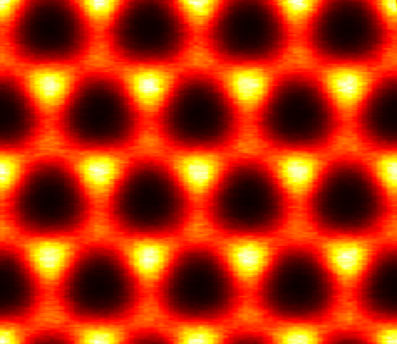
The wavefunction takes the form of a Slater determinant, a mathematical arrangement that prevents two electrons from occupying the same quantum state (as required by the Pauli exclusion principle), but with orbitals continuously deformed by the neural network. The network minimizes the total energy of the system, like a ball rolling downhill to find the lowest point. No labeled data required. Just physics.
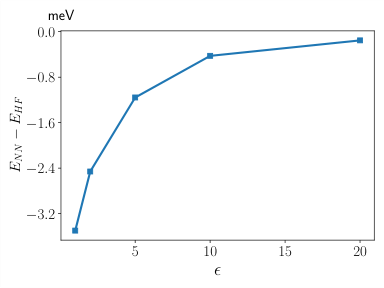
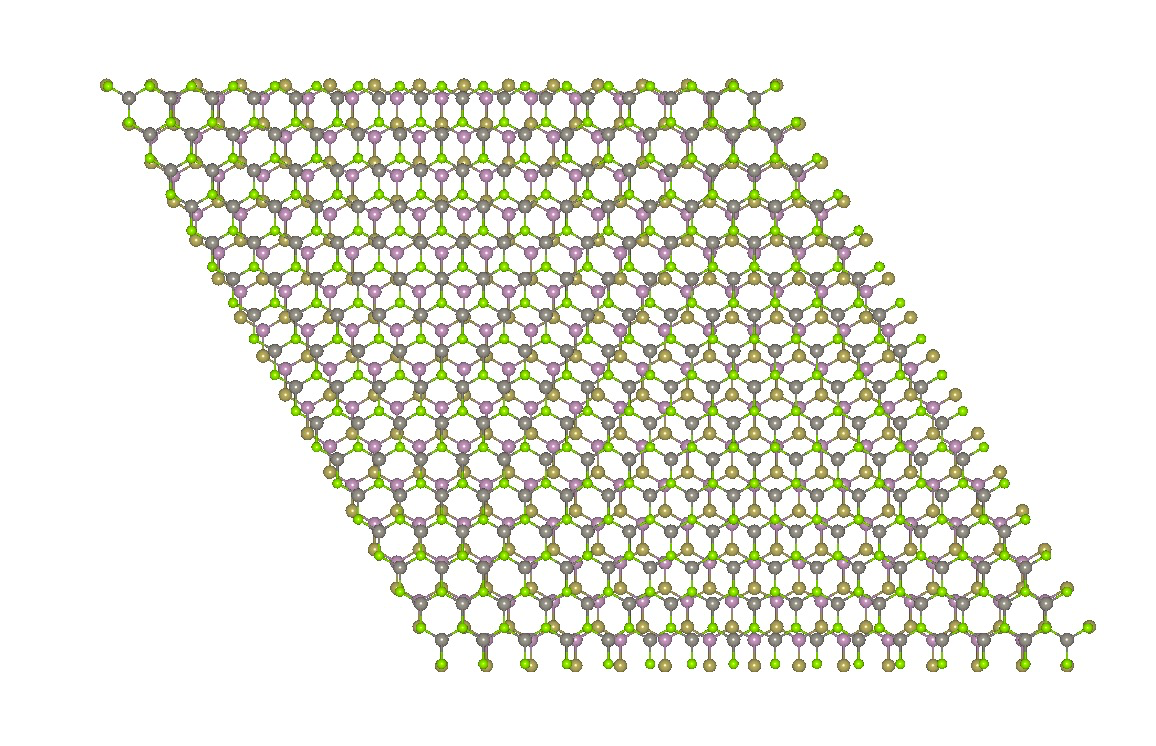
The team applied this framework to WSe2/WS2, a semiconductor heterostructure where a 4% lattice mismatch creates a moiré period of about 8.2 nanometers. Sweeping across different filling factors (the number of holes per moiré unit cell), the neural wavefunction finds the ground state at each filling, matching and surpassing Hartree-Fock on energy accuracy while revealing three distinct quantum phases.
What They Found
At filling n = 1/3, the neural wavefunction finds a generalized Wigner crystal: electrons spontaneously arranging into a regular lattice to minimize mutual repulsion. Think of it as a quantum-mechanical game of keep-away.
At n = 1 (one hole per moiré cell), the simulation captures a charge-transfer Mott insulator, where strong repulsion freezes electrons in place despite what band theory would predict as a metal. Classical methods struggle here because Mott physics is fundamentally a correlation effect, invisible to Hartree-Fock.
The real surprise comes at n = 2. Here the neural wavefunction reveals a correlated insulator hosting local magnetic moments on each site, with neighboring moments pointing in opposite directions, a classic signature of antiferromagnetic order. Charge and spin are entangled in ways that require carefully capturing many-body correlations. Simpler methods produce qualitatively wrong answers.
Why It Matters
This work cuts across two fields at once. In condensed matter physics, moiré materials are the hottest frontier right now. They’ve already produced surprises like unconventional superconductivity in twisted bilayer graphene and fractional quantum anomalous Hall states in semiconductor heterostructures. A reliable computational microscope for their ground states opens the door to predicting new phases before they’re discovered in the lab.
For machine learning, this is part of a growing wave showing that physics-informed neural networks can outperform domain-specific numerical methods when the architecture is designed with care. The key move, embedding Bloch symmetry directly into the wavefunction, is a template that could generalize to any crystalline material with strong correlations. One architecture, trained from first principles, capable of landing in qualitatively different phases depending on parameters: that versatility is rare in traditional many-body methods.
Looking ahead, the approach opens natural extensions: finite-temperature simulations, real-time dynamics after a quantum quench, or hunting for topological phases carrying fractional quasiparticles. The moiré phase diagram remains largely unmapped. A tool that can navigate it from first principles is exactly what the field needs.
Bottom Line: A neural network wavefunction built to respect moiré periodicity accurately simulates strongly correlated quantum phases (Wigner crystals, Mott insulators, and antiferromagnets) that break conventional methods, pointing toward AI-assisted discovery of entirely new states of matter.
IAIFI Research Highlights

This work directly merges deep learning architecture design with quantum condensed matter physics, using neural networks as physics-aware variational ansätze that encode crystalline symmetry from the ground up.

The many-body neural Bloch wavefunction introduces a novel message-passing graph network approach to fermionic systems in periodic potentials, extending the FermiNet/PauliNet paradigm from quantum chemistry to strongly correlated solid-state physics.

By accurately resolving competing quantum phases (Wigner crystal, Mott insulator, and antiferromagnetic correlated insulator) across different electron fillings in WSe2/WS2, the method provides a first-principles computational route into the rich phase diagram of moiré quantum matter.
Future extensions could target topological and superconducting phases in moiré heterostructures, with the unified variational framework potentially applicable across the full family of TMD moiré systems; see [arXiv:2406.17645](https://arxiv.org/abs/2406.17645) (Luo, Dai, Fu, 2024).