

SN 2021foa: The "Flip-Flop" Type IIn / Ibn supernova
Authors
D. Farias, C. Gall, G. Narayan, S. Rest, V. A. Villar, C. R. Angus, K. Auchettl, K. W. Davis, R. Foley, A. Gagliano, J. Hjorth, L. Izzo, C. D. Kilpatrick, H . M. L. Perkins, E. Ramirez-Ruiz, C. L. Ransome, A. Sarangi, R. Yarza, D. A. Coulter, D. O. Jones, N. Khetan, A. Rest, M. R. Siebert, J. J. Swift, K. Taggart, S. Tinyanont, P. Wrubel, T. J. L. de Boer, K. E. Clever, A. Dhara, H. Gao, C. -C. Lin
Abstract
We present a comprehensive analysis of the photometric and spectroscopic evolution of SN~2021foa, unique among the class of transitional supernovae for repeatedly changing its spectroscopic appearance from hydrogen-to-helium-to-hydrogen-dominated (IIn-to-Ibn-to-IIn) within 50 days past peak brightness. The spectra exhibit multiple narrow ($\approx$ 300--600~km~s$^{-1}$) absorption lines of hydrogen, helium, calcium and iron together with broad helium emission lines with a full-width-at-half-maximum (FWHM) of $\sim 6000$~km~s$^{-1}$. For a steady, wind-mass loss regime, light curve modeling results in an ejecta mass of $\sim 8$ M$_{\odot}$ and CSM mass below 1 M$_{\odot}$, and an ejecta velocity consistent with the FWHM of the broad helium lines. We obtain a mass-loss rate of $\approx 2$ M$_{\odot} {\rm yr}^{-1}$. This mass-loss rate is three orders of magnitude larger than derived for normal Type II SNe. We estimate that the bulk of the CSM of SN~2021foa must have been expelled within half a year, about 15 years ago. Our analysis suggests that SN~2021foa had a helium rich ejecta which swept up a dense shell of hydrogen rich CSM shortly after explosion. At about 60 days past peak brightness, the photosphere recedes through the dense ejecta-CSM region, occulting much of the red-shifted emission of the hydrogen and helium lines, which results in observed blue-shift ($\sim -3000$~km~s$^{-1}$). Strong mass loss activity prior to explosion, such as those seen in SN~2009ip-like objects and SN~2021foa as precursor emission, are the likely origin of a complex, multiple-shell CSM close to the progenitor star.
Concepts
The Big Picture
Imagine a chameleon that can’t make up its mind, shifting colors every few weeks, cycling between two very different looks. Now imagine that chameleon is a dying star hundreds of millions of light-years away, and its changing “colors” are chemical signatures of hydrogen and helium gas moving at thousands of kilometers per second. That’s what astronomers found when they pointed their telescopes at SN 2021foa, a supernova so unusual it earned the nickname the “Flip-Flop.”
When a massive star exhausts its nuclear fuel and collapses, the resulting core-collapse supernova tears through layers of gas shed in the years before death. Astronomers classify these explosions by what shows up in the emitted light: Type IIn supernovae are dominated by hydrogen signatures, while Type Ibn supernovae show helium instead. These two classes reflect different stellar histories and different compositions of the circumstellar medium (CSM), the gas cloud surrounding the dying star.
Transitioning between these types is already unusual. But switching back? That had never been documented.
SN 2021foa did exactly that, oscillating from IIn to Ibn to IIn again within just 50 days of peak brightness. It gave astronomers a real-time view of a stellar death wrapped in a spectacularly turbulent gas environment.
Key Insight: SN 2021foa is the first supernova ever observed to repeatedly switch its spectroscopic classification between hydrogen-dominated (Type IIn) and helium-dominated (Type Ibn), revealing an onion-like circumstellar medium built from violent mass ejections in the years before the explosion.
How It Works
The research team assembled an extensive dataset: brightness measurements over time and dozens of spectra spanning ultraviolet to near-infrared, collected through the Las Cumbres Observatory, the Swift satellite, and several other facilities. This multi-wavelength, time-resolved portrait let them watch the supernova’s face change in real time.
The flip-flop’s explanation lies in what the exploding star ran into. The team proposes that SN 2021foa had helium-rich ejecta that plowed into a surrounding shell of hydrogen-rich CSM shortly after detonation.
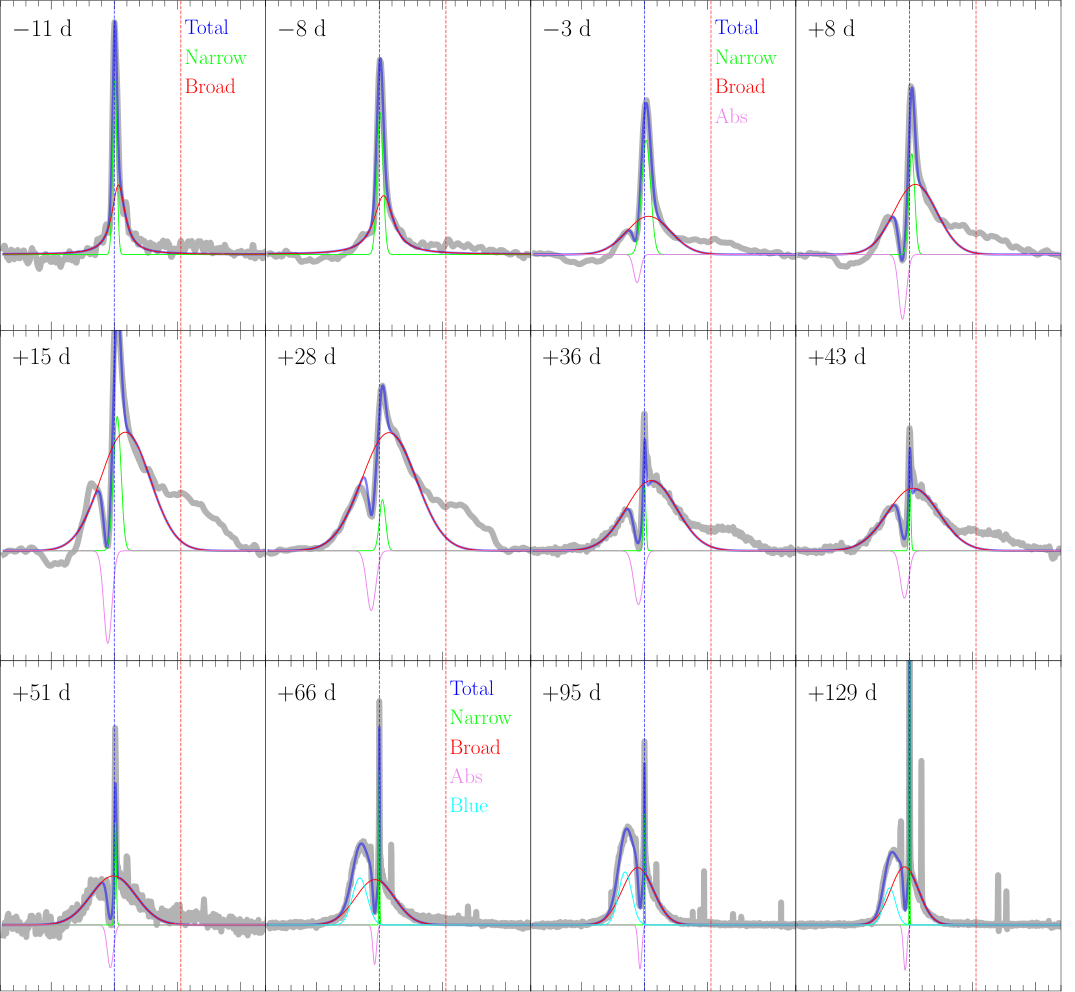
This collision produced the initial IIn signature. Fast ejecta compressed and heated the hydrogen shell, lighting it up with narrow emission lines, bright spectral spikes indicating slow-moving gas drifting at just 300–600 km/s. As the ejecta punched through the hydrogen shell and helium-rich layers came to dominate, the spectrum flipped to Ibn. Then the outer hydrogen CSM was re-illuminated, and hydrogen signatures returned. The whole transition reads out the supernova’s layered structure, like peeling back an onion in real time.
The photosphere, the surface from which light appears to escape, matters here too. Around 60 days past peak brightness, it retreated inward through the dense ejecta-CSM interaction zone. This blocked the receding (red-shifted) half of the emitting gas from view, leaving only the approaching (blue-shifted) material visible. The result was a dramatic apparent blue-shift of ~3,000 km/s in the spectral lines, a telltale sign of rapidly evolving explosion geometry.
To quantify what they were seeing, the team modeled the light curve using a steady wind mass-loss scenario, in which the progenitor continuously shed material into space before exploding. Their best fit returned:
- Ejecta mass: ~8 solar masses
- CSM mass: less than 1 solar mass
- Mass-loss rate: ~2 solar masses per year
That last number is staggering. Normal Type II supernova progenitors lose mass at roughly one-thousandth of a solar mass per year. SN 2021foa’s progenitor was shedding material at a rate three orders of magnitude higher, equivalent to dumping two entire suns’ worth of gas into space annually. The timing suggests this violent episode lasted less than six months and occurred roughly 15 years before the star finally exploded.
This picture fits with a class of volatile massive stars known as SN 2009ip-like objects, stars caught in repeated outbursts before their terminal explosion. SN 2021foa showed precursor emission before its main event, hinting that its progenitor was already shedding shells of material that would become the complex, multi-layered CSM the supernova eventually collided with.
Why It Matters
SN 2021foa puts real pressure on our models of massive stellar evolution. A single supernova that exhibits both IIn and Ibn spectral characteristics, and switches between them repeatedly, complicates the clean taxonomy astronomers have built around these classes. The IIn/Ibn boundary may not reflect fundamentally different types of stars so much as different viewing angles, evolutionary moments, or CSM architectures around similar progenitors. That’s a real revision to how we think about the final years of the most massive stars.
The extreme pre-explosion mass-loss rates inferred here also remain poorly understood on theoretical grounds. What drives a star to expel multiple solar masses of material per year just before it dies? Pulsational instabilities, binary interactions, and eruptive episodes driven by radiation pressure near the Eddington luminosity are all candidates, but none fully account for all observed cases.
SN 2021foa adds another well-characterized data point to a growing population of supernova precursor events. The next generation of sky surveys, including the Rubin Observatory’s LSST, should catch dozens more, helping astronomers pin down the mechanism.
Bottom Line: SN 2021foa’s unprecedented hydrogen-helium-hydrogen identity crisis reveals a star that spent its final years violently shedding its outer layers, creating the multi-shell circumstellar architecture that made this explosion unlike any supernova seen before.
IAIFI Research Highlights

This study combines multi-wavelength photometric and spectroscopic data to construct a detailed physical model of circumstellar interaction, showing how careful data synthesis across observational astrophysics and stellar physics can decode the hidden geometry of stellar deaths.

The work contributes to a growing library of labeled supernovae with well-characterized spectral evolution, directly supporting the development of AI classifiers that upcoming time-domain surveys will need to categorize millions of transient events automatically.

SN 2021foa provides the first observational evidence of a supernova repeatedly switching between IIn and Ibn spectral classes, challenging existing taxonomies and revealing a previously undocumented mode of ejecta-CSM interaction driven by stratified, multi-shell pre-explosion mass loss.
Future all-sky surveys will catch more events like SN 2021foa in their early stages, enabling real-time monitoring of the flip-flop transition; the full analysis is available at [arXiv:2409.01359](https://arxiv.org/abs/2409.01359).