

SN 2024afav: A Superluminous Supernova with Multiple Light Curve Bumps and Spectroscopic Signatures of Circumstellar Interaction
Authors
Harsh Kumar, Peter K. Blanchard, Edo Berger, Wasundara Athukoralalage, Daichi Hiramatsu, Sebastian Gomez, Moira Andrews, K. Azalee Bostroem, Joseph R. Farah, D. Andrew Howell, Curtis McCully
Abstract
We present a comprehensive optical and near-infrared spectroscopic study of SN 2024afav - a hydrogen-poor superluminous supernova (SLSN-I) that peaks at $\approx$ -20.7 mag and exhibits an unusual multi-bumped light curve. Our spectroscopic observations, spanning phases of -14 to +160 d, reveal several unusual features: (i) a narrow (1,800 km s$^{-1}$) and blueshifted (11,000 km s$^{-1}$) absorption from H$α$ starting at +20 d; (ii) persistent optical and NIR He I lines at all available phases, showing double absorption structure in NIR spectra at +23 d, with a high velocity component at a similar velocity to H$α$; (iii) early appearance of nebular [O III] emission starting at $\approx$ +50 d; and (iv) strong [O II] + [Ca II] 7300 Å emission complex starting at $\approx$ +110 d. These unusual features, and their onset at the time of the light curve bumps, provide compelling evidence of circumstellar interaction between the SN ejecta and a nearby hydrogen-rich shell, as well as the presence of helium in both the outer layers of the progenitor star and in the circumstellar medium. A comparison of SN 2024afav to other SLSNe-I showing bumpy light curves and similar spectral properties (PTF10hgi, SN 2017egm, SN 2019hge), points to a rare sub-group of SLSNe-I in which CSM interaction provides an important modulation to the energy input.
Concepts
The Big Picture
Imagine a star that explodes with a billion times the sun’s luminosity, bright enough to outshine its entire host galaxy, and then, just when astronomers think they understand what’s happening, it flickers. Not once, but repeatedly. These “bumps” in the brightness record of certain superluminous supernovae have puzzled astrophysicists for over a decade. Are they the signature of a spinning neutron star born in the explosion? Or echoes of material the dying star shed into space before it detonated?
Superluminous supernovae (SLSNe) occupy an extreme corner of the stellar explosion zoo. The most popular explanation for their extraordinary brightness is the magnetar model: a rapidly spinning, ultra-magnetized neutron star left behind by the explosion, whose rotational energy continuously powers the light show. It works well for most of these events.
But roughly 30% of SLSNe show irregular, multi-bumped brightness records that no smoothly decelerating magnetar can explain. Something else is going on.
SN 2024afav, discovered in late 2024, is one of those stubborn outliers. A team of astronomers at Harvard, MIT, and collaborating institutions spent months collecting detailed spectra, essentially reading the light to identify which chemical elements were present and how fast they were moving. What they found offers the clearest chemical fingerprint yet of circumstellar interaction driving the bumps in a hydrogen-poor superluminous supernova.
SN 2024afav reveals that at least some superluminous supernovae carry hidden shells of hydrogen-rich gas ejected by their progenitor stars before death. When the explosion slams into this material, it creates the mysterious brightness bumps that have defied explanation.
How It Works
The star that became SN 2024afav was, at the time of explosion, hydrogen-poor: a stripped stellar core, the kind expected to produce an SLSN-I (the hydrogen-poor subtype). But stripping doesn’t happen cleanly. Stars can violently shed their outer layers in the years or centuries before they die, leaving behind a circumstellar medium (CSM), a shell of gas and dust surrounding the explosion site.
When the supernova ejecta, material blasted outward at tens of thousands of kilometers per second, slams into this shell, it generates additional light. Think cosmic fender-bender.
The team gathered spectra across 26 epochs spanning −14 to +160 days relative to peak brightness. Several spectral features arrived precisely when the light curve showed new bumps:
- Narrow Hα absorption, a telltale hydrogen line, appeared at +20 days, blueshifted at 11,000 km/s with a velocity width of only 1,800 km/s. Hydrogen shouldn’t show up in a hydrogen-free SLSN-I at all. The narrow width points to compact, dense material sitting outside the main explosion: a hydrogen-rich shell.
- He I lines (neutral helium features) persisted throughout all observed phases, with a double absorption structure in near-infrared spectra at +23 days. The high-velocity component matched the hydrogen absorption velocity, suggesting helium exists in both the outer stellar envelope and the circumstellar material itself.
- Nebular [O III] emission, light from doubly ionized oxygen, appeared unusually early, around +50 days. The ejecta were becoming transparent faster than normal because interaction with the CSM was heating and ionizing the oxygen-rich core prematurely.
- [O II] + [Ca II] emission emerged at ~+110 days, building a broad emission complex. The explosion had punched deep into oxygen-dominated ejecta while outer CSM interaction continued feeding energy into the system.
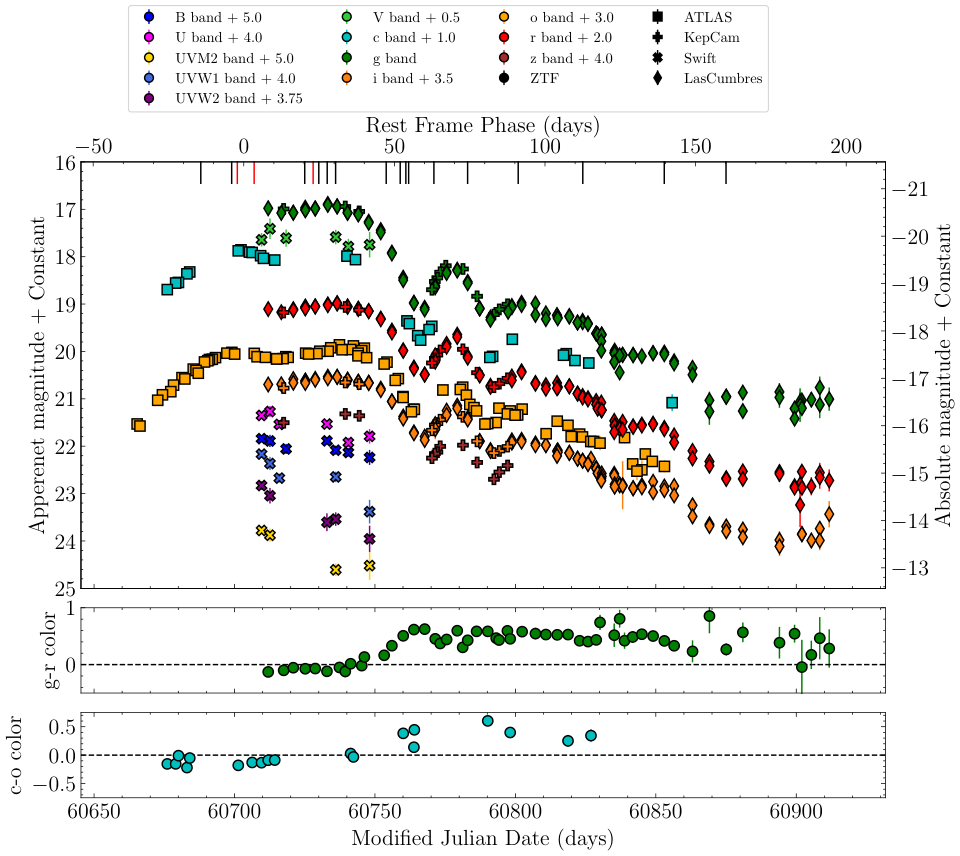
The timing is not a coincidence. Each spectral feature debuted when the light curve showed a new bump, a synchronicity that argues strongly for successive encounters between expanding ejecta and discrete shells of pre-ejected circumstellar material.
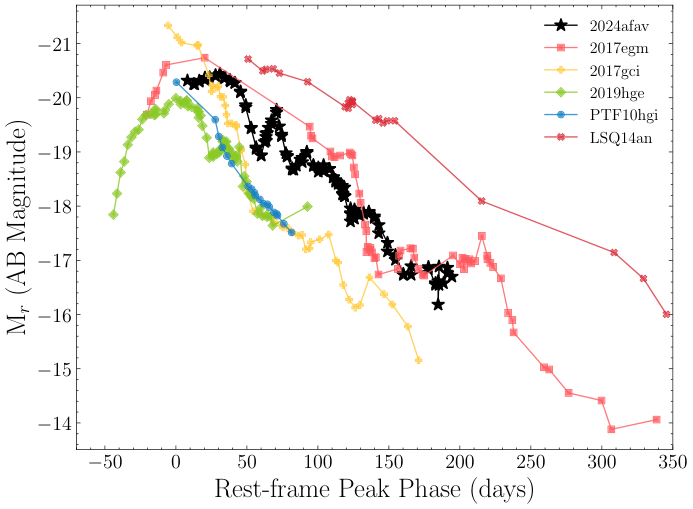
The team compared SN 2024afav to three analogues with similarly bumpy light curves: PTF10hgi, SN 2017egm, and SN 2019hge. All four share the helium signature, the hydrogen absorption, and the early [O III]. In each case, a progenitor shed hydrogen-rich material into its immediate environment before dying as a stripped core. The ejecta-CSM collision then lit up the scene repeatedly as the expanding shock wave hit discrete shells.
Why It Matters
This result goes straight at a decade-long mystery: what causes bumpy brightness records in SLSNe-I? The magnetar model, while elegant, has been stretched uncomfortably to explain features it was never designed to produce. CSM interaction offers a physically motivated, spectroscopically confirmed alternative that fits both the timing and the spectral evolution. The hydrogen and helium signatures are smoking guns. That material couldn’t have come from within the stripped progenitor itself.
SN 2024afav also implies that some SLSN progenitors have chaotic, episodic mass-loss histories. The star didn’t shed its hydrogen envelope once in a smooth wind. It apparently ejected discrete shells at different times before dying, pointing toward stars undergoing violent instabilities in their final years, or binary systems stripping each other in complicated ways.
Understanding this subclass could reshape how astronomers think about the most massive stars and their deaths. Future surveys with wide-field sky-monitoring facilities like the Vera Rubin Observatory will catch hundreds more of these events, and the spectroscopic blueprint established here will be the key to sorting out which ones belong to this rare, interaction-driven family.
SN 2024afav is the most spectroscopically complete case yet for CSM interaction driving light curve bumps in a hydrogen-poor superluminous supernova. These extreme explosions sometimes erupt inside the very material their progenitor stars shed, and the collision writes its story in light.
IAIFI Research Highlights

This work combines intensive multi-epoch spectroscopic monitoring with physical modeling to decode the signatures of stellar mass loss, connecting observational astrophysics and stellar evolution theory at extreme scales.

The spectroscopic framework developed here, correlating light curve morphology with spectral feature emergence, provides a labeled dataset that can train AI classifiers to automatically identify CSM-interacting SLSNe in large survey streams.

SN 2024afav provides direct evidence that hydrogen-poor superluminous supernovae can retain circumstellar hydrogen and helium shells, revising the progenitor picture for this class and constraining the physics of pre-supernova mass loss in massive stars.
Future spectroscopic campaigns with next-generation observatories and systematic AI-driven classification of bumpy SLSNe will test whether CSM interaction is the universal driver of light curve variability; the full study is available at [arXiv:2512.06067](https://arxiv.org/abs/2512.06067).