

Spectral Diversity in Type Ibn Supernovae and the Large Host Offset of SN2024acyl
Authors
Yize Dong, V. Ashley Villar, Anya Nugent, Griffin Hosseinzadeh, Ryan J. Foley, Christa Gall, Monica Gallegos-Garcia, Conor Ransome, Aidan Sedgewick, Daichi Tsuna, Stefano Valenti, Henna Abunemeh, Moira Andrews, Katie Auchettl, K. Azalee Bostroem, David A. Coulter, Thomas de Boer, Kaylee de Soto, Diego A. Farias, Joseph Farah, Danielle Frostig, Hua Gao, Alex Gagliano, Emily Hoang, D. Andrew Howell, Willem B. Hoogendam, Mark E. Huber, David O. Jones, Chien-Cheng Lin, Michael Lundquist, Curtis McCully, Darshana Mehta, Anthony L. Piro, Aravind P. Ravi, Nicolás Meza Retamal, César Rojas-Bravo, S. Karthik Yadavalli, Qinan Wang
Abstract
In this paper, we first present observations of SN~2024acyl, a normal Type Ibn supernova with a large projected offset ($\sim$35~kpc) from its host galaxy. The low star-formation rate measured at the explosion site raises the possibility that the progenitor of SN~2024acyl may not have been a massive star. We then examine, more broadly, the spectral diversity of Type Ibn supernovae around 20--35 days after peak brightness and identify two distinct groups: Group I, which shows bluer rest-frame optical color and narrower He~I emission lines; and Group II, which shows redder rest-frame optical color and broader He~I lines. Group~I also tends to show higher peak luminosities. The diversity we identify appears to be closely connected to the diversity observed around peak and to persist into late phases ($>80$ days after peak). Given its redder color and broader He~I lines, we classify SN~2024acyl as belonging to Group II. Based on the current dataset, we find no clear connection between this spectral diversity and either the host environments of Type Ibn SNe or their pre-explosion activity. The observed diversity in Type Ibn SNe likely reflects differences in circumstellar material properties and/or explosion energetics. These differences could result from a range of progenitor properties, such as different helium star mass, orbital period and companion type if they are in binary systems, and may indicate fundamentally diverse progenitors. Whether a continuous distribution exists between the two groups remains to be determined and will require further data to explore.
Concepts
The Big Picture
Imagine a star exploding roughly 114,000 light-years from its host galaxy, farther out than the Milky Way is wide. That’s what astronomers found when they discovered SN 2024acyl late in 2024, which raises an obvious question: what was a star doing way out there?
Type Ibn supernovae are already exotic. When a massive star exhausts its fuel and explodes, its light can show narrow spikes of helium emission, a sign the dying star was wrapped in a dense cocoon of helium-rich gas it shed before detonation. These events are thought to arise from stars stripped of their outer hydrogen layers, leaving behind a naked helium core. They’re rare, fast-evolving, and poorly understood.
A team led by Yize Dong and V. Ashley Villar at the Center for Astrophysics | Harvard & Smithsonian has now done two things at once: documented the peculiar case of SN 2024acyl, and used it as a launching point to show that the entire Type Ibn population splits into two distinct spectral families with different properties.
Key Insight: Type Ibn supernovae fall into two groups with different colors, line widths, and luminosities, suggesting these explosions may arise from genuinely different progenitor stars or environments rather than a single well-understood channel.
How It Works
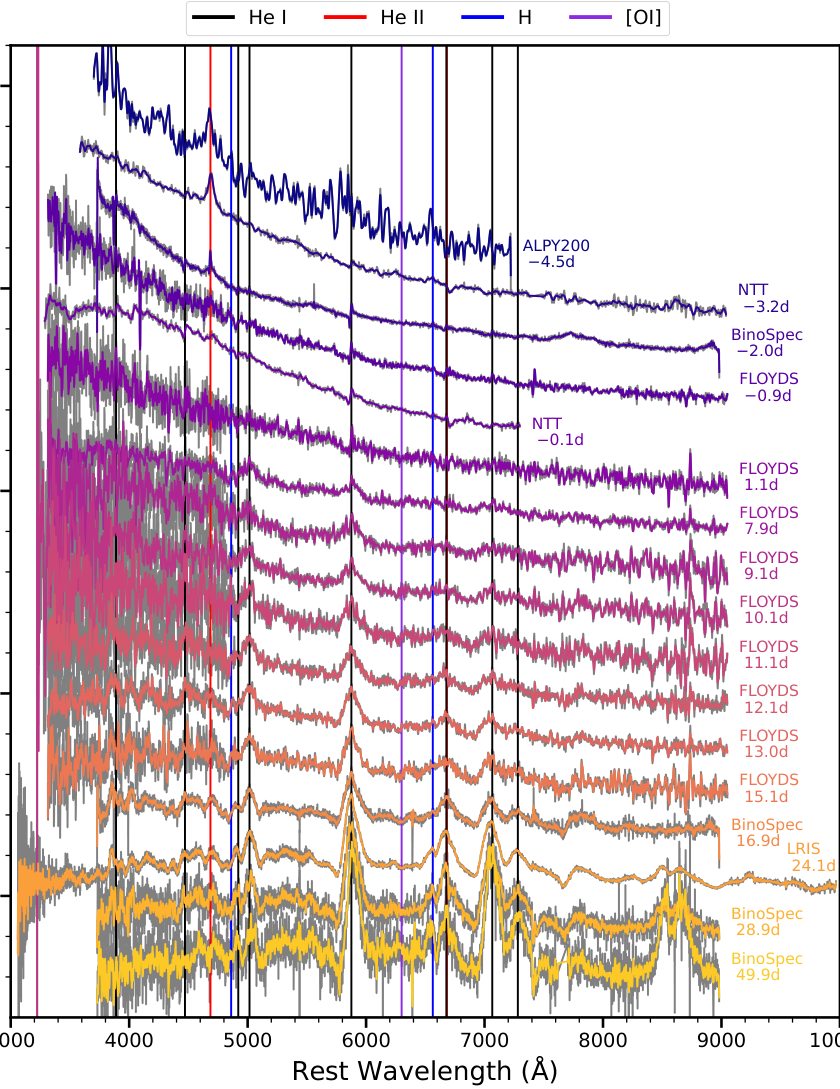
The analysis started with SN 2024acyl itself. The team gathered photometric and spectroscopic observations over weeks following discovery. Its spectra looked like a typical Type Ibn event, with He I emission lines produced when fast-moving explosion debris slams into slower-moving surrounding gas. The location was the strange part.
Measuring the projected offset from the host galaxy, the researchers found SN 2024acyl sat roughly 35 kiloparsecs away, about 114,000 light-years. Massive stars live fast and die young; they don’t travel far from where they formed. A star reaching that distance would have needed a powerful kick from a previous explosion in a binary system, or an extraordinarily long lifetime. The star-formation rate at the explosion site (a proxy for how actively new stars are being born) was almost zero. Quiet, empty space. Hard to reconcile with a massive progenitor.
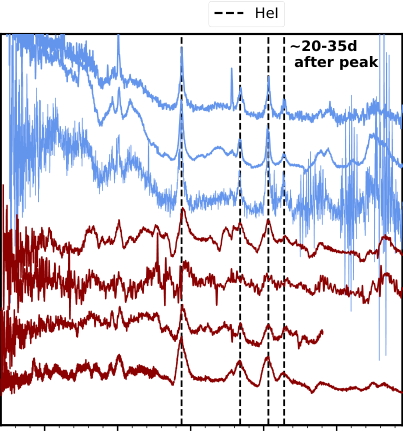
The team then gathered spectra from the literature for 17 Type Ibn supernovae, focusing on a window 20 to 35 days after peak brightness. At this post-peak phase, the initial flash has faded enough to reveal the underlying circumstellar interaction more clearly, as the collision between explosion ejecta and surrounding gas dominates the signal.
Two clusters emerged:
- Group I events show bluer rest-frame optical colors and narrower He I emission lines. They tend to be brighter at peak.
- Group II events show redder colors and broader He I lines. They are generally less luminous.
This isn’t a subtle statistical trend. The separation persists: Group I events at peak remain Group I at 20–35 days and even beyond 80 days. The diversity is baked in from early on, not a transient artifact of explosion dynamics.
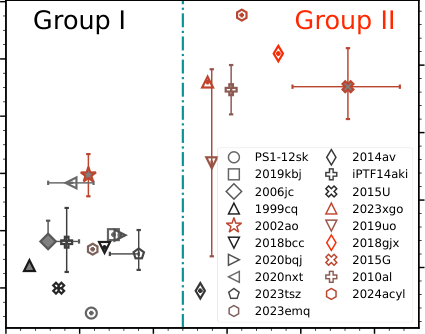
SN 2024acyl, with its broader He I lines and redder color, falls squarely into Group II. Neither host galaxy properties nor known pre-explosion outbursts showed any clear connection to the groupings.
Why It Matters
The standard picture involves a helium star (the stripped-down remnant of a massive star that lost its outer hydrogen layers) exploding while still embedded in material shed through stellar winds or pulled away by a binary companion. But a single progenitor channel can’t explain both groups at once.
Group I’s narrower lines and brighter peaks may point to a different geometry of circumstellar material (CSM), perhaps more compact or symmetric. Group II’s broader, redder signatures may reflect more energetic explosions, more extended CSM, or a different range of helium star masses.
SN 2024acyl adds another wrinkle. A progenitor found 114,000 light-years from any star-forming region might not be a massive star at all. It could be a white dwarf accreting helium from a companion until it triggers a thermonuclear explosion, a runaway nuclear reaction fundamentally different from the gravitational implosion that ends a massive star’s life. That would make some Type Ibn supernovae different beasts entirely from others, even while looking superficially similar at peak. Whether the two spectral groups represent a continuous distribution or discrete progenitor populations remains open; answering it will require larger samples and systematic multi-epoch follow-up.
Bottom Line: Type Ibn supernovae show a clear spectral dichotomy, two groups with different colors, line widths, and luminosities that persist from peak through late phases, and the outlier SN 2024acyl, found 35 kpc from its host, hints that not all of these exotic explosions share the same progenitor type.
IAIFI Research Highlights

Systematic observational classification applied to a rare class of stellar explosions reveals hidden population structure, connecting stellar evolution theory with the large survey datasets now becoming available.

Upcoming sky surveys like LSST/Rubin will discover hundreds of Type Ibn events. The spectral classification criteria established here provide labeled training sets for AI classifiers that will need to identify and prioritize these transients in real time.

The discovery that Type Ibn supernovae split into two spectral groups undermines the single-progenitor model and points toward connections between circumstellar material properties, binary stellar physics, and observable explosion signatures.
Larger samples and multi-epoch spectroscopy will test whether the two groups reflect a continuous distribution or truly discrete progenitor populations. The paper is available at [arXiv:2511.03926](https://arxiv.org/abs/2511.03926).