

StreamGen: Connecting Populations of Streams and Shells to Their Host Galaxies
Authors
Adriana Dropulic, Nora Shipp, Stacy Kim, Zeineb Mezghanni, Lina Necib, Mariangela Lisanti
Abstract
In this work, we study how the abundance and dynamics of populations of disrupting satellite galaxies change systematically as a function of host galaxy properties. We apply a theoretical model of the phase-mixing process to classify intact satellite galaxies, stellar stream-like and shell-like debris in ~1500 Milky Way-mass systems generated by a semi-analytic galaxy formation code, SatGen. In particular, we test the effect of host galaxy halo mass, disk mass, ratio of disk scale height to length, and stellar feedback model on disrupting satellite populations. We find that the counts of tidal debris are consistent across all host galaxy models, within a given host mass range, and that all models can have stream-like debris on low-energy orbits, consistent with those observed around the Milky Way. However, we find a preference for stream-like debris on lower-energy orbits in models with a thicker (lower-density) host disk or on higher-energy orbits in models with a more-massive host disk. Importantly, we observe significant halo-to-halo variance across all models. These results highlight the importance of simulating and observing large samples of Milky Way-mass galaxies and accounting for variations in host properties when using disrupting satellites in studies of near-field cosmology.
Concepts
The Big Picture
Look up at the night sky and you’re seeing the aftermath of a cosmic feeding frenzy. Our Milky Way didn’t grow in isolation. It built itself up by devouring smaller galaxies over billions of years, and most of those unlucky neighbors didn’t survive intact.
Gravity slowly tore them apart, scattering their stars into long ribbons called stellar streams or sweeping arc-shaped bands called shells. These are the bones of galaxies past, and they carry information about the dark matter and physics that shaped the universe.
But when astronomers compare observed streams around the Milky Way to streams modeled in simulations, something doesn’t add up. Simulated streams tend to orbit at higher energies, farther from the galactic center, than the ones we actually observe.
Is that a clue about dark matter physics? A quirk of how we build simulations? Or simply that our Milky Way might be an unusual host galaxy, the larger system whose gravity these streams orbit inside? Untangling these possibilities requires running not one simulation, but thousands.
A new study by Dropulic and colleagues introduces StreamGen, a fast computational framework that classifies stellar streams and shells across roughly 1,500 simulated Milky Way-mass galaxies. By systematically varying host galaxy properties, the framework tests how much those choices matter.
Key Insight: The orbital energy distribution of stellar streams is sensitive to the host galaxy’s disk mass and thickness, meaning that before drawing conclusions about dark matter from stream observations, we must account for the galaxy’s own structure.
How It Works
StreamGen is built on top of SatGen, a semi-analytic galaxy formation code (a fast mathematical model, as opposed to a full physics simulation) that rapidly generates large populations of satellite galaxies and their merger histories. A high-resolution hydrodynamical simulation might take weeks of supercomputer time to produce a single galaxy. SatGen can generate hundreds of Milky Way-analog systems at a fraction of the cost.
For each of those ~1,500 host galaxies, the researchers tracked satellite populations and applied a theoretical model of phase mixing, the process by which tidal debris (stars torn loose by gravity) gradually loses coherence over time. Think of dropping dye into a swirling coffee cup: right after you drop it in, you see a streak (a stream); after enough stirring, the dye spreads into a diffuse cloud (a shell). The phase-mixing model translates this intuition into math, using a satellite’s mass, orbital path, and interaction timescale to predict whether its debris looks more stream-like or shell-like.
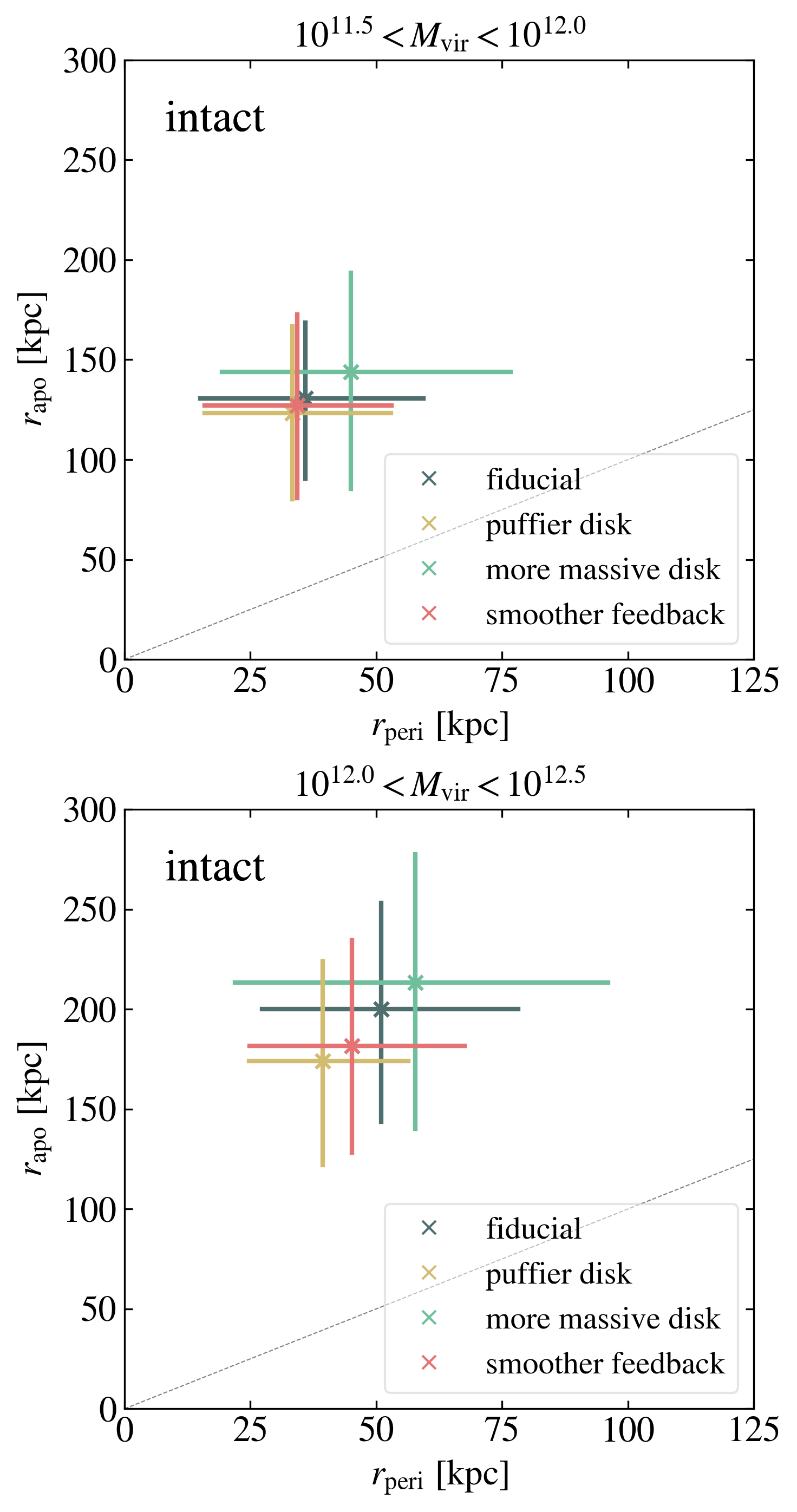
The researchers varied four key host galaxy properties across their sample:
- Halo mass — the total mass of the surrounding dark matter halo
- Disk mass — the mass of the visible stellar disk
- Disk shape — how thick or thin the disk is, measured by the ratio of its vertical height to its horizontal extent
- Stellar feedback model — the physical recipe governing how supernovae and stellar winds regulate star formation
Each satellite is then classified as intact, stream-like, or shell-like. These classifications feed directly into population statistics: how many streams exist, where they orbit, and how that distribution shifts when you change the host.
Why It Matters
The headline result is that total counts of tidal debris are stable across different host galaxy models, as long as you compare galaxies within the same mass range. Changing disk shape, feedback recipe, or other structural parameters doesn’t dramatically alter how many streams or shells a galaxy hosts. That’s good news for cosmologists, since it means debris abundance is a relatively reliable signal.
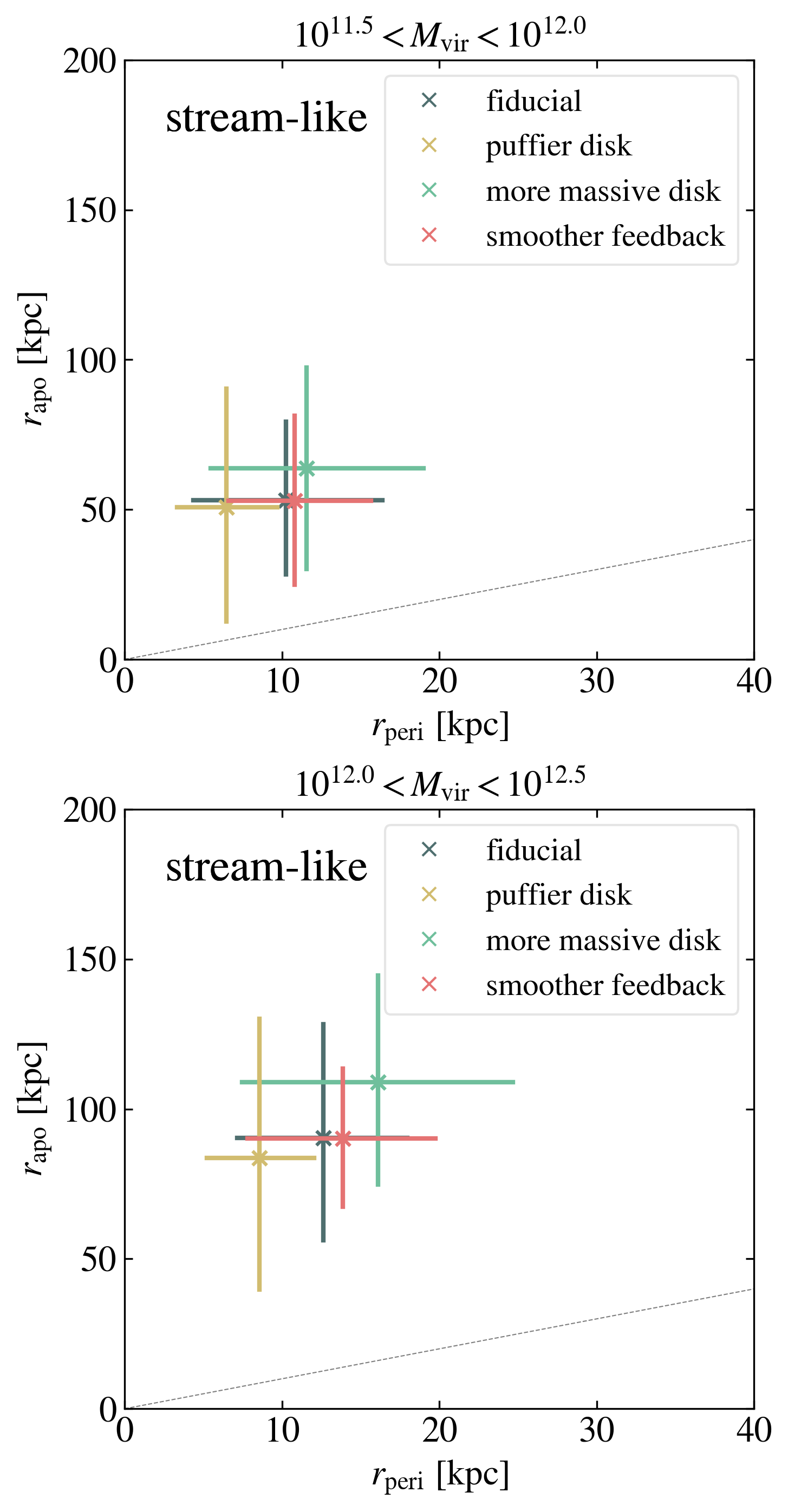
But the orbital energy distribution of streams, essentially where in the galaxy those streams tend to orbit, is another story. Disk properties leave a clear fingerprint:
- Galaxies with a thicker, lower-density disk host stream-like debris on lower-energy orbits, closer to the galactic center.
- Galaxies with a more massive disk show a preference for streams on higher-energy orbits, farther out in the outer halo.
This matters for interpreting Milky Way observations. The streams we see around our galaxy sit on notably low-energy orbits compared to simulated counterparts. StreamGen offers a physical explanation: a thicker or lower-mass Milky Way disk could naturally produce exactly that pattern, with no need to invoke exotic dark matter physics.
The study also quantified halo-to-halo variance, the natural galaxy-to-galaxy scatter that exists even among galaxies with identical average properties. That variance is large enough that drawing firm conclusions from a single galaxy like our own Milky Way is inherently risky.
This work sits at the heart of near-field cosmology, the idea that we can test dark matter theories by studying the detailed structure of the Milky Way and its neighbors. Stellar streams are one of the sharpest tools in that toolkit, because their shapes and orbits encode information about the gravitational forces acting on them, and therefore about how dark matter is distributed around the galaxy.
What StreamGen makes plain is that you can’t interpret stream observations in isolation. The host galaxy’s disk (its mass, its geometry) shapes which streams survive, where they orbit, and what we can detect. Getting that structure right comes first; extracting dark matter physics from stream data comes second. With the Rubin Observatory’s LSST coming online and mapping the stellar halo in more detail than ever, a fast and flexible framework that can generate predictions across thousands of galaxy configurations will be a necessary companion to the data.
One Milky Way is not enough. Only by simulating large samples of Milky Way-mass galaxies, and accounting for the full range of host properties, can we confidently connect local observations to the fundamental physics driving them.
Bottom Line: StreamGen shows that a galaxy’s disk structure leaves a measurable imprint on the orbital energies of its stellar streams. This cautions against one-to-one comparisons between the Milky Way and simulations that don’t match its specific properties, and argues for population-level, statistical analyses in near-field cosmology.
IAIFI Research Highlights

StreamGen combines a semi-analytic galaxy formation code with a phase-mixing classifier to systematically map how host galaxy properties shape tidal debris populations across ~1,500 simulated systems, linking computational astrophysics with statistical modeling.

The semi-analytic pipeline shows how fast, scalable surrogate modeling can stand in for computationally prohibitive full simulations when population-level inference is the goal, a strategy with clear applications in AI-assisted scientific discovery.

By showing that disk mass and thickness alter the orbital energy distribution of stellar streams, this work provides a necessary calibration for near-field cosmological probes of dark matter using observed streams in the Milky Way and external galaxies.
Future work will integrate StreamGen predictions with upcoming Rubin/LSST stream catalogs and extend the framework to constrain dark matter models; the paper is available at [arXiv:2409.13810](https://arxiv.org/abs/2409.13810).