

Symphony: Symmetry-Equivariant Point-Centered Spherical Harmonics for 3D Molecule Generation
Authors
Ameya Daigavane, Song Kim, Mario Geiger, Tess Smidt
Abstract
We present Symphony, an $E(3)$-equivariant autoregressive generative model for 3D molecular geometries that iteratively builds a molecule from molecular fragments. Existing autoregressive models such as G-SchNet and G-SphereNet for molecules utilize rotationally invariant features to respect the 3D symmetries of molecules. In contrast, Symphony uses message-passing with higher-degree $E(3)$-equivariant features. This allows a novel representation of probability distributions via spherical harmonic signals to efficiently model the 3D geometry of molecules. We show that Symphony is able to accurately generate small molecules from the QM9 dataset, outperforming existing autoregressive models and approaching the performance of diffusion models.
Concepts
The Big Picture
Imagine building a LEGO molecule in the dark, with no instructions and only the knowledge that certain pieces click together in certain ways. Now scale that to billions of possible molecular shapes, each governed by the strict rules of quantum mechanics. That’s the challenge facing computational chemists who want to design new drugs, materials, or catalysts from scratch.
The problem is geometrically treacherous. Molecules are 3D structures where the exact position of every atom determines whether a compound is a life-saving drug or a useless blob. They also have deep symmetries: rotate a water molecule 180 degrees and it’s still a water molecule. An AI model that treats rotated structures as fundamentally different wastes computing power relearning the same thing.
Researchers at MIT and NVIDIA developed Symphony, a generative model that builds molecules atom by atom while respecting these 3D symmetries at a deeper level than prior work. It outperforms earlier step-by-step AI approaches and matches leading diffusion models that work by progressively refining random noise into molecular structure.
Key Insight: Symphony uses higher-degree equivariant features and spherical harmonic projections to represent the probability distribution of where the next atom should go, baking 3D symmetry directly into the model’s architecture rather than bolting it on afterward.
How It Works
Symphony builds molecules sequentially: start with a single atom, then repeatedly ask “where should the next atom go?” until the molecule is complete. This autoregressive approach (predicting one piece at a time based on everything placed so far) is the same strategy behind language models that generate text word by word.
But molecules aren’t sentences. Each new atom’s position isn’t a single number or a category. It’s a point in continuous 3D space, requiring a probability distribution over all of that space.
Previous models like G-SchNet and G-SphereNet sidestepped this with rotationally invariant features: representations that look the same regardless of how you orient the molecule. Simple, but limiting. You lose directionality that could sharpen predictions.
Symphony takes a different path. It uses E(3)-equivariant features, representations that don’t stay the same when you rotate a molecule but transform predictably with the rotation. Think of arrows attached to atoms: rotate the molecule, and the arrows rotate with it. These features carry directional information while still respecting symmetry.
At each generation step, Symphony:
- Selects a focus atom in the current fragment to serve as the origin for the next placement decision.
- Runs message-passing across the existing fragment to build rich equivariant features at the focus atom, incorporating information from neighbors.
- Projects a probability distribution onto spherical harmonics, mathematical functions that tile the surface of a sphere and can represent any angular distribution. The model predicts coefficients for these harmonics, painting a picture of where the next atom is likely to land.
- Samples a position from this distribution, handling radial distance and angular direction separately.
Spherical harmonics are worth pausing on. They’re the same mathematical objects used in quantum mechanics to describe electron orbitals. The s, p, and d orbital shapes from chemistry class are literally spherical harmonics. They form a complete basis for functions on a sphere, so any angular distribution can be represented exactly given enough terms. Symphony uses harmonics up to degree l = 5, capturing features from broad blobs down to detailed directional lobes.
Because the spherical harmonic coefficients are themselves equivariant features, rotating the molecule rotates the predicted distribution with it, exactly as physics demands. Symphony doesn’t need to laboriously learn that a carbon-hydrogen bond pointing left is the same as one pointing right. It knows by construction.
Why It Matters
On the QM9 benchmark (a standard dataset of small organic molecules) Symphony outperforms all previous autoregressive models and comes close to state-of-the-art diffusion models on measures of chemical validity, uniqueness, and structural accuracy. Diffusion models, which iteratively denoise random noise into molecular structures, have dominated 3D molecule generation in recent years. Matching their performance with an autoregressive approach is interesting because autoregressive models offer distinct advantages in controllability, interpretability, and the ability to build on a partial structure as a starting point.
That last point matters in practice. Symphony can generate valid molecules conditioned on molecular fragments it has never seen during training, a property that drug designers care about. You often want to grow a known scaffold (a core structural template) into unexplored chemical territory. The model’s equivariant architecture also generalizes across orientations without data augmentation, making it more sample-efficient on new datasets.
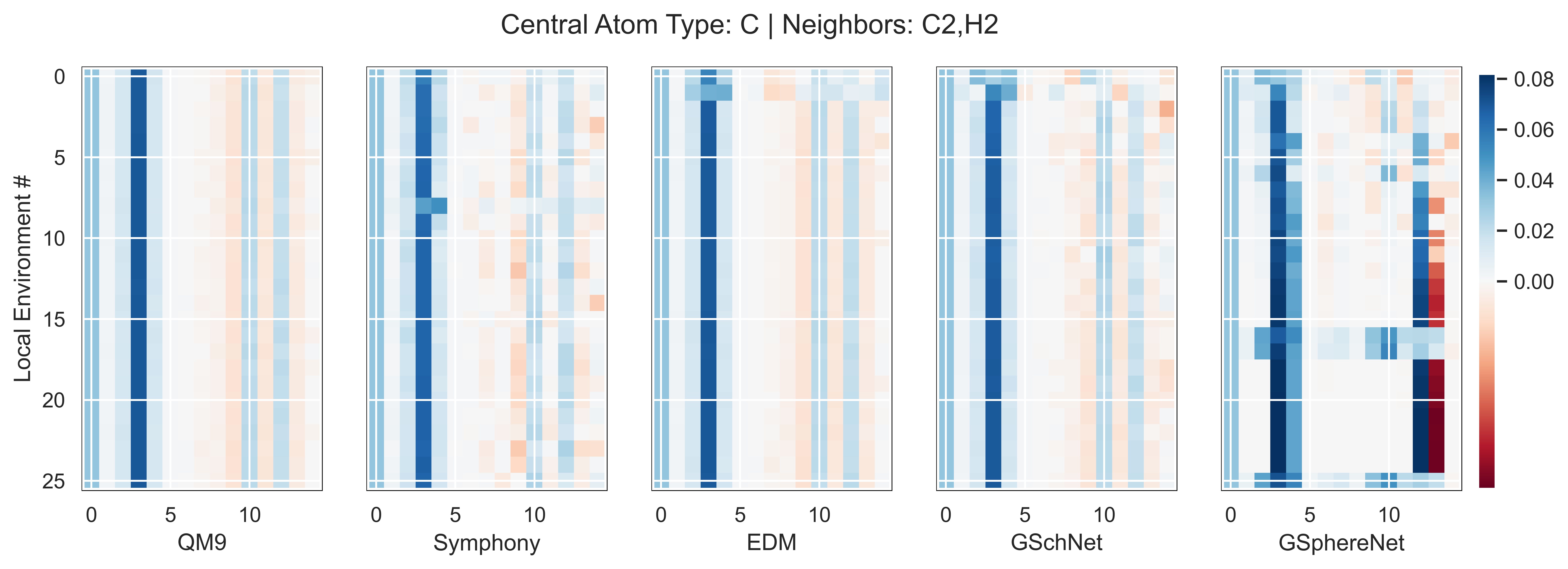
The spherical harmonic framework could scale to protein design, crystal structure prediction, or other domains where 3D geometry and symmetry matter. The bispectrum-based evaluation tool the team introduces, which measures how accurately the model captures the angular arrangement of atoms around each position, is a useful contribution on its own. Standard benchmarks often miss subtle geometric errors that matter for downstream applications.
Bottom Line: Baking 3D symmetry deeply into a model’s mathematical language, rather than engineering it out, pays off in both accuracy and generalization. Symphony charts a new direction for AI-driven molecular design.
IAIFI Research Highlights

Symphony imports mathematical tools from quantum mechanics (spherical harmonics, group-theoretic equivariance) into deep learning architecture, building AI systems grounded in the symmetry principles of physics.

By representing probability distributions over 3D space using spherical harmonic signals, Symphony outperforms prior autoregressive baselines and rivals diffusion models on QM9, establishing a new approach to geometry-aware generative modeling.

The model's ability to capture precise 3D molecular geometry, including correct local chemical environments verified via bispectrum analysis, advances machine learning for quantum chemistry and materials discovery.
Future work may extend Symphony's fragment-based autoregressive framework to larger molecular systems, proteins, and crystalline materials; the paper is available at [arXiv:2311.16199](https://arxiv.org/abs/2311.16199) and was published at ICLR 2024.
Original Paper Details
Symphony: Symmetry-Equivariant Point-Centered Spherical Harmonics for 3D Molecule Generation
2311.16199
["Ameya Daigavane", "Song Kim", "Mario Geiger", "Tess Smidt"]
We present Symphony, an $E(3)$-equivariant autoregressive generative model for 3D molecular geometries that iteratively builds a molecule from molecular fragments. Existing autoregressive models such as G-SchNet and G-SphereNet for molecules utilize rotationally invariant features to respect the 3D symmetries of molecules. In contrast, Symphony uses message-passing with higher-degree $E(3)$-equivariant features. This allows a novel representation of probability distributions via spherical harmonic signals to efficiently model the 3D geometry of molecules. We show that Symphony is able to accurately generate small molecules from the QM9 dataset, outperforming existing autoregressive models and approaching the performance of diffusion models.